Department of Medicine for Older People, Amsterdam UMC Location Vrije Universiteit, Amsterdam, The Netherlands.
Amsterdam Public Health Research Institute, Amsterdam, The Netherlands.
BMC Infect Dis. 2024 Aug 30;24(1):890. doi: 10.1186/s12879-024-09727-w.
Asymptomatic bacteriuria (ASB) - the presence of bacteria in urine without urinary tract infection (UTI) related signs & symptoms (S&S) - is common in the elderly bladder and is not considered pathogenic for UTI. We hypothesise that colonisation with non-uropathogenic bacteria could protect the bladder from invasion of more harmful bacteria. The exact role and dynamics of bacteriuria in the relation to the development of a UTI is still unknown. We aim to provide insight into the course of bacteriuria in the elderly bladder and its relation to UTI in frail older adults.
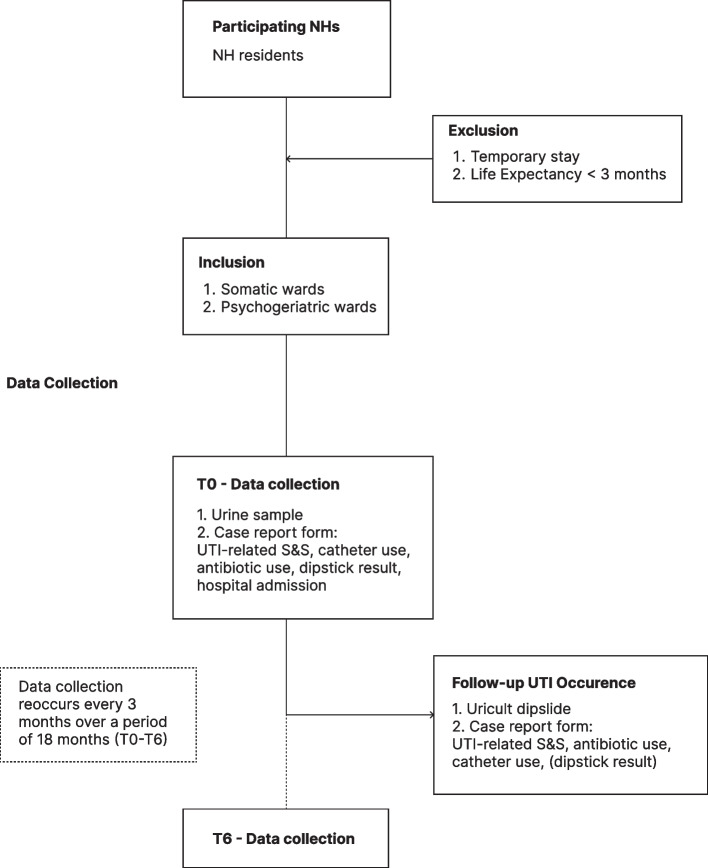
A prospective observational cohort study is being conducted in Dutch nursing homes (NHs) between February 2024 and December 2025. Urine samples and case report forms (CRF) on UTI-related S&S will be collected from each consenting NH resident every 3 months for a follow-up period of 18 months. Whenever a UTI-suspicion occurs in between the 3 monthly time points, additional data and a urine sample will be collected. Urine samples undergo several urinalyses (e.g. dipstick and bacterial culture). Additional molecular analysis will be conducted on a selection of cultured Escherichia coli (E. coli) for virulence genes. Primary analyses will be conducted between residents with and without ASB at each time point. The primary outcome is UTI incidence during follow-up. In secondary analyses we will also take into account the low versus high presence of virulence genes of the E. coli.
The combination of high ASB prevalence and a reduced ability of frail older adults to express UTI-related S&S may lead to UTI misdiagnosis and inappropriate antibiotic use. To our knowledge, this is the first study to investigate the dynamics and role of bacteriuria in the elderly bladder and their potential protective effect on the development of UTI. The study findings with comprehensive analysis of epidemiological, clinical and molecular data could set the fundamental base for future guidelines and studies, and contribute to improving prevention, diagnosis and treatment of UTI in frail older adults, in addition to contributing to antibiotic stewardship in NHs.
无症状性菌尿(ASB)——尿液中存在细菌而无尿路感染(UTI)相关症状和体征(S&S)——在老年膀胱中很常见,且不被认为与 UTI 具有致病性。我们假设,非尿路致病性细菌的定植可以保护膀胱免受更有害细菌的侵袭。细菌尿在与 UTI 发展的关系中的确切作用和动态仍不清楚。我们旨在深入了解老年膀胱中细菌尿的发生过程及其与体弱老年人 UTI 的关系。
一项前瞻性观察队列研究正在荷兰护理院(NH)中进行,时间为 2024 年 2 月至 2025 年 12 月。将从每位同意参与的 NH 居民收集尿液样本和 UTI 相关 S&S 的病例报告表(CRF),每 3 个月进行一次随访,时间为 18 个月。每当在 3 个月的时间点之间出现 UTI 疑似症状时,将额外收集数据和尿液样本。尿液样本进行多项尿液分析(例如,试纸和细菌培养)。对选定的培养大肠埃希菌(E. coli)的一些毒力基因进行额外的分子分析。主要分析将在每个时间点对有和无 ASB 的居民进行。主要结局是随访期间 UTI 的发生率。在次要分析中,我们还将考虑 E. coli 毒力基因的低表达和高表达。
高 ASB 患病率和体弱老年人表达 UTI 相关 S&S 能力降低的结合可能导致 UTI 误诊和不适当的抗生素使用。据我们所知,这是第一项研究无症状性菌尿在老年膀胱中的动态和作用及其对 UTI 发展的潜在保护作用。该研究的结果结合了全面的流行病学、临床和分子数据分析,可为未来的指南和研究奠定基础,并有助于改善体弱老年人 UTI 的预防、诊断和治疗,同时为 NH 中的抗生素管理做出贡献。