Department of Health Policy, Laboratory of Pharmacoepidemiology and Human Nutrition, Istituto di Ricerche Farmacologiche Mario Negri IRCCS, Via Mario Negri, 2, 20156, Milan, Italy.
Italian Institute for Planetary Health (IIPH), Milan, Italy.
J Transl Med. 2024 Aug 30;22(1):806. doi: 10.1186/s12967-024-05491-2.
The Mediterranean Diet (MD) has been recognized for its benefits for human health and sustainability for the planet, but it has considered not easy to reproduce in other populations. The United Nations Educational, Scientific and Cultural Organization (UNESCO) Chair on Health Education and Sustainable Development is fostering a research project (Planeterranea), aiming to identify a healthy dietary pattern based on local foods with the same MD features. The aim of our study is to develop a MD-based food pyramid for Asian populations.
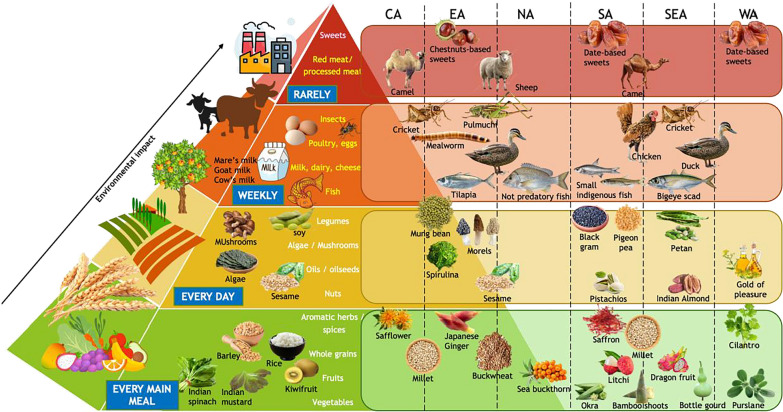
Asia was stratified into six areas according to pedo-climatic conditions. For each region a comprehensive scoping review of local crops and typical foods was conducted on several databases such as the US Department of Agriculture (USDA)'s database, the Food and Agriculture Organization of the United Nations (FAO) website, and PubMed, focusing on both plant-based and animal-based foods. Narrative review was then conducted on the identified foods to determine their nutritional composition and planetary health impact. Finally, the collected information was used to build up the Asian food pyramid with details for each respective region.
We proposed a food pyramid for Asian countries, guaranteeing the same nutritional intake and health benefits as MD, by considering dietary habits and typical foods of this population. From the bottom to the top, Asian fruits and vegetables present similar nutritional profile as those in MD. Whole grains (barley) may represent valid alternative to white rice. Sesame oil represents a source of unsaturated fats and an alternative to olive oil. Legumes (soybean), edible insects, mushrooms and algae, guarantee an adequate intake of plant-based proteins with a complete amino-acid profile and a low environmental impact with respect to animal-based ones.
This work is a new insight of healthy and sustainable local food system based on MD principles for the Asian population.
地中海饮食(Mediterranean Diet,MD)因其对人类健康的益处和对地球可持续性的贡献而备受认可,但它被认为在其他人群中不易复制。联合国教科文组织(UNESCO)健康教育与可持续发展教席正在推动一个研究项目(Planeterranea),旨在根据当地食物识别出一种具有相同 MD 特征的健康饮食模式。我们的研究旨在为亚洲人群制定基于 MD 的食物金字塔。
根据 pedo-climatic 条件,亚洲被分为六个区域。对于每个区域,我们在多个数据库(如美国农业部(USDA)数据库、联合国粮食及农业组织(FAO)网站和 PubMed)上对当地作物和典型食物进行了全面的范围综述,重点关注植物性和动物性食物。然后对确定的食物进行叙述性综述,以确定其营养成分和对地球健康的影响。最后,将收集到的信息用于构建亚洲食物金字塔,并为每个地区提供详细信息。
我们提出了一种亚洲国家的食物金字塔,通过考虑该人群的饮食习惯和典型食物,保证了与 MD 相同的营养摄入和健康益处。从底层到顶层,亚洲的水果和蔬菜与 MD 中的营养成分相似。全谷物(大麦)可以作为白米的有效替代品。芝麻油是不饱和脂肪的来源,可以替代橄榄油。豆类(大豆)、食用昆虫、蘑菇和藻类可以保证植物性蛋白质的充足摄入,具有完整的氨基酸谱,并且与动物性蛋白质相比对环境的影响较低。
这项工作为亚洲人群提供了一种基于 MD 原则的健康和可持续的当地食物系统的新见解。