Department of Biomedical Informatics, Konyang University, Daejeon, Republic of Korea.
Department of Statistics, Korea University, Seoul, Republic of Korea.
Sci Rep. 2024 Aug 31;14(1):20283. doi: 10.1038/s41598-024-71217-5.
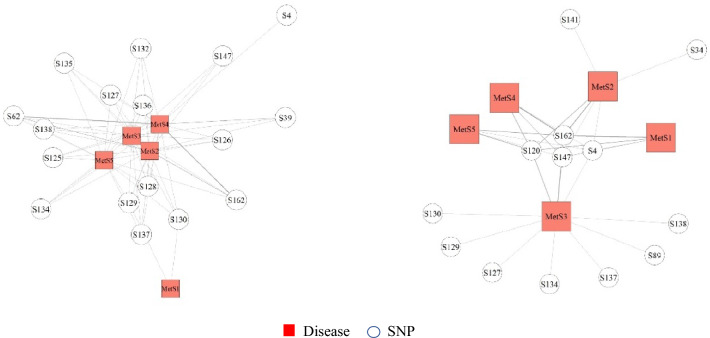
Network analysis has become a crucial tool in genetic research, enabling the exploration of associations between genes and diseases. Its utility extends beyond genetics to include the assessment of environmental factors. Unipartite network analysis is commonly used in genomics to visualize initial insights and relationships among variables. Syndromic diseases, such as metabolic syndrome, are characterized by the simultaneous occurrence of various signs, symptoms, and clinicopathological features. Metabolic syndrome encompasses hypertension, diabetes, obesity, and dyslipidemia, and both genetic and environmental factors contribute to its development. Given that relevant data often consist of distinct sets of variables, a more intuitive visualization method is needed. This study applied multipartite network analysis as an effective method to understand the associations among genetic, environmental, and disease components in syndromic diseases. We considered three distinct variable sets: genetic factors, environmental factors, and disease components. The process involved projecting a tripartite network onto a two-mode bipartite network and then simplifying it into a one-mode network. This approach facilitated the visualization of relationships among factors across different sets and within individual sets. To transition from multipartite to unipartite networks, we suggest both sequential and concurrent projection methods. Data from the Korean Association Resource (KARE) project were utilized, including 352,228 SNPs from 8840 individuals, alongside information on environmental factors such as lifestyle, dietary, and socioeconomic factors. The single-SNP analysis step filtered SNPs, supplemented by reference SNPs reported in a genome-wide association study catalog. The resulting network patterns differed significantly by sex: demographic factors and fat intake were crucial for women, while alcohol consumption was central for men. Indirect relationships were identified through projected bipartite networks, revealing that SNPs such as rs4244457, rs2156552, and rs10899345 had lifestyle interactions on metabolic components. Our approach offers several advantages: it simplifies the visualization of complex relationships among different datasets, identifies environmental interactions, and provides insights into SNP clusters sharing common environmental factors and metabolic components. This framework provides a comprehensive approach to elucidate the mechanisms underlying complex diseases like metabolic syndrome.
网络分析已成为遗传研究的重要工具,能够探索基因与疾病之间的关联。它的用途不仅限于遗传学,还包括环境因素的评估。在基因组学中,单分网络分析通常用于可视化变量之间的初始见解和关系。综合征疾病,如代谢综合征,其特征是各种体征、症状和临床病理特征同时发生。代谢综合征包括高血压、糖尿病、肥胖症和血脂异常,遗传和环境因素都促成了其发展。鉴于相关数据通常由不同的变量集组成,因此需要一种更直观的可视化方法。本研究应用多部分网络分析作为一种有效的方法来理解综合征疾病中遗传、环境和疾病成分之间的关联。我们考虑了三个不同的变量集:遗传因素、环境因素和疾病成分。该过程涉及将三分网络投影到两模式二分网络上,然后将其简化为单模式网络。这种方法便于可视化不同集合之间以及单个集合内因素之间的关系。为了从多部分网络过渡到单部分网络,我们建议使用顺序和并发投影方法。利用韩国协会资源 (KARE) 项目的数据,包括 8840 个人的 352228 个 SNP 以及生活方式、饮食和社会经济因素等环境因素的信息。单 SNP 分析步骤过滤了 SNP,并补充了全基因组关联研究目录中报告的参考 SNP。网络模式因性别而异:女性中,人口统计学因素和脂肪摄入非常重要,而男性中,酒精摄入则是关键因素。通过投影二分网络识别间接关系,表明 rs4244457、rs2156552 和 rs10899345 等 SNP 对代谢成分存在生活方式相互作用。我们的方法有几个优点:它简化了不同数据集之间复杂关系的可视化,识别了环境相互作用,并提供了有关共享共同环境因素和代谢成分的 SNP 簇的见解。该框架提供了一种全面的方法来阐明代谢综合征等复杂疾病的机制。