Infection, Immunity and Global Health, Murdoch Children's Research Institute, Melbourne, Australia; Department of Paediatrics, University of Melbourne, Melbourne, Australia.
Infection, Immunity and Global Health, Murdoch Children's Research Institute, Melbourne, Australia; Department of Paediatrics, University of Melbourne, Melbourne, Australia.
EBioMedicine. 2024 Sep;107:105318. doi: 10.1016/j.ebiom.2024.105318. Epub 2024 Aug 31.
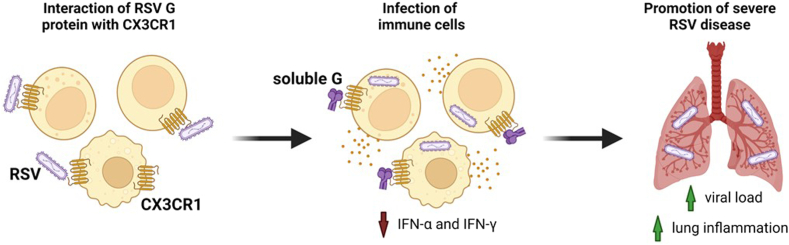
Severe respiratory syncytial virus (RSV) disease is a significant contributor to the global burden of disease in infants and children. The RSV attachment protein (G) has been shown to be critical in invading airway epithelial cells through its CX3C motif interacting with the host receptor CX3CR1. The ubiquitous expression of this receptor on immune cells may explain their susceptibility to RSV infection. The RSV G protein may enhance disease severity through reprogramming of normal cellular functionality leading to inhibition of antiviral responses. While existing preventives targeting the RSV fusion (F) protein are highly effective, there are no RSV therapeutics based on the G protein to limit RSV pathogenesis. Monoclonal antibodies targeting the RSV G protein administered as post-infection therapeutics in mice have been shown to improve the antiviral response, reduce viral load and limit disease severity. Further research is required to better understand how RSV infection of immune cells contributes to pathogenesis for the development of more targeted and efficacious therapeutics.
严重的呼吸道合胞病毒(RSV)疾病是导致婴儿和儿童全球疾病负担的重要因素。研究表明,RSV 附着蛋白(G)通过其与宿主受体 CX3CR1 相互作用的 CX3C 基序,在入侵气道上皮细胞方面起着至关重要的作用。这种受体在免疫细胞中的普遍表达可能解释了它们对 RSV 感染的易感性。RSV G 蛋白可能通过重编程正常细胞功能来增强疾病的严重程度,从而抑制抗病毒反应。虽然针对 RSV 融合(F)蛋白的现有预防措施非常有效,但目前尚无基于 G 蛋白的 RSV 治疗药物来限制 RSV 的发病机制。研究表明,在感染后给予靶向 RSV G 蛋白的单克隆抗体作为治疗药物,可改善抗病毒反应、降低病毒载量并减轻疾病严重程度。为了更好地了解 RSV 感染免疫细胞如何导致发病机制,从而开发更有针对性和更有效的治疗方法,还需要进一步的研究。