Herrera-Moro Huitron Luis, Cruz-Holguin Víctor Javier, Ulloa-Aguilar José Manuel, De Jesús-González Luis Adrián, Osuna-Ramos Juan Fidel, Guzmán-Huerta Mario, de León-Bautista Mercedes Piedad, León-Reyes Guadalupe, García-Cordero Julio, Cedillo-Barrón Leticia, Cerna-Cortes Jorge Francisco, León-Juárez Moisés
Laboratorio de Virología Perinatal y Diseño Molecular de Antígenos y Biomarcadores, Departamento de Inmunobioquímica, Instituto Nacional de Perinatología, Ciudad de México 11000, Mexico.
Laboratorio de Microbiología Molecular, Departamento de Microbiología, Escuela Nacional de Ciencias Biológicas, Instituto Politécnico Nacional, Ciudad de México 11340, Mexico.
Cells. 2025 Apr 22;14(9):624. doi: 10.3390/cells14090624.
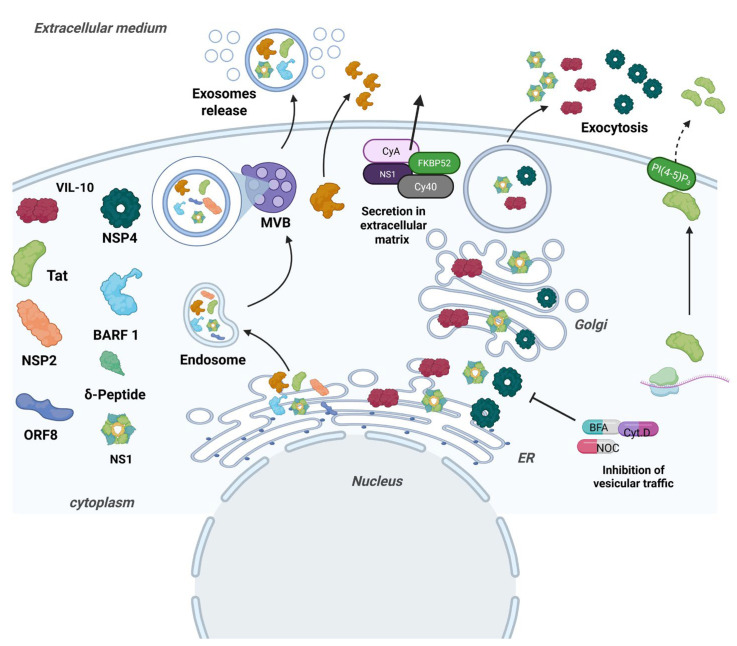
Secreted viral proteins are crucial in virus-host interactions, as they modify the host microenvironment to promote infection. These secreted proteins could alter immune and inflammatory responses, allowing viruses to evade defense mechanisms such as cytotoxic T cell activation and antibody neutralization. Some secreted proteins mimic host molecules to suppress antiviral responses, making them valuable targets for antivirals and diagnostics. Notable examples include BARF1 from Epstein-Barr virus, associated with gastric cancer; vIL-10 from Epstein-Barr virus, which regulates immune responses and contributes to autoimmune diseases; NS1 from dengue virus, associated with vascular permeability and early diagnosis; and NSP4 from rotavirus as an enterotoxin, among others. The study of these proteins improves our understanding of viral pathogenesis and helps to develop innovative treatments for infectious and non-infectious diseases, taking advantage of the evolutionary adaptations of viruses. This review explores their impact on the infection cycle, disease progression, and key processes, such as cell cycle regulation, apoptosis, and cell signaling. Research on these proteins deepens our basic knowledge of virology and generates alternative methods for detecting biomarkers and creating more effective therapies, as well as implementing some emerging technologies, such as biosensors and plasmon resonance, for the diagnosis of viral diseases.
分泌型病毒蛋白在病毒与宿主的相互作用中至关重要,因为它们会改变宿主微环境以促进感染。这些分泌型蛋白可改变免疫和炎症反应,使病毒能够逃避诸如细胞毒性T细胞活化和抗体中和等防御机制。一些分泌型蛋白模仿宿主分子以抑制抗病毒反应,使其成为抗病毒药物和诊断的重要靶点。显著的例子包括与胃癌相关的爱泼斯坦-巴尔病毒的BARF1;调节免疫反应并导致自身免疫性疾病的爱泼斯坦-巴尔病毒的vIL-10;与血管通透性和早期诊断相关的登革病毒的NS1;以及作为肠毒素的轮状病毒的NSP4等。对这些蛋白的研究增进了我们对病毒发病机制的理解,并有助于利用病毒的进化适应性开发针对传染病和非传染病的创新疗法。本综述探讨了它们对感染周期、疾病进展以及细胞周期调控、细胞凋亡和细胞信号传导等关键过程的影响。对这些蛋白的研究加深了我们对病毒学的基础知识,并产生了检测生物标志物和创造更有效疗法的替代方法,以及实施一些新兴技术,如生物传感器和表面等离子体共振,用于病毒性疾病的诊断。