Okui Nobuo, Okui Machiko A
Dentistry, Kanagawa Dental University, Kanagawa, JPN.
Urogynecology, Yokosuka Urogynecology and Urology Clinic, Kanagawa, JPN.
Cureus. 2024 Jul 31;16(7):e65829. doi: 10.7759/cureus.65829. eCollection 2024 Jul.
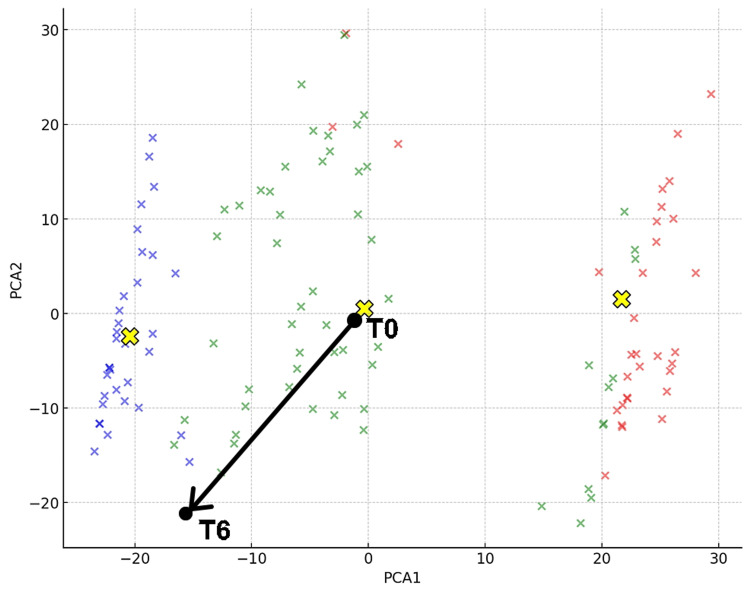
This case series presents three patients with bladder pain syndrome/interstitial cystitis (BPS/IC) and vulvodynia, demonstrating the efficacy of an individualized treatment approach using cluster analysis and combination laser therapy. Principal component analysis (PCA) was used to visualize the dynamic nature of symptom clusters and guide treatment decisions. Case 1 was a 41-year-old woman initially classified as Cluster 1 (PCA coordinates: 1.65, 0.03) transitioned to Cluster 2 (-16.93, -21.75) after bladder hydrodistension. Subsequent Fotona laser (Ljubljana, Slovenia) treatment resulted in the complete resolution of symptoms. Case 2 was a 55-year-old woman, contraindicated for hormone therapy due to breast cancer history, presented as Cluster 2 (PCA coordinates: -24.16, 8.74). Fotona laser treatment shifted her to Cluster 1 (11.22, -20.22), followed by bladder hydrodistension for complete cure. Case 3 was a 49-year-old woman, initially in Cluster 0 (PCA coordinates: 1.892, 30.11), who underwent fulguration for Hunner's lesions. Posttreatment, she moved to Cluster 2 (-24.31, 1.767) and achieved full recovery after Fotona laser therapy. The dynamic nature of symptom clusters, visualized through PCA, guided treatment decisions. The PCA transformation, represented as =, where is the standardized symptom vector and is the principal component matrix, allows for the objective tracking of symptom changes. Combination Fotona laser therapy, including vaginal erbium YAG and neodymium YAG, has proven effective in managing vulvar pain, particularly when hormone therapy is contraindicated. This approach, addressing both urological and gynecological aspects, resulted in sustained symptom improvement for over 12 months in all cases. This case series highlights the synergistic relationship between BPS/IC and vulvodynia, demonstrating the efficacy of comprehensive, adaptive treatment strategies guided by mathematical analysis for complex pelvic pain syndromes.
本病例系列介绍了3例患有膀胱疼痛综合征/间质性膀胱炎(BPS/IC)和外阴痛的患者,展示了使用聚类分析和联合激光治疗的个体化治疗方法的疗效。主成分分析(PCA)用于可视化症状聚类的动态性质并指导治疗决策。病例1是一名41岁女性,最初分类为聚类1(PCA坐标:1.65,0.03),膀胱水扩张术后转变为聚类2(-16.93,-21.75)。随后的 Fotona 激光(斯洛文尼亚卢布尔雅那)治疗使症状完全缓解。病例2是一名55岁女性,因乳腺癌病史而禁忌激素治疗,表现为聚类2(PCA坐标:-24.16,8.74)。Fotona激光治疗使其转变为聚类1(11.22,-20.22),随后进行膀胱水扩张以实现完全治愈。病例3是一名49岁女性,最初处于聚类0(PCA坐标:1.892,30.11),因膀胱黏膜白斑病接受了电灼术。治疗后,她转变为聚类2(-24.31,1.767),Fotona激光治疗后完全康复。通过PCA可视化的症状聚类的动态性质指导了治疗决策。PCA变换表示为 = ,其中 是标准化症状向量, 是主成分矩阵,允许对症状变化进行客观跟踪。包括阴道铒钇铝石榴石激光和钕钇铝石榴石激光在内的联合Fotona激光治疗已被证明对治疗外阴疼痛有效,特别是在激素治疗禁忌时。这种方法兼顾了泌尿外科和妇科方面,在所有病例中均使症状持续改善超过12个月。本病例系列突出了BPS/IC与外阴痛之间的协同关系,展示了以数学分析为指导的综合、适应性治疗策略对复杂盆腔疼痛综合征的疗效。