Fang Camila S, Wang Wanyi, Schroff Chanel, Movahed-Ezazi Misha, Vasudevaraja Varshini, Serrano Jonathan, Sulman Erik P, Golfinos John G, Orringer Daniel, Galbraith Kristyn, Feng Yang, Snuderl Matija
Department of Pathology NYU Langone Health and NYU Grossman School of Medicine, New York, New York, USA.
Department of Biostatistics, NYU School of Global Public Health, New York, New York, USA.
Neurooncol Adv. 2024 Aug 2;6(1):vdae135. doi: 10.1093/noajnl/vdae135. eCollection 2024 Jan-Dec.
In many cancers, specific subtypes are more prevalent in specific racial backgrounds. However, little is known about the racial distribution of specific molecular types of brain tumors. Public data repositories lack data on many brain tumor subtypes as well as diagnostic annotation using the current World Health Organization classification. A better understanding of the prevalence of brain tumors in different racial backgrounds may provide insight into tumor predisposition and development, and improve prevention.
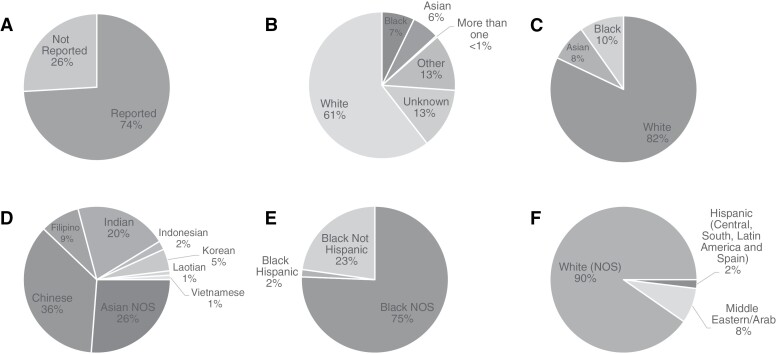
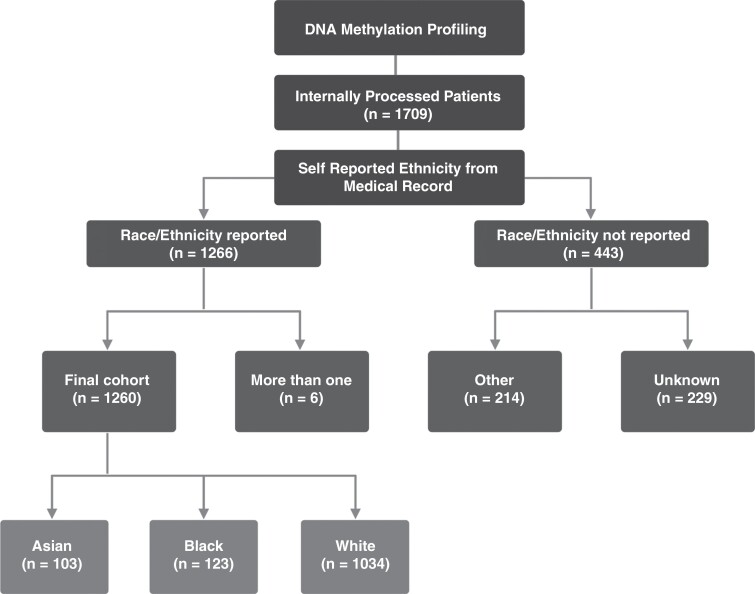
We retrospectively analyzed the racial distribution of 1709 primary brain tumors classified by their methylation profiles using clinically validated whole genome DNA methylation. Self-reported race was obtained from medical records. Our cohort included 82% White, 10% Black, and 8% Asian patients with 74% of patients reporting their race.
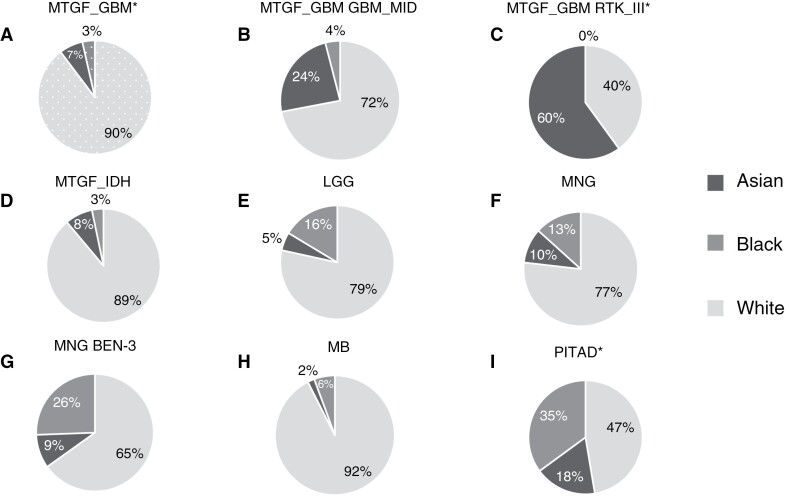
There was a significant difference in the racial distribution of specific types of brain tumors. Blacks were overrepresented in pituitary adenomas (35%, < .001), with the largest proportion of FSH/LH subtype. Whites were underrepresented at 47% of all pituitary adenoma patients ( < .001). Glioblastoma (GBM) IDH wild-type showed an enrichment of Whites, at 90% ( < .001), and a significantly smaller percentage of Blacks, at 3% ( < .001).
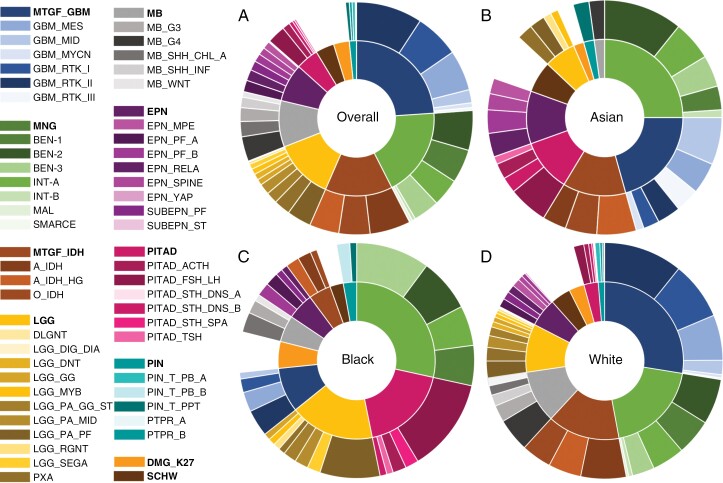
Molecularly classified brain tumor groups and subgroups show different distributions among the three main racial backgrounds suggesting the contribution of race to brain tumor development.
在许多癌症中,特定亚型在特定种族背景中更为普遍。然而,关于脑肿瘤特定分子类型的种族分布情况却知之甚少。公共数据存储库缺乏许多脑肿瘤亚型的数据以及使用当前世界卫生组织分类法的诊断注释。更好地了解不同种族背景中脑肿瘤的患病率可能有助于深入了解肿瘤易感性和发展情况,并改善预防措施。
我们回顾性分析了1709例原发性脑肿瘤的种族分布情况,这些脑肿瘤通过临床验证的全基因组DNA甲基化按其甲基化谱进行分类。自我报告的种族信息来自病历。我们的队列包括82%的白人、10%的黑人以及8%的亚洲患者,其中74%的患者报告了他们的种族。
特定类型脑肿瘤的种族分布存在显著差异。垂体腺瘤中黑人占比过高(35%,P <.001),其中促卵泡激素/促黄体生成素亚型占比最大。白人在所有垂体腺瘤患者中占比过低,为47%(P <.001)。胶质母细胞瘤(GBM)异柠檬酸脱氢酶(IDH)野生型中白人占比丰富,为90%(P <.001),而黑人占比显著较小,为3%(P <.001)。
分子分类的脑肿瘤组和亚组在三种主要种族背景中显示出不同的分布,表明种族对脑肿瘤发展有影响。