Pattamaprapanont Pattarawan, Cooney Eileen M, MacDonald Tara L, Paulo Joao A, Pan Hui, Dreyfuss Jonathan M, Lessard Sarah J
Research Division, Joslin Diabetes Center, Boston, MA, USA.
Harvard Medical School, Boston, MA, USA.
Matrix Biol Plus. 2024 Aug 7;23:100159. doi: 10.1016/j.mbplus.2024.100159. eCollection 2024 Aug.
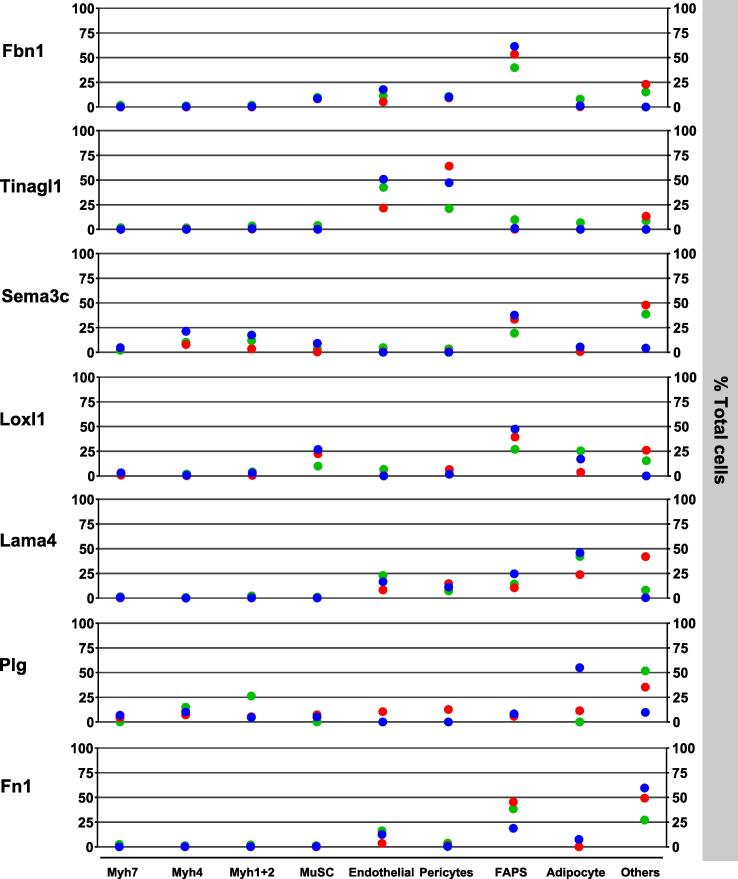
Skeletal muscle has a unique ability to remodel in response to stimuli such as contraction and aerobic exercise training. Phenotypic changes in muscle that occur with training such as a switch to a more oxidative fiber type, and increased capillary density contribute to the well-known health benefits of aerobic exercise. The muscle matrisome likely plays an important role in muscle remodeling with exercise. However, due to technical limitations in studying muscle ECM proteins, which are highly insoluble, little is known about the muscle matrisome and how it contributes to muscle remodeling. Here, we utilized two-fraction methodology to extract muscle proteins, combined with multiplexed tandem mass tag proteomic technology to identify 161 unique ECM proteins in mouse skeletal muscle. In addition, we demonstrate that aerobic exercise training induces remodeling of a significant proportion of the muscle matrisome. We performed follow-up experiments to validate exercise-regulated ECM targets in a separate cohort of mice using Western blotting and immunofluorescence imaging. Our data demonstrate that changes in several key ECM targets are strongly associated with muscle remodeling processes such as increased capillary density in mice. We also identify LOXL1 as a novel muscle ECM target associated with aerobic capacity in humans. In addition, publically available data and databases were used for in silico modeling to determine the likely cellular sources of exercise-induced ECM remodeling targets and identify ECM interaction networks. This work greatly enhances our understanding of ECM content and function in skeletal muscle and demonstrates an important role for ECM remodeling in the adaptive response to exercise. The raw MS data have been deposited to the ProteomeXchange with identifier PXD053003.
骨骼肌具有独特的能力,能够响应诸如收缩和有氧运动训练等刺激而进行重塑。训练时肌肉发生的表型变化,如向更具氧化能力的纤维类型转变以及毛细血管密度增加,有助于有氧运动对健康产生众所周知的益处。肌肉基质组可能在运动引起的肌肉重塑中起重要作用。然而,由于研究高度不溶性的肌肉细胞外基质(ECM)蛋白存在技术限制,人们对肌肉基质组及其如何促进肌肉重塑知之甚少。在这里,我们利用两部分法提取肌肉蛋白,并结合串联质量标签蛋白质组学技术,鉴定出小鼠骨骼肌中161种独特的ECM蛋白。此外,我们证明有氧运动训练可诱导很大一部分肌肉基质组发生重塑。我们进行了后续实验,使用蛋白质免疫印迹法和免疫荧光成像在另一组小鼠中验证运动调节的ECM靶点。我们的数据表明,几个关键ECM靶点的变化与肌肉重塑过程密切相关,如小鼠毛细血管密度增加。我们还将赖氨酰氧化酶样蛋白1(LOXL1)鉴定为与人类有氧能力相关的新型肌肉ECM靶点。此外,我们使用公开可用的数据和数据库进行计算机模拟,以确定运动诱导的ECM重塑靶点可能的细胞来源,并识别ECM相互作用网络。这项工作极大地增进了我们对骨骼肌中ECM含量和功能的理解,并证明了ECM重塑在运动适应性反应中的重要作用。原始质谱数据已存入蛋白质组交换库,标识符为PXD053003。