Özmen Emre, Baris Alican, Circi Esra, Yuksel Serdar, Beytemür Ozan
Istanbul Physical Treatment and Rehabilitation Training and Research Hospital, Istanbul, Türkiye.
SBU Bagcilar Training and Research Hospital, Istanbul, Türkiye.
Adv Orthop. 2024 Aug 22;2024:5510319. doi: 10.1155/2024/5510319. eCollection 2024.
Opening wedge high-tibial osteotomy (OWHTO) is widely used for correcting mechanical axis deviations and offloading the medial compartment in unicompartmental osteoarthritis. However, lateral hinge fractures (LHFs) pose a significant complication. This study investigates protective measures to mitigate these fractures, guided by prior observations of mechanical stress impact on LHFs.
The study aims to assess the effectiveness of different protective measures, specifically the use of varying sizes of Kirchner wires and drill holes, in reducing the incidence of LHFs during OWHTO. . The study employs a quantitative, comparative analysis using a finite element method (FEM) based on computed tomography (CT) scans.
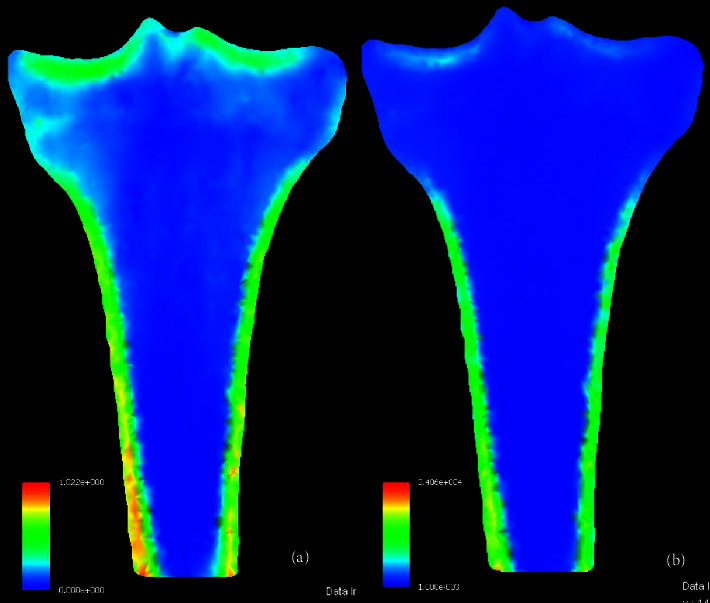
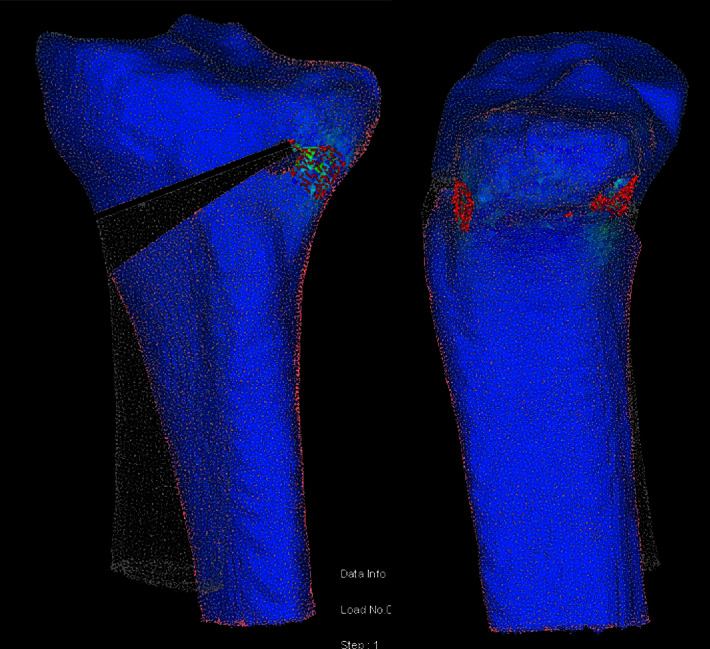
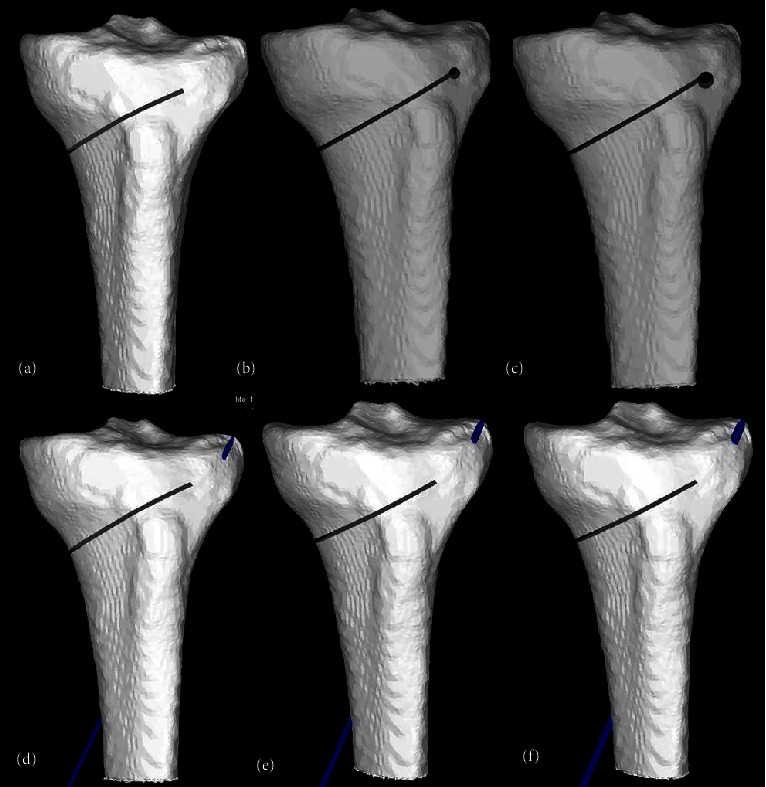
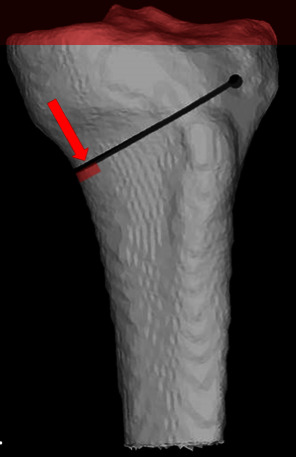
Using CT-based FEM, the study compares the impact of different sizes of K-wires (1.6 mm, 2.0 mm, and 2.5 mm) and drill holes (3.2 mm and 4.5 mm) on the mechanical stresses around the hinge area in OWHTO. The models were created from a CT scan of a healthy 33-year-old male, focusing on the force required to open the osteotomy gap and the incidence of cracked shell elements.
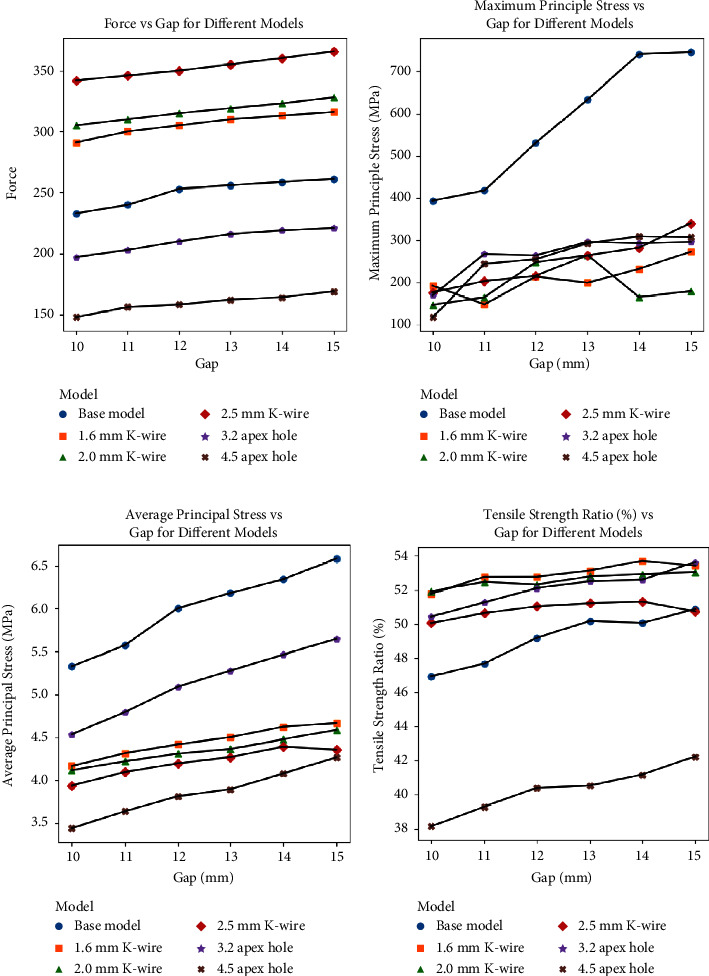
The study found that thicker K-wires increased the force required to open the osteotomy gap, whereas larger apical holes decreased it. The 4.5 mm apical hole model demonstrated significantly fewer cracks compared to the 2.0 mm K-wire model, with no significant difference observed compared to the 2.5 mm K-wire model. Models using a 1.6 mm K-wire or a 3.2 mm drill hole did not significantly reduce cracks compared to the base model.
The findings suggest that a 4.5 mm drill hole may be more effective in reducing the risk of LHFs compared to thinner diameter K-wires or smaller apical holes. Both a 2.5 mm K-wire and a 4.5 mm drill hole reduce the number of cracked elements, but the 4.5 mm drill hole also significantly decreases the average and maximum principal stresses as well as the average tensile strength ratio at the hinge area. These findings may be important for surgical planning, particularly in cases requiring increased osteotomy distraction.
开放楔形高位胫骨截骨术(OWHTO)广泛用于矫正机械轴偏差并减轻单髁骨关节炎内侧间室的负荷。然而,外侧铰链骨折(LHFs)是一种严重的并发症。本研究根据先前对机械应力对LHFs影响的观察,探讨减轻这些骨折的保护措施。
本研究旨在评估不同保护措施,特别是使用不同尺寸的克氏针和钻孔,在OWHTO期间降低LHFs发生率的有效性。该研究采用基于计算机断层扫描(CT)扫描的有限元方法(FEM)进行定量比较分析。
使用基于CT的有限元模型,该研究比较了不同尺寸的克氏针(1.6毫米、2.0毫米和2.5毫米)和钻孔(3.2毫米和4.5毫米)对OWHTO中铰链区域周围机械应力的影响。模型由一名33岁健康男性的CT扫描创建,重点关注打开截骨间隙所需的力和壳单元破裂的发生率。
研究发现,较粗的克氏针增加了打开截骨间隙所需的力,而较大的顶孔则降低了该力。与2.0毫米克氏针模型相比,4.5毫米顶孔模型的裂纹明显更少,与2.5毫米克氏针模型相比无显著差异。与基础模型相比,使用1.6毫米克氏针或3.2毫米钻孔的模型并未显著减少裂纹。
研究结果表明,与较细直径的克氏针或较小的顶孔相比,4.5毫米钻孔在降低LHFs风险方面可能更有效。2.5毫米克氏针和4.5毫米钻孔均可减少破裂单元的数量,但4.5毫米钻孔还可显著降低铰链区域的平均和最大主应力以及平均拉伸强度比。这些发现可能对手术规划很重要,特别是在需要增加截骨撑开的情况下。