Department of Biochemistry and Molecular Biology, University of Dhaka, Dhaka, 1000, Bangladesh.
Department of Microbiology, University of Dhaka, Dhaka, 1000, Bangladesh.
Sci Rep. 2024 Sep 2;14(1):20379. doi: 10.1038/s41598-024-71472-6.
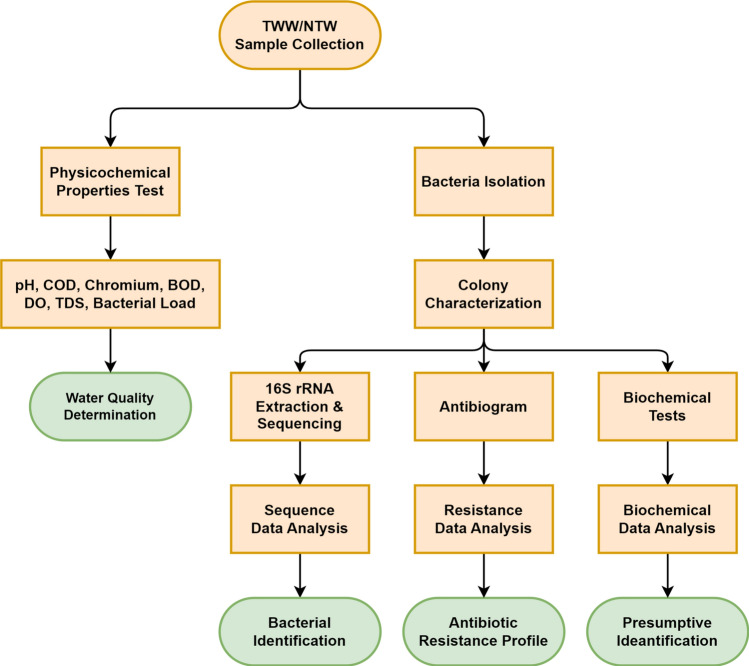
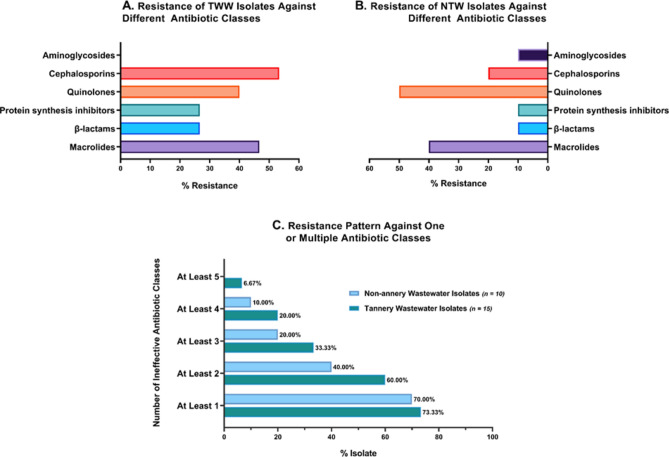
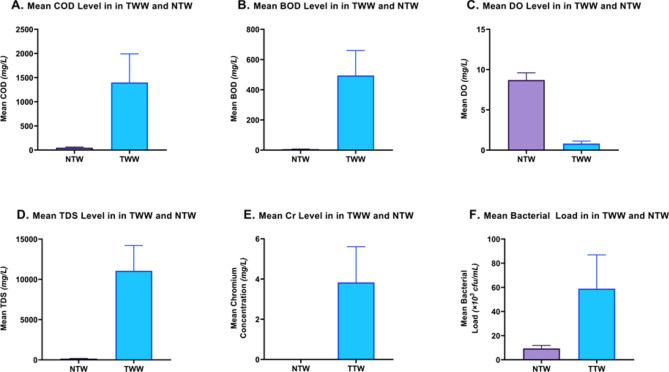
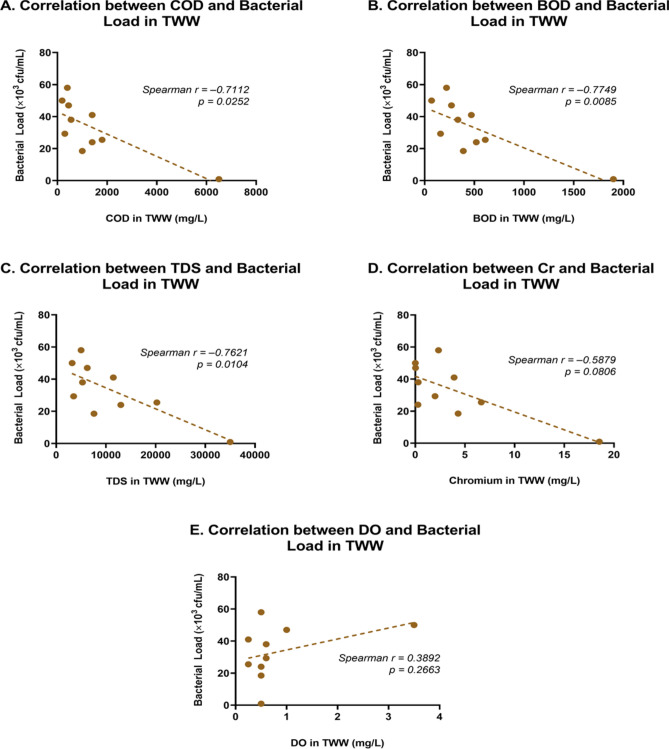
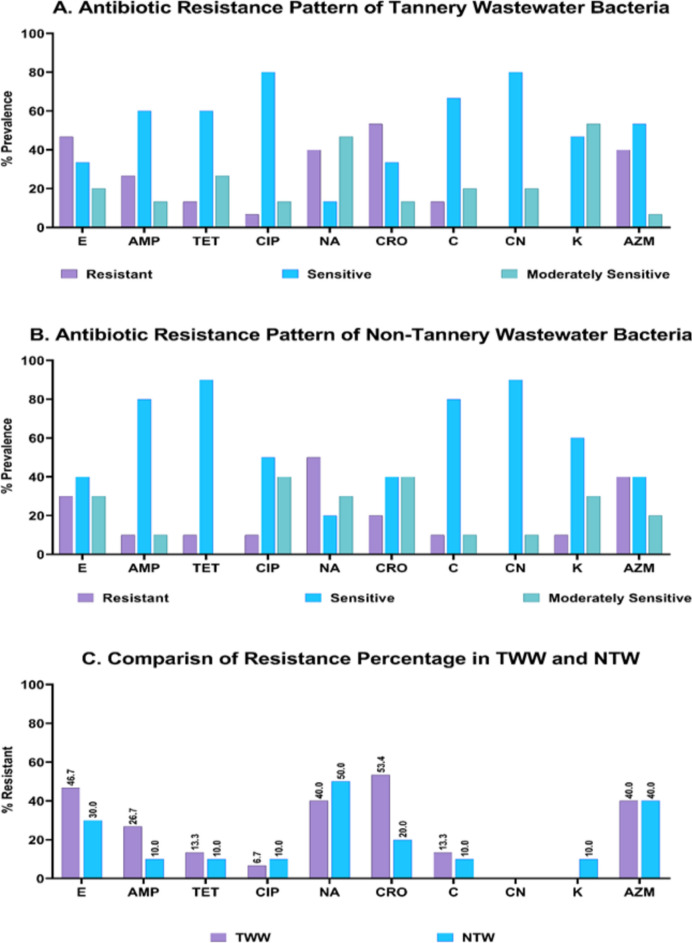
The tannery industry produces one of the worst contaminants, and unsafe disposal in nearby waterbodies and landfills has become an imminent threat to public health, especially when the resulting multidrug-resistant bacteria and heavy metals enter community settings and animal food chains. In this study, we have collected 10 tannery wastewater (TWW) samples and 10 additional non-tannery wastewater (NTW) samples to compare the chemical oxygen demand (COD), pH, biological oxygen demand (BOD), dissolved oxygen (DO), total dissolved solids (TDS), chromium concentration, bacterial load, and antibiotic resistance profiles. While COD, pH, and chromium concentration data were previously published from our lab, this part of the study uncovers that TWW samples had a significantly higher bacterial load, compared to the non-tannery wastewater samples (5.89 × 10 and 9.38 × 10 cfu/mL, respectively), higher BOD and TDS values, and significantly lower DO values. The results showed that 53.4, 46.7, 40.0, and 40.0% of the TWW isolates were resistant to ceftriaxone, erythromycin, nalidixic acid, and azithromycin, respectively. On the other hand, 20.0, 30.0, 50.0, and 40.0% of the NTW isolates were resistant to the same antibiotics, respectively. These findings suggest that the TWW isolates were more resistant to antibiotics than the NTW isolates. Moreover, the TWW isolates exhibited higher multidrug resistance than the NTW isolates, 33.33, and 20.00%, respectively. Furthermore, spearman correlation analysis depicts that there is a negative correlation between BOD and bacterial load up to a certain level (r = - 0.7749, p = 0.0085). In addition, there is also a consistent negative correlation between COD and bacterial load (r = - 0.7112, p = 0.0252) and TDS and bacterial load (r = - 0.7621, p = 0.0104). These findings suggest that TWW could pose a significant risk to public health and the environment and highlight the importance of proper wastewater treatment in tannery industries.
皮革厂行业产生了最严重的污染物之一,将其不安全地处置在附近的水体和垃圾填埋场中,对公众健康构成了迫在眉睫的威胁,尤其是当由此产生的多药耐药菌和重金属进入社区环境和动物食物链时。在这项研究中,我们收集了 10 个制革厂废水(TWW)样本和 10 个额外的非制革厂废水(NTW)样本,以比较化学需氧量(COD)、pH 值、生物需氧量(BOD)、溶解氧(DO)、总溶解固体(TDS)、铬浓度、细菌负荷和抗生素耐药谱。虽然 COD、pH 值和铬浓度数据之前已由我们实验室发表,但本研究部分揭示,与非制革厂废水样本相比,TWW 样本的细菌负荷明显更高(分别为 5.89×10 和 9.38×10cfu/mL),BOD 和 TDS 值更高,DO 值明显更低。结果表明,53.4%、46.7%、40.0%和 40.0%的 TWW 分离株分别对头孢曲松、红霉素、萘啶酸和阿奇霉素耐药。另一方面,20.0%、30.0%、50.0%和 40.0%的 NTW 分离株分别对相同的抗生素耐药。这些发现表明,TWW 分离株对抗生素的耐药性高于 NTW 分离株。此外,TWW 分离株的多药耐药性高于 NTW 分离株,分别为 33.33%和 20.00%。此外,Spearman 相关性分析表明,BOD 和细菌负荷之间存在负相关,直到一定水平(r=-0.7749,p=0.0085)。此外,COD 和细菌负荷(r=-0.7112,p=0.0252)以及 TDS 和细菌负荷(r=-0.7621,p=0.0104)之间也存在一致的负相关。这些发现表明,TWW 可能对公众健康和环境构成重大风险,并强调制革行业废水处理的重要性。