Zettlemoyer Meredith A, Munck Svenja, Poschlod Peter, Rosbakh Sergey
Division of Biological Sciences University of Montana Missoula Montana USA.
Department of Ecology and Conservation Biology Universitat Regensburg Regensburg Germany.
Ecol Evol. 2024 Sep 2;14(9):e70035. doi: 10.1002/ece3.70035. eCollection 2024 Sep.
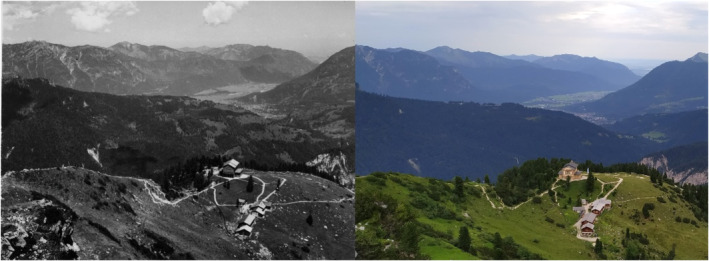
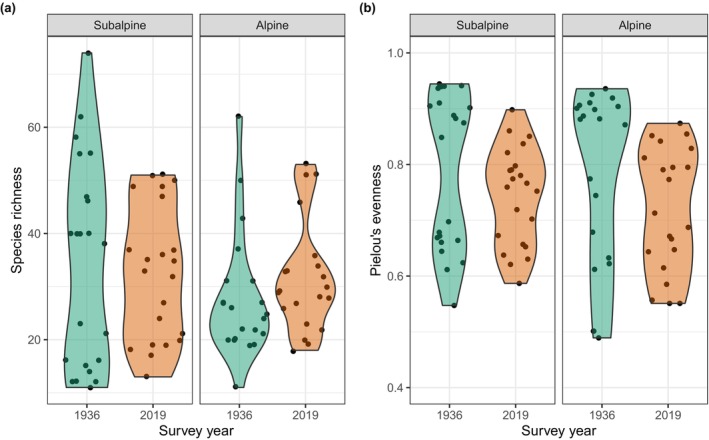
Historical resurveys represent a unique opportunity to analyze vegetation dynamics over longer timescales than is typically achievable. Leveraging the oldest historical dataset of vegetation change in the Bavarian Alps, Germany, we address how environmental conditions, vegetation composition, and functional diversity in the calcareous grasslands of the Schachen region have changed across different elevational ranges over an 83-year timeframe. We document changes in regional average temperature and precipitation. We use indicator values (IV) for species' ecological preferences and their palatability to grazers to infer local conditions (temperature, soil moisture/fertility, and grazing regime). We further estimate changes in temporal beta-diversity and functional trait community composition between historical (1936) and contemporary (2019) surveys in two elevational (subalpine and alpine) belts. Both subalpine and alpine sites became drier; subalpine sites also became warmer with more palatable plants. Species occurrence and abundance in the Schachen region has not changed substantially over time despite changing macroclimate and local environmental conditions under anthropogenic change. Yet these grasslands have experienced several "invisible" changes in functional composition over the past 80 years. As the Schachen has become drier, species with traits related to drought tolerance and animal-based dispersal have increased in dominance. Specifically, in alpine sites, community-weighted means revealed that with low fecundity, higher potential for endo- and epizoochory (seed dispersal via animal gut and fur, respectively), higher foliar frost tolerance, and deeper dormancy increased in dominance. Similar trends were found for increasing dominance of low fecundity, epizoochorous species in subalpine sites. Vegetation data from resurveying historical plots in combination with changes in local conditions, classic biodiversity indices, and functional trait indices can provide more holistic insights into changes in the environment and potential impacts of those environmental changes on long-term plant community and functional diversity.
历史调查提供了一个独特的机会,能够在比通常可实现的更长时间尺度上分析植被动态。利用德国巴伐利亚阿尔卑斯山最古老的植被变化历史数据集,我们探讨了在83年的时间范围内,沙肯地区钙质草地的环境条件、植被组成和功能多样性在不同海拔范围内是如何变化的。我们记录了区域平均温度和降水量的变化。我们使用物种生态偏好的指示值(IV)及其对食草动物的适口性来推断当地条件(温度、土壤湿度/肥力和放牧制度)。我们进一步估计了在两个海拔带(亚高山带和高山带)历史调查(1936年)和当代调查(2019年)之间时间β多样性和功能性状群落组成的变化。亚高山带和高山带的地点都变得更干燥;亚高山带的地点也变得更温暖,且出现了更多适口性好的植物。尽管在人为变化下宏观气候和当地环境条件发生了变化,但沙肯地区的物种出现情况和丰度随时间并没有显著变化。然而,在过去80年里,这些草地在功能组成方面经历了几次“无形”的变化。随着沙肯地区变得更干燥,具有耐旱和动物传播相关性状的物种优势度增加。具体而言,在高山带地点,群落加权平均值显示,低繁殖力、内果皮传播和外果皮传播(分别通过动物肠道和皮毛进行种子传播)潜力更高、叶片霜冻耐受性更高以及休眠更深的物种优势度增加。在亚高山带地点,低繁殖力、外果皮传播物种优势度增加也发现了类似趋势。重新调查历史样地的植被数据,结合当地条件变化、经典生物多样性指数和功能性状指数,可以为环境变化以及这些环境变化对长期植物群落和功能多样性的潜在影响提供更全面的见解。