Ahmadi Gohari Milad, Haghdoost Ali Akbar, Ahmadinejad Mehdi, Balooch Hasankhani Mohammadreza, Mirzaei Hossein, Jahani Yunes
Modeling in Health Research Center, Institute for Futures Studies in Health, Kerman University of Medical Sciences, Kerman, Iran.
Department of Anesthesia, Kerman University of Medical Sciences, Kerman, Iran.
Bull Emerg Trauma. 2024;12(2):73-80. doi: 10.30476/BEAT.2024.101960.1500.
With the COVID-19 outbreak in countries around the world, the countries' healthcare systems underwent an unprecedented shock. This study aimed to examine the resilience of the medical service delivery system in providing emergency services during the Covid-19 pandemic.
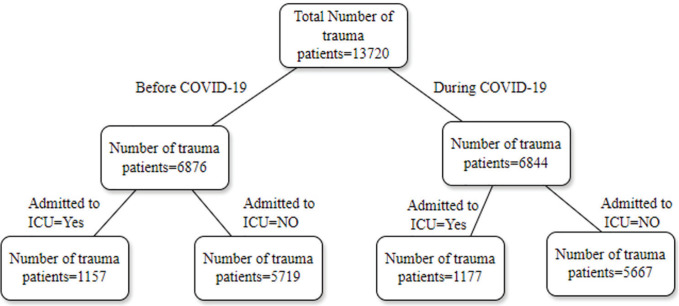
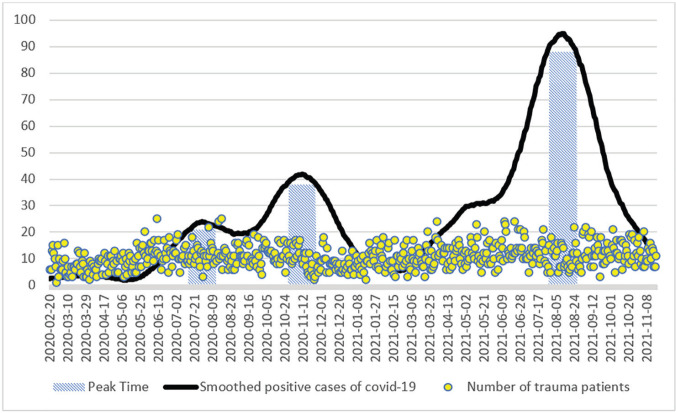
This study was conducted in a reference hospital in Kerman that provided emergency services to trauma patients. It compared service delivery before and after COVID-19, as well as during the COVID-19 peak and non-peak periods. The compared variables were the number of trauma patients admitted to the hospital and the ICU, the number of patients who died in the hospital due to trauma, and the length of stay in the hospital and the ICU.
The pre- and post-COVID-19 comparisons showed no significant difference in the number of daily hospital admissions, ICU admissions, and patient deaths. The median length of stay in the ICU was significantly reduced by almost 2 days during the COVID-19 outbreak. However, the length of stay at the hospital was almost the same. Furthermore, a comparison of the COVID-19 peaks and non-peak periods indicated no statistically significant difference in the number of admissions in the ICU, hospital and ICU length of stay, and trauma-induced mortality.
Despite the substantial workload imposed by COVID-19 on hospitals, especially during the peak periods of the disease, the provision of medical services to emergency trauma patients did not drop significantly, and the quality of services provided to patients was within the acceptable range.
随着新冠疫情在世界各国爆发,各国医疗系统遭受了前所未有的冲击。本研究旨在考察新冠疫情期间医疗服务提供系统在提供急诊服务方面的恢复能力。
本研究在克尔曼的一家为创伤患者提供急诊服务的参考医院开展。比较了新冠疫情前后以及疫情高峰期和非高峰期的服务提供情况。比较的变量包括入院和入住重症监护病房(ICU)的创伤患者数量、在医院因创伤死亡的患者数量、以及在医院和ICU的住院时长。
新冠疫情前后的比较显示,每日入院人数、入住ICU人数和患者死亡人数无显著差异。在新冠疫情爆发期间,ICU的中位住院时长显著缩短了近2天。然而,在医院的住院时长基本相同。此外,对新冠疫情高峰期和非高峰期的比较表明,入住ICU的人数、在医院和ICU的住院时长以及创伤导致的死亡率在统计学上无显著差异。
尽管新冠疫情给医院带来了巨大的工作量,尤其是在疾病高峰期,但为急诊创伤患者提供的医疗服务并未显著下降,且为患者提供的服务质量在可接受范围内。