Sadeghi Rad Zohreh, Farahmand Mahnaz, Kavousi Mahsa
Department of Biology, East Tehran Branch, Islamic Azad University, Tehran, Iran.
GMS Hyg Infect Control. 2024 Jul 9;19:Doc36. doi: 10.3205/dgkh000491. eCollection 2024.
, renowned for its exceptional multidrug resistance and its role as a prevalent nosocomial pathogen, poses a formidable challenge to conventional antibiotic therapies. The primary objective of this investigation was to evaluate the efficacy of Secapin, an antimicrobial peptide, against multidrug-resistant (MDR) . Furthermore, the mechanisms underlying Secapin's antibacterial and antibiofilm activities were elucidated.
The antimicrobial and antibiofilm effectiveness of Secapin against MDR was assessed through a series of experiments. The minimum inhibitory concentration (MIC) and minimum bactericidal concentration (MBC) of Secapin were determined using established protocols. Time-kill kinetic analysis was performed to assess the concentration-dependent bactericidal effect of Secapin. Additionally, the capacity of Secapin to impede biofilm formation and eradicate biofilms was investigated. Hemolytic potential was evaluated using human red blood cells, while mammalian cell viability was examined at varying Secapin concentrations.
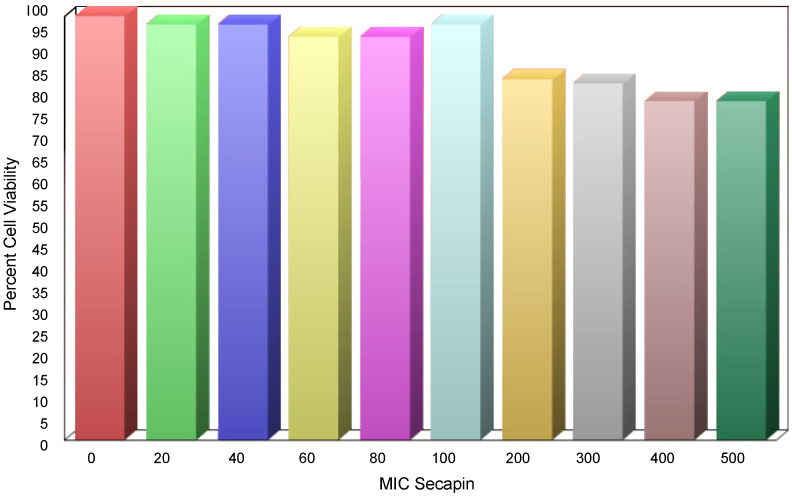
Secapin exhibited robust bactericidal activity at minimal concentrations, with an MIC of 5 µg/mL and an MBC of 10 µg/mL against MDR . The time-kill kinetic analysis confirmed the concentration-dependent efficacy of Secapin in diminishing bacterial viability. Moreover, Secapin demonstrated the ability to prevent biofilm formation and eliminate established biofilms. Notably, Secapin exhibited no hemolytic activity and preserved mammalian cell viability up to a concentration of 100 µg/mL.
These findings underscore the substantial potential of Secapin as a potent agent against multidrug-resistant , showcasing its efficacy in both antibacterial and antibiofilm capacities. The favorable attributes of Secapin, characterized by its minimal hemolytic effects and high mammalian cell viability, position it as a promising contender in the fight against antibiotic resistance.
以其卓越的多重耐药性及其作为常见医院病原体的作用而闻名,对传统抗生素疗法构成了巨大挑战。本研究的主要目的是评估抗菌肽Secapin对多重耐药(MDR)的疗效。此外,还阐明了Secapin抗菌和抗生物膜活性的潜在机制。
通过一系列实验评估Secapin对MDR的抗菌和抗生物膜效果。使用既定方案确定Secapin的最低抑菌浓度(MIC)和最低杀菌浓度(MBC)。进行时间杀灭动力学分析以评估Secapin的浓度依赖性杀菌效果。此外,研究了Secapin阻止生物膜形成和根除生物膜的能力。使用人红细胞评估溶血潜力,同时在不同Secapin浓度下检测哺乳动物细胞活力。
Secapin在最低浓度下表现出强大的杀菌活性,对MDR的MIC为5μg/mL,MBC为10μg/mL。时间杀灭动力学分析证实了Secapin在降低细菌活力方面的浓度依赖性疗效。此外,Secapin表现出预防生物膜形成和消除已形成生物膜的能力。值得注意的是,Secapin在浓度高达100μg/mL时未表现出溶血活性并保持了哺乳动物细胞活力。
这些发现强调了Secapin作为对抗多重耐药菌的有效药物的巨大潜力,展示了其在抗菌和抗生物膜能力方面的疗效。Secapin的有利特性,以其最小的溶血作用和高哺乳动物细胞活力为特征,使其成为对抗抗生素耐药性斗争中的一个有前途的竞争者。