Tran Ivy, Tang Sunny X, Baumel Amit, Moore Tyler, Berretta Sarah, Behbehani Leily, Birnbaum Michael L
Psychology Department, Hofstra University, Hempstead, NY, USA.
School of Medicine, Department of Psychiatry, Boston Medical Center, Boston, MA, USA.
Digit Health. 2024 Aug 30;10:20552076241277186. doi: 10.1177/20552076241277186. eCollection 2024 Jan-Dec.
Social interactions and experiences are increasingly occurring online, including for young adults with psychosis. Healthy social interactions and experiences are widely recognized as a critical component of social recovery, yet research thus far has focused predominantly on offline interactions with limited understanding of these interactions online. We developed the Social Media and Internet sociaL Engagement (SMILE) questionnaire to assess the type, frequency, and nature of online social interactions and experiences among young adults with early psychosis to better assess online social activity and ultimately support personalized interventions.
Participants ( = 49) completed the SMILE questionnaire which asked about online platforms used, frequency of use, and if positive and negative experiences were more likely to happen online or offline. Participants completed additional self-report measures of victimization, positive psychotic symptoms, social functioning, and demographics. Exploratory factor analysis and correlations between identified factors and clinical measures of interest were completed.
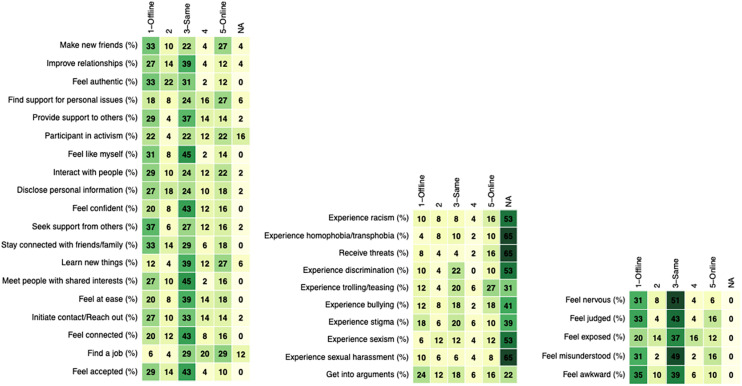
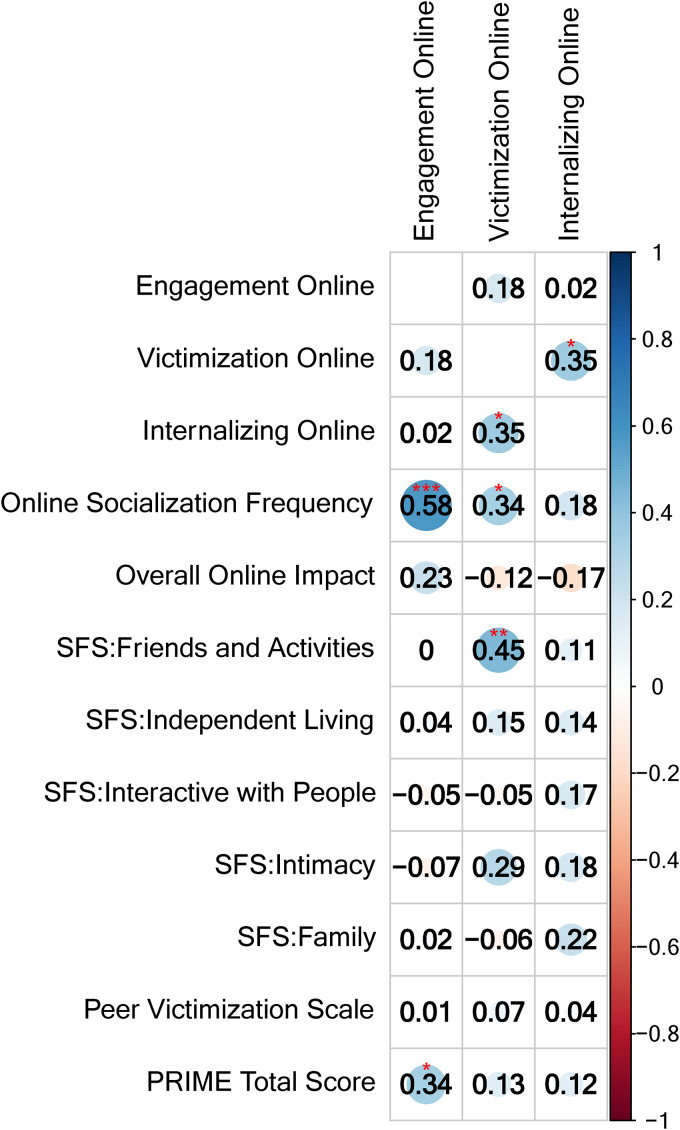
Exploratory factor analysis revealed three factors: positive engagement, victimization, and internalizing experiences. Most participants (6%-37%) experienced positive engagement offline. Victimization occurred equally online and offline (8%-27% and 4%-24%, respectively). Most participants (37%-51%) endorsed internalizing experiences as occurring equally offline and online, but approximately a third of participants reported internalizing experiences more frequently offline (20%-35%). Victimization was moderately 0.34) correlated with overall online social experiences, suggesting more online time may increase the likelihood of victimization. Age was inversely related to the frequency of overall online social experiences.
Young adults with early psychosis experience positive and negative social experiences online and offline. New scales and measures to comprehensively assess the nature and function of online social interactions and experiences are needed.
社交互动和体验越来越多地在网上进行,包括患有精神病的年轻人。健康的社交互动和体验被广泛认为是社会康复的关键组成部分,但迄今为止的研究主要集中在离线互动,对这些在线互动的理解有限。我们开发了社交媒体和互联网社交参与(SMILE)问卷,以评估早期精神病青年成人在线社交互动和体验的类型、频率和性质,以便更好地评估在线社交活动,并最终支持个性化干预。
参与者(n = 49)完成了SMILE问卷,该问卷询问了所使用的在线平台、使用频率,以及积极和消极体验更可能发生在网上还是网下。参与者还完成了关于受害、阳性精神病症状、社会功能和人口统计学的额外自我报告测量。完成了探索性因素分析以及已识别因素与感兴趣的临床测量之间的相关性分析。
探索性因素分析揭示了三个因素:积极参与、受害和内化体验。大多数参与者(6%-37%)在离线时经历了积极参与。受害在网上和网下发生的频率相同(分别为8%-27%和4%-24%)。大多数参与者(37%-51%)认可内化体验在网上和网下发生的频率相同,但约三分之一的参与者报告内化体验在离线时更频繁发生(20%-35%)。受害与总体在线社交体验呈中度相关(r = 0.34),表明更多的在线时间可能会增加受害的可能性。年龄与总体在线社交体验的频率呈负相关。
患有早期精神病的年轻成人在网上和网下都经历了积极和消极的社交体验。需要新的量表和测量方法来全面评估在线社交互动和体验的性质和功能。