Department of Psychology, City, University of London, London, ECIV 0HB, UK.
Department of Psychosis Studies, King's College London, Institute of Psychiatry, Psychology and Neuroscience, De Crespigny Park, London, SE5 8AF, UK.
Eur Arch Psychiatry Clin Neurosci. 2022 Feb;272(1):119-127. doi: 10.1007/s00406-021-01278-4. Epub 2021 Jun 15.
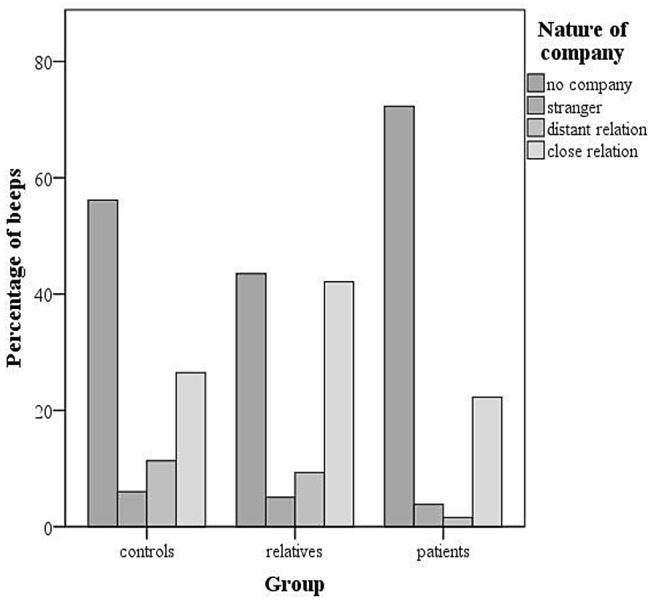
Social isolation has been suggested to foster paranoia. Here we investigate whether social company (i.e., being alone vs. not) and its nature (i.e., stranger/distant vs. familiar other) affects paranoia differently depending on psychosis risk. Social interactions and paranoid thinking in daily life were investigated in 29 patients with clinically stable non-affective psychotic disorders, 20 first-degree relatives, and 26 controls (n = 75), using the experience sampling method (ESM). ESM was completed up to ten times daily for 1 week. Patients experienced marginally greater paranoia than relatives [b = 0.47, p = 0.08, 95% CI (- 0.06, 1.0)] and significantly greater paranoia than controls [b = 0.55, p = 0.03, 95% CI (0.5, 1.0)], but controls and relatives did not differ [b = 0.07, p = 0.78, 95% CI (- 0.47, 0.61)]. Patients were more often alone [68.5% vs. 44.8% and 56.2%, respectively, p = 0.057] and experienced greater paranoia when alone than when in company [b = 0.11, p = 0.016, 95% CI (0.02, 0.19)]. In relatives this was reversed [b = - 0.17, p < 0.001, 95% CI (- 0.28, - 0.07)] and in controls non-significant [b = - 0.02, p = 0.67, 95% CI (- 0.09, 0.06)]. The time-lagged association between being in social company and subsequent paranoia was non-significant and paranoia did not predict the likelihood of being in social company over time (both p's = 0.68). All groups experienced greater paranoia in company of strangers/distant others than familiar others [X(2) = 4.56, p = 0.03] and being with familiar others was associated with lower paranoia over time [X(2) = 4.9, p = 0.03]. Patients are frequently alone. Importantly, social company appears to limit their paranoia, particularly when being with familiar people. The findings stress the importance of interventions that foster social engagement and ties with family and friends.
社会孤立被认为会助长偏执。在这里,我们研究了社会交往(即独处与不独处)及其性质(即陌生人/疏远的人与熟悉的人)是否会因精神病风险的不同而对偏执产生不同的影响。我们使用经验抽样法(ESM)调查了 29 名临床稳定的非情感性精神病患者、20 名一级亲属和 26 名对照者(n=75)的社交互动和日常生活中的偏执思维。ESM 每天最多完成 10 次,持续 1 周。患者的偏执程度略高于亲属[b=0.47,p=0.08,95%置信区间(-0.06,1.0)],明显高于对照组[b=0.55,p=0.03,95%置信区间(0.5,1.0)],但对照组和亲属之间没有差异[b=0.07,p=0.78,95%置信区间(-0.47,0.61)]。患者独处的频率更高[分别为 68.5%、44.8%和 56.2%,p=0.057],独处时的偏执程度高于与人交往时[b=0.11,p=0.016,95%置信区间(0.02,0.19)]。在亲属中,这种情况相反[b=-0.17,p<0.001,95%置信区间(-0.28,-0.07)],而在对照组中,这种情况则不显著[b=-0.02,p=0.67,95%置信区间(-0.09,0.06)]。社交交往与随后的偏执之间的时间滞后关联不显著,偏执也不能预测随着时间的推移社交交往的可能性(两者 p 值均为 0.68)。所有组在与陌生人/疏远的人交往时比与熟悉的人交往时的偏执程度更高[X(2)=4.56,p=0.03],与熟悉的人交往时间越长,偏执程度越低[X(2)=4.9,p=0.03]。患者经常独处。重要的是,社交交往似乎限制了他们的偏执,尤其是与熟悉的人交往时。研究结果强调了促进社交参与以及与家人和朋友建立联系的干预措施的重要性。