Division of General Surgery, Department of Surgery, University of Toronto, Toronto, Ontario, Canada.
Institute of Health Policy Management and Evaluation, University of Toronto, Toronto, Ontario, Canada.
BJS Open. 2024 Sep 3;8(5). doi: 10.1093/bjsopen/zrae094.
Increased length of stay after surgery is associated with increased healthcare utilization and adverse patient outcomes. While enhanced recovery after surgery (ERAS) protocols have been shown to reduce length of stay after colorectal surgery in trial settings, their effectiveness in real-world settings is more uncertain. The aim of this study was to assess the impact of ERAS protocol implementation on length of stay after colorectal surgery, using real-world data.
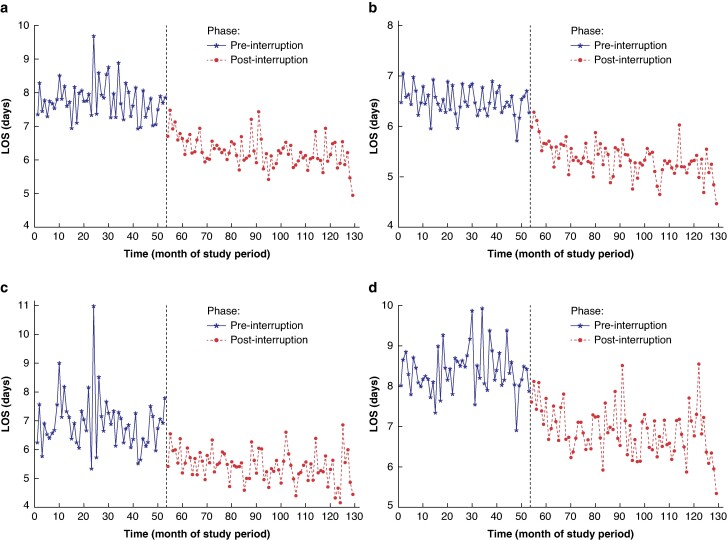
In 2012, ERAS protocols were introduced at 15 Ontario hospitals as part of the iERAS study. A cohort of patients undergoing colorectal surgery treated at these hospitals between 2008 and 2019 was created using health administrative data. Mean length of stay was computed for the intervals before and after ERAS implementation. Interrupted time series analyses were performed for predefined subgroups, namely all colorectal surgery, colorectal surgery without complications, right-sided colorectal surgery, and left-sided colorectal surgery. Sensitivity analyses were then conducted using adjusted length of stay, accounting for length of stay predictors, including: patient age, sex, marginalization, co-morbidities, and diagnosis; surgeon volume of cases, years in practice, and colorectal surgery expertise; hospital volume; and other contextual factors, including procedure type and timing, surgical approach, and in-hospital complications.
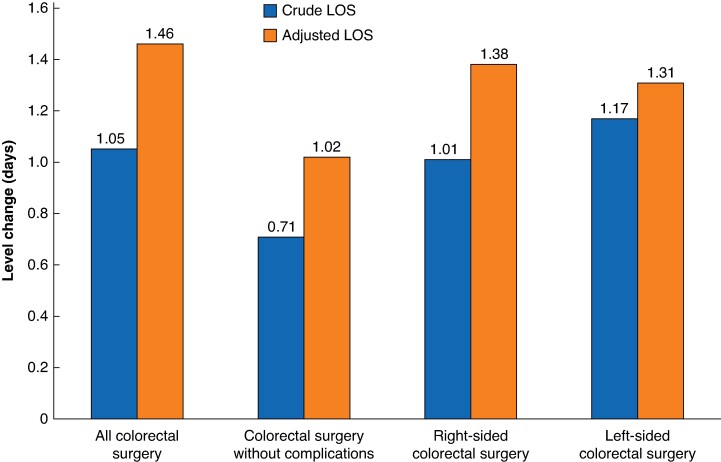
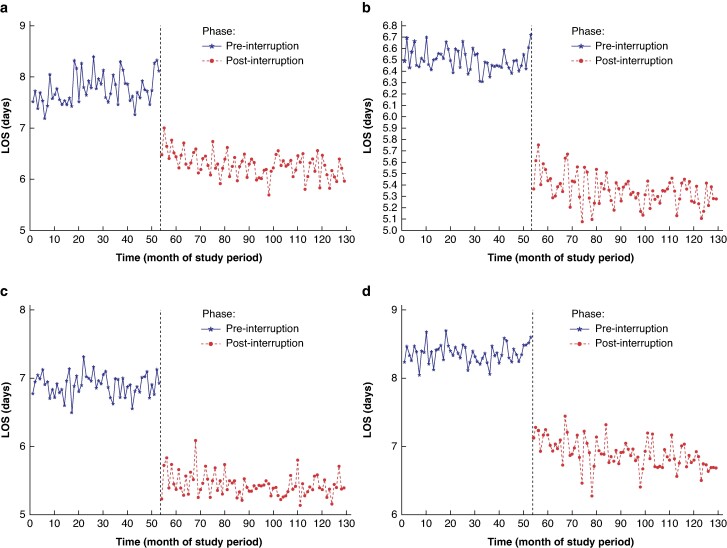
A total of 32 612 patients underwent colorectal surgery during the study interval. ERAS implementation led to a decrease in length of stay of 1.05 days (13.7%). Larger decreases in length of stay were seen with more complex surgeries, with a level change of 1.17 days (15.6%) noted for the subgroup of patients undergoing left-sided colorectal surgery. The observed decreases in length of stay were durable for the length of the study interval in all analyses. When adjusting for predictors of length of stay, the effect of ERAS implementation on length of stay was larger (reduction of 1.46 days).
Introducing formal ERAS protocols reduces length of stay after colorectal surgery significantly, independent of temporal trends toward decreasing length of stay. These effects are durable, demonstrating that ERAS protocol implementation is an effective hospital-level intervention to reduce length of stay after colorectal surgery.
手术后住院时间延长与医疗保健利用增加和患者不良结局相关。虽然强化术后康复(ERAS)方案已被证明可减少结直肠手术后的住院时间,但在真实环境中其有效性更不确定。本研究旨在使用真实数据评估 ERAS 方案实施对结直肠手术后住院时间的影响。
2012 年,作为 iERAS 研究的一部分,15 家安大略省医院引入了 ERAS 方案。使用健康管理数据创建了在这些医院接受结直肠手术治疗的患者队列,时间范围为 2008 年至 2019 年。计算 ERAS 实施前后的平均住院时间。对预先设定的亚组进行了中断时间序列分析,即所有结直肠手术、无并发症的结直肠手术、右半结直肠手术和左半结直肠手术。然后使用调整后的住院时间进行敏感性分析,考虑了住院时间预测因素,包括:患者年龄、性别、边缘化、合并症和诊断;外科医生手术量、从业年限和结直肠手术专业知识;医院量;以及其他背景因素,包括手术类型和时间、手术方法和院内并发症。
研究期间共有 32612 例患者接受了结直肠手术。ERAS 实施使住院时间缩短了 1.05 天(13.7%)。对于接受左半结直肠手术的患者亚组,手术更复杂的情况下住院时间减少幅度更大,水平变化为 1.17 天(15.6%)。在所有分析中,观察到的住院时间减少在研究期间内都是持久的。在调整住院时间预测因素后,ERAS 实施对住院时间的影响更大(减少 1.46 天)。
正式引入 ERAS 方案可显著减少结直肠手术后的住院时间,且独立于住院时间缩短的趋势。这些效果持久,表明 ERAS 方案的实施是减少结直肠手术后住院时间的有效医院层面干预措施。