Gannan Medical University, Ganzhou City, Jiangxi Province, 341000, China.
Department of Rehabilitation Medicine, First Affiliated Hospital of Gannan Medical University, Ganzhou City, Jiangxi Province, 341000, China.
BMC Musculoskelet Disord. 2024 Sep 3;25(1):703. doi: 10.1186/s12891-024-07805-3.
Keen Osteoarthritis (KOA) is a common chronic disabling disease characterized by joint pain and dysfunction, which seriously affects patients' quality of life. Recent studies have shown that transcranial direct current stimulation (tDCS) was a promising treatment for KOA.
Investigate the effects of tDCS on pain and physical function in patients with KOA.
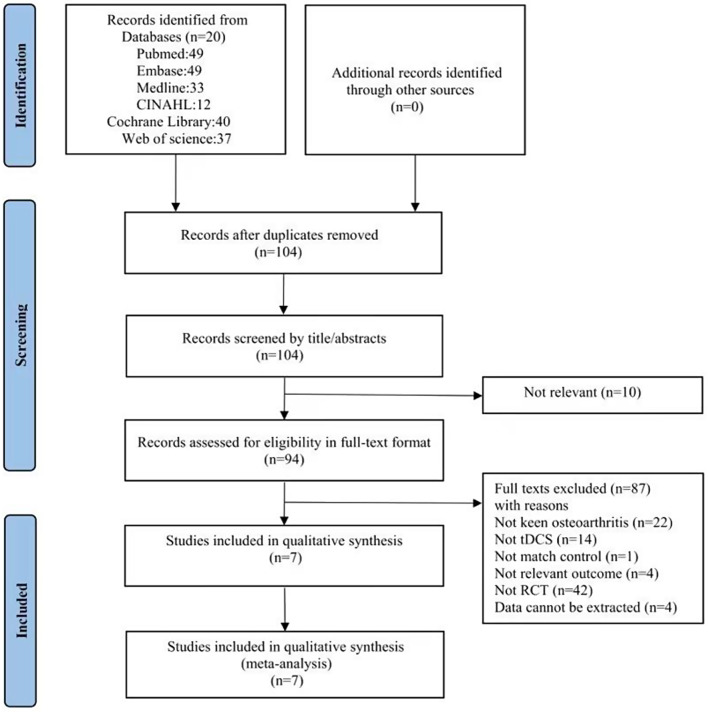
Randomized controlled trials related to tDCS and KOA were systematically searched in the PubMed, Embase, Medline, Cochrane Library, CINHL, and Web of Science databases from inception to July 23, 2024. The pain intensity was evaluated using the visual analog scale or the numeric rating scale, and the pain sensitivity was assessed using conditioned pain modulation, pressure pain threshold, heat pain threshold, or heat pain tolerance. The physical function outcome was evaluated using the Western Ontario and McMaster Universities Osteoarthritis Index or the Knee injury and Osteoarthritis Outcome Score. Statistical analysis was performed using Review Manager 5.4.
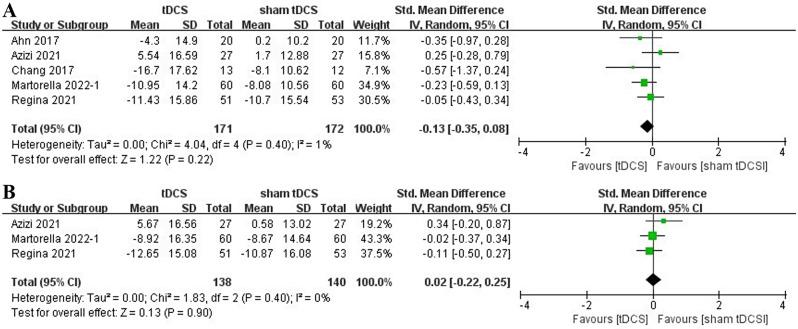
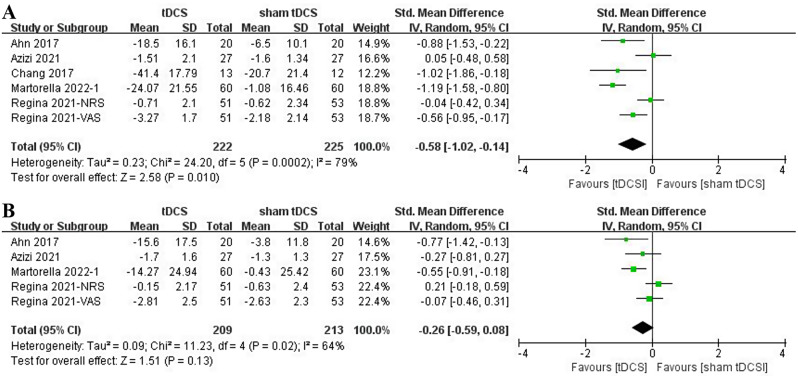
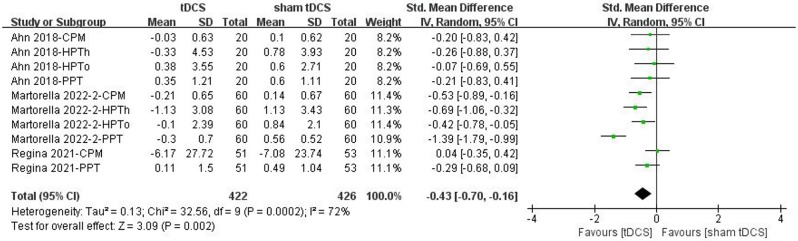
Seven studies with a total of 503 participants were included. Compared to sham tDCS, tDCS was effective in reducing the short-term pain intensity (SMD: -0.58; 95% CI: -1.02, -0.14; p = 0.01) and pain sensitivity (SMD: -0.43; 95% CI: -0.70, -0.16; p = 0.002) but failed to significantly improve the long-term pain intensity (SMD: -0.26; 95% CI: -0.59, 0.08; p = 0.13) in KOA patients. In addition, tDCS did not significantly improve the short-term (SMD: -0.13; 95% CI: -0.35, 0.08; p = 0.22) and long-term (SMD: 0.02; 95% CI: -0.22, 0.25; p = 0.90) physical function in patients with KOA.
The tDCS can reduce short-term pain intensity and sensitivity but fails to significantly relieve long-term pain intensity and improve the physical function in patients with KOA. Thus, tDCS may be a potential therapeutic tool to reduce short-term pain intensity and pain sensitivity in patients with KOA.
膝骨关节炎(KOA)是一种常见的慢性致残性疾病,其特征为关节疼痛和功能障碍,严重影响患者的生活质量。最近的研究表明,经颅直流电刺激(tDCS)是治疗 KOA 的一种有前途的方法。
探讨 tDCS 对 KOA 患者疼痛和身体功能的影响。
系统检索了 PubMed、Embase、Medline、Cochrane 图书馆、CINHL 和 Web of Science 数据库中自成立至 2024 年 7 月 23 日与 tDCS 和 KOA 相关的随机对照试验。使用视觉模拟评分或数字评分量表评估疼痛强度,使用条件性疼痛调制、压痛阈值、热痛阈值或热痛耐量评估疼痛敏感性。使用 Western Ontario 和 McMaster 大学骨关节炎指数或膝关节损伤和骨关节炎结果评分评估身体功能结局。使用 Review Manager 5.4 进行统计学分析。
纳入了 7 项共 503 名参与者的研究。与假 tDCS 相比,tDCS 可有效降低短期疼痛强度(SMD:-0.58;95%CI:-1.02,-0.14;p=0.01)和疼痛敏感性(SMD:-0.43;95%CI:-0.70,-0.16;p=0.002),但不能显著改善 KOA 患者的长期疼痛强度(SMD:-0.26;95%CI:-0.59,0.08;p=0.13)。此外,tDCS 对 KOA 患者的短期(SMD:-0.13;95%CI:-0.35,0.08;p=0.22)和长期(SMD:0.02;95%CI:-0.22,0.25;p=0.90)身体功能均无显著改善。
tDCS 可降低短期疼痛强度和敏感性,但不能显著缓解长期疼痛强度和改善 KOA 患者的身体功能。因此,tDCS 可能是一种潜在的治疗工具,可降低 KOA 患者的短期疼痛强度和疼痛敏感性。