Groupe de Recherche Action en Santé (GRAS), 06 BP 10248, Ouagadougou 06, Burkina Faso.
ReMeD, 21bis Avenue du Commandant de L'Herminier, Saint-Nazaire, 44 600, France.
Trials. 2024 Sep 3;25(1):583. doi: 10.1186/s13063-024-08428-8.
Primaquine (PQ) has activity against mature P. falciparum gametocytes and proven transmission blocking efficacy (TBE) between humans and mosquitoes. WHO formerly recommended a single transmission blocking dose of 0.75 mg/kg but this was little used. Then in 2012, faced with the emergence of artemisinin-resistant P. falciparum (ARPf) in SE Asia, the WHO recommended a lower dose of 0.25 mg/kg to be added to artemisinin-based combination therapy in falciparum-infected patients in low transmission areas. This dose was considered safe in glucose-6-phosphate dehydrogenase deficiency (G6PDd) and not requiring G6PD testing. Subsequent single low-dose primaquine (SLDPQ) studies have demonstrated safety in different G6PD variants. Dosing remains challenging in children under the age of 5 because of the paucity of PQ pharmacokinetic (PK) data. We plan to assess the anti-infectivity efficacy of SLDPQ using an allometrically scaled, weight-based regimen, with a target dose of 0.25 mg/kg, in children with acute uncomplicated falciparum malaria.
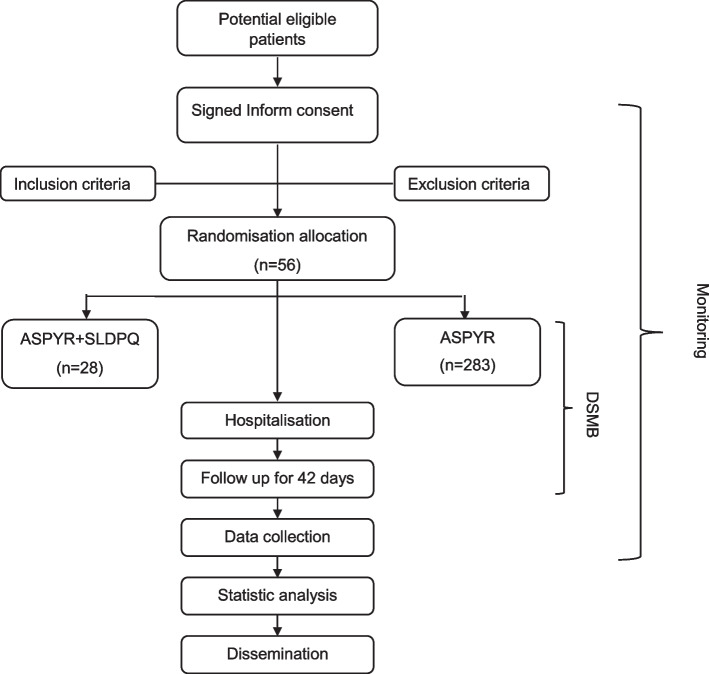
This study is an open label, randomised 1:1, phase IIb study to assess TBE, tolerability, pharmacokinetics and acceptability of artesunate pyronaridine (ASPYR) administered alone or combined with SLDPQ in 56 Burkinabe children aged ≥ 6 months- < 5 years, with uncomplicated P. falciparum and a haemoglobin (Hb) concentration of ≥ 5 g/dL. We will assess TBE, using direct membrane feeding assays (DMFA), and further investigate PQ pharmacokinetics, adverse events, Hb dynamics, G6PD, sickle cells, thalassaemia and cytochrome 2D6 (CYP2D6) status, acceptability of flavoured PQ [CAST-ClinSearch Acceptability Score Test], and the population's knowledge, attitude and practices on malaria.
We expect children to accept tablets, confirm the TBE and gametocytocidal effects of SLDPQ and then construct a PK infectivity model (including age, sex, baseline Hb, G6PD and CYP2D6 status) to define the dose response TBE relationship that may lead to fine tuning our SLDPQ regimen. Our study will complement others that have examined factors associated with Hb dynamics and PQ PK. It will provide much needed, high-quality evidence of SLDPQ in sick African children and provide reassurance that SLDPQ should be used as a strategy against emerging ARPf in Africa.
ISRCTN16297951. Registered on September 26, 2021.
伯氨喹(PQ)对成熟的疟原虫配子体具有活性,并已被证实具有人类与蚊子之间的传播阻断功效(TBE)。世界卫生组织(WHO)曾建议使用 0.75mg/kg 的单次 TBE 剂量,但该剂量很少被使用。然后在 2012 年,面对东南亚地区出现的青蒿素耐药疟原虫(ARPf),WHO 建议在青蒿素为基础的联合疗法中,对低传播地区的疟疾病人使用较低剂量的 0.25mg/kg 的伯氨喹。该剂量在葡萄糖-6-磷酸脱氢酶缺乏症(G6PDd)患者中被认为是安全的,不需要进行 G6PD 检测。随后的单次低剂量伯氨喹(SLDPQ)研究表明,在不同的 G6PD 变体中使用该剂量是安全的。由于缺乏伯氨喹药代动力学(PK)数据,5 岁以下儿童的用药剂量仍然具有挑战性。我们计划使用按比例缩放、基于体重的方案来评估 SLDPQ 的抗感染力功效,目标剂量为 0.25mg/kg,用于治疗患有急性无并发症的恶性疟原虫感染的儿童。
这是一项开放标签、随机 1:1、IIb 期研究,旨在评估在 56 名布基纳法索 6 个月至 5 岁的患有无并发症的恶性疟原虫感染、血红蛋白(Hb)浓度≥5g/dL 的儿童中,单独使用青蒿琥酯吡喹酮(ASPYR)或与 SLDPQ 联合使用时的 TBE、耐受性、PK 和可接受性。我们将使用直接膜喂养测定法(DMFA)评估 TBE,并进一步研究 PQ PK、不良事件、Hb 动力学、G6PD、镰状细胞、地中海贫血和细胞色素 2D6(CYP2D6)状态、PQ 口感(CAST-ClinSearch 可接受性评分测试)的可接受性,以及该人群对疟疾的知识、态度和实践。
我们预计儿童会接受片剂,确认 SLDPQ 的 TBE 和配子体杀伤作用,然后构建 PK 感染模型(包括年龄、性别、基线 Hb、G6PD 和 CYP2D6 状态),以确定与 TBE 相关的剂量反应关系,这可能会使我们的 SLDPQ 方案得到进一步优化。我们的研究将补充其他研究,这些研究已经检验了与 Hb 动力学和 PQ PK 相关的因素。它将为非洲患有镰状细胞病的儿童提供急需的高质量的 SLDPQ 证据,并确保 SLDPQ 应该作为一种对抗非洲出现的新型 ARPf 的策略。
ISRCTN85360642。于 2021 年 9 月 26 日注册。