Yamashita Shinji, Okugawa Yoshinaga, Mizuno Naru, Imaoka Hiroki, Shimura Tadanobu, Kitajima Takahito, Kawamura Mikio, Okita Yoshiki, Ohi Masaki, Toiyama Yuji
Division of Reparative Medicine, Department of Gastrointestinal and Pediatric Surgery, Institute of Life Sciences Mie University Graduate School of Medicine Tsu Japan.
Department of Genomic Medicine Mie University Hospital Tsu Japan.
Ann Gastroenterol Surg. 2024 May 28;8(5):826-835. doi: 10.1002/ags3.12829. eCollection 2024 Sep.
The prognosis of colorectal cancer (CRC) has been historically reliant on the Tumor Node Metastasis (TNM) staging system, but there is variability in outcomes among patients at similar stages. Therefore, there is an urgent need for more robust biomarkers. The aim of this study was to assess the clinical feasibility of the recently reported Inflammatory Burden Index (IBI) for predicting short- and long-term outcomes in patients with CRC.
This was a retrospective observational study of 555 CRC patients undergoing surgery for primary tumor resection. We determined the prognostic value of preoperative IBI for disease-free and overall survival, and its predictive value for perioperative risk of infectious complications, including surgical site infection.
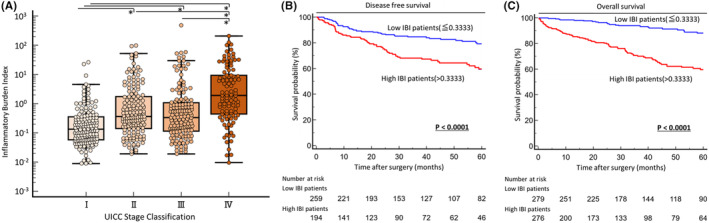
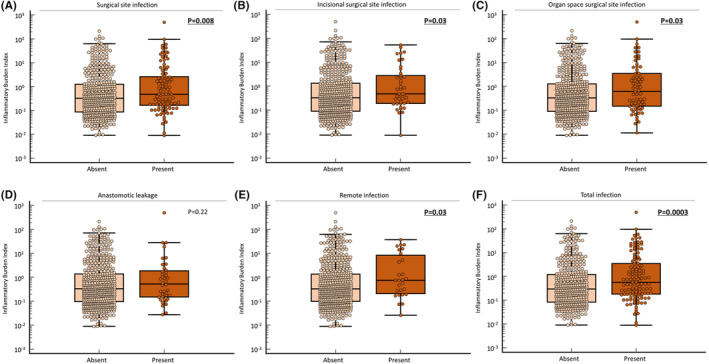
Increased preoperative IBI was significantly associated with advanced disease stage and poor oncological outcome in CRC patients. Higher IBI was independently linked to poorer disease-free and overall survival. Similar outcomes were observed in a subanalysis focused on high-risk stage II and stage III CRC patients. Elevated preoperative IBI was significantly correlated with an increased risk of surgical site infection and other postoperative infectious complications. Propensity score-matching analysis validated the impact of IBI on the prognosis in CRC patients.
We established preoperative IBI as a valuable predictive biomarker for perioperative risks and oncological outcomes in CRC patients. Preoperative IBI is useful for designing effective perioperative management and postoperative oncological follow-up.
结直肠癌(CRC)的预后历来依赖于肿瘤淋巴结转移(TNM)分期系统,但处于相似分期的患者其预后存在差异。因此,迫切需要更可靠的生物标志物。本研究的目的是评估最近报道的炎症负担指数(IBI)在预测CRC患者短期和长期预后方面的临床可行性。
这是一项对555例接受原发性肿瘤切除手术的CRC患者进行的回顾性观察研究。我们确定了术前IBI对无病生存期和总生存期的预后价值,以及其对包括手术部位感染在内的围手术期感染并发症风险的预测价值。
术前IBI升高与CRC患者的疾病晚期和不良肿瘤学结局显著相关。较高的IBI与较差的无病生存期和总生存期独立相关。在针对高危II期和III期CRC患者的亚分析中也观察到了类似的结果。术前IBI升高与手术部位感染和其他术后感染并发症的风险增加显著相关。倾向评分匹配分析验证了IBI对CRC患者预后的影响。
我们将术前IBI确立为CRC患者围手术期风险和肿瘤学结局的有价值的预测生物标志物。术前IBI有助于设计有效的围手术期管理和术后肿瘤学随访。