Department of Women and Children's Health, University of Padua, Padova, Italy.
Department of Obstetrics and Gynecology Princess Christian Maternity Hospital (PCMH), University of Sierra Leone, Freetown, Sierra Leone.
BMJ Open. 2024 Sep 3;14(9):e081143. doi: 10.1136/bmjopen-2023-081143.
WHO recommends the use of the Robson's 'Ten Groups Classification' for monitoring and assessing caesarean section (CS) rates. The aim of this study was to investigate the rates, indications and outcomes of CS using Robson classification in a tertiary hospital in Sierra Leone.
Cross-sectional study.
Princess Christian Maternity Hospital (PCMH), Freetown, Sierra Leone.
All women who gave birth in PCMH from 1 October 2020 to 31 January 2021.
Primary outcome: CS rate by Robson group.
indications for CS and the newborn outcomes for each Robson group.
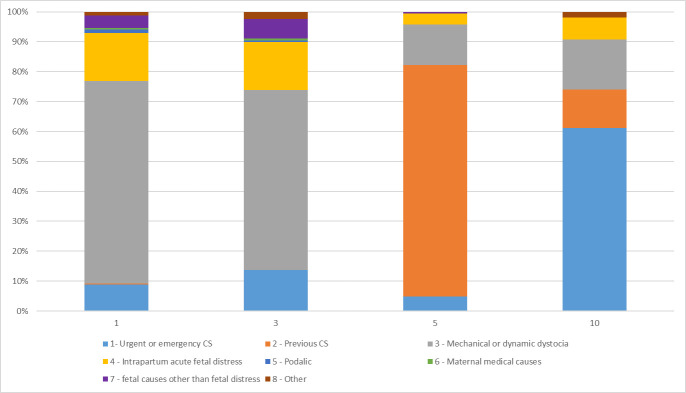
1998 women gave birth during the study period and 992 CS were performed, with a CS rate of 49.6%. Perinatal mortality was 7.8% and maternal mortality accounted for 0.5%. Two-thirds of the women entered labour spontaneously and were considered at low risk (groups 1 and 3). CS rates in these groups were very high (43% group 1 and 33% group 3) with adverse outcomes (perinatal mortality, respectively, 4.1% and 6%). Dystocia was the leading indication for CS accounting for about two-thirds of the CS in groups 1 and 3. Almost all women with a previous CS underwent CS again (95%). The group of women who give birth before term (group 10) represents 5% of the population with high CS rate (50%) mainly because of emergency conditions.
Our data reveals a notably high CS rate, particularly among low-risk groups according to the Robson classification. Interpretation must consider PCMH as a referral hospital within an extremely low-resourced healthcare system, centralising all the complicated deliveries from a vast catchment area. Further research is required to assess the impact of referred obstetrical complications on the CS rate and the feasibility of implementing measures to improve the management of women with dystocia and previous CS.
世界卫生组织(WHO)建议使用 Robson 的“十组分类”来监测和评估剖宫产率。本研究旨在调查塞拉利昂一家三级医院使用 Robson 分类的剖宫产率、指征和结局。
横断面研究。
塞拉利昂弗里敦的Princess Christian Maternity Hospital(PCMH)。
2020 年 10 月 1 日至 2021 年 1 月 31 日期间在 PCMH 分娩的所有妇女。
主要结果:Robson 组的剖宫产率。
剖宫产指征和每个 Robson 组的新生儿结局。
在研究期间,有 1998 名妇女分娩,其中 992 例行剖宫产,剖宫产率为 49.6%。围产儿死亡率为 7.8%,孕产妇死亡率为 0.5%。三分之二的妇女自然分娩,被认为是低风险(第 1 组和第 3 组)。这些组的剖宫产率非常高(第 1 组 43%,第 3 组 33%),结局不良(围产儿死亡率分别为 4.1%和 6%)。难产是剖宫产的主要指征,约占第 1 组和第 3 组剖宫产的三分之二。几乎所有有剖宫产史的妇女再次行剖宫产(95%)。早产组(第 10 组)占人口的 5%,剖宫产率高(50%),主要是因为急诊情况。
我们的数据显示,剖宫产率明显较高,特别是根据 Robson 分类,低危组的剖宫产率更高。解释时必须考虑到 PCMH 是一个资源极其有限的医疗体系中的转诊医院,集中了从广大服务区转诊来的所有复杂分娩。需要进一步研究评估转诊产科并发症对剖宫产率的影响,以及实施措施改善难产和有剖宫产史的妇女管理的可行性。