Department of Biochemistry, Key University Laboratory of Metabolism and Health of Guangdong, School of Medicine, Institute for Biological Electron Microscopy, Southern University of Science and Technology, Shenzhen, Guangdong Province, China.
Institute for Hepatology, National Clinical Research Center for Infectious Disease, Shenzhen Third People's Hospital; The Second Affiliated Hospital, School of Medicine, Southern University of Science and Technology, Shenzhen, Guangdong Province, China.
Nat Commun. 2024 Sep 4;15(1):7715. doi: 10.1038/s41467-024-51973-8.
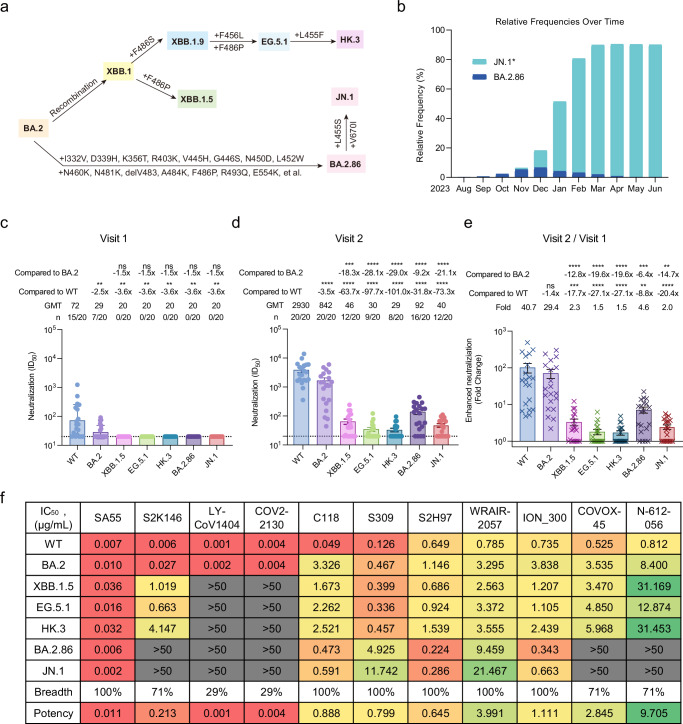
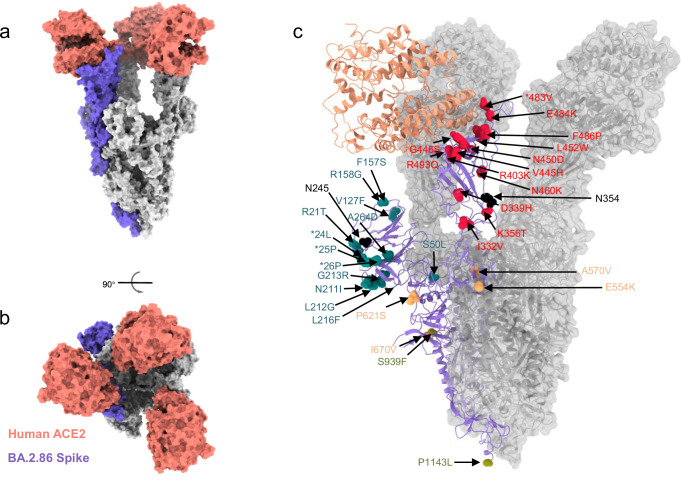
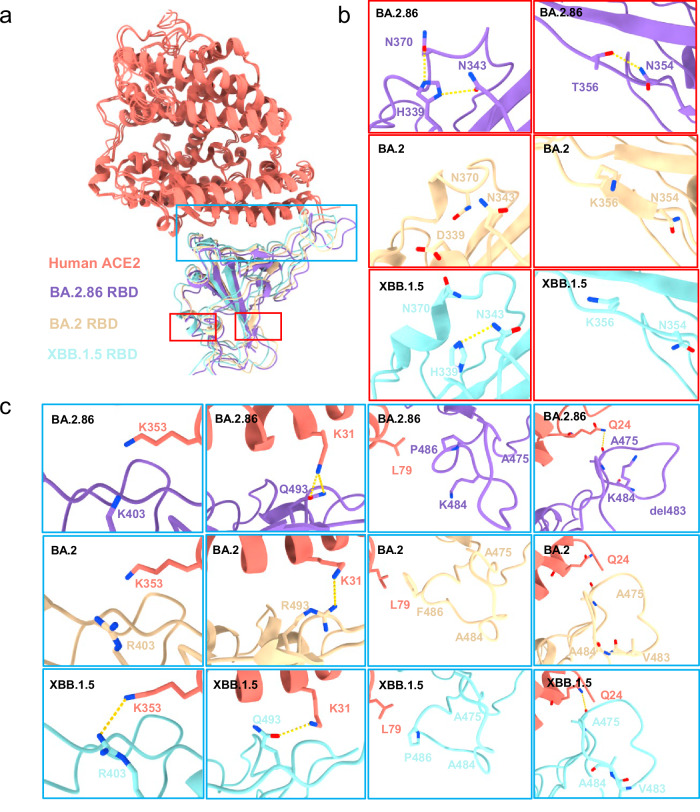
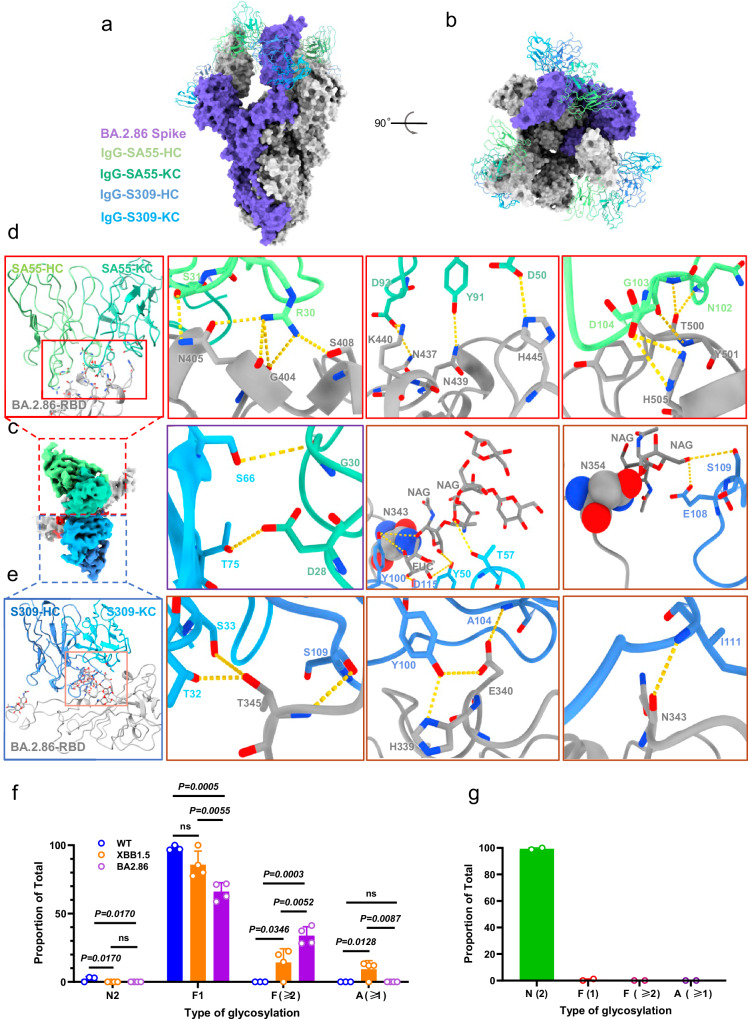
The Omicron subvariants of SARS-CoV-2, especially for BA.2.86 and JN.1, have rapidly spread across multiple countries, posing a significant threat in the ongoing COVID-19 pandemic. Distinguished by 34 additional mutations on the Spike (S) protein compared to its BA.2 predecessor, the implications of BA.2.86 and its evolved descendant, JN.1 with additional L455S mutation in receptor-binding domains (RBDs), are of paramount concern. In this work, we systematically examine the neutralization susceptibilities of SARS-CoV-2 Omicron subvariants and reveal the enhanced antibody evasion of BA.2.86 and JN.1. We also determine the cryo-EM structures of the trimeric S proteins from BA.2.86 and JN.1 in complex with the host receptor ACE2, respectively. The mutations within the RBDs of BA.2.86 and JN.1 induce a remodeling of the interaction network between the RBD and ACE2. The L455S mutation of JN.1 further induces a notable shift of the RBD-ACE2 interface, suggesting the notably reduced binding affinity of JN.1 than BA.2.86. An analysis of the broadly neutralizing antibodies possessing core neutralizing epitopes reveals the antibody evasion mechanism underlying the evolution of Omicron BA.2.86 subvariant. In general, we construct a landscape of evolution in virus-receptor of the circulating Omicron subvariants.
新冠病毒奥密克戎亚变体,尤其是 BA.2.86 和 JN.1,已迅速在多个国家传播,对当前的 COVID-19 大流行构成了重大威胁。与之前的 BA.2 相比,BA.2.86 在刺突(S)蛋白上有 34 个额外的突变,而其进化后的后代 JN.1 在受体结合域(RBD)中又有额外的 L455S 突变,这引起了极大的关注。在这项工作中,我们系统地研究了新冠病毒奥密克戎亚变体的中和敏感性,并揭示了 BA.2.86 和 JN.1 的抗体逃避能力增强。我们还分别确定了 BA.2.86 和 JN.1 的三聚体 S 蛋白与宿主受体 ACE2 复合物的冷冻电镜结构。BA.2.86 和 JN.1 的 RBD 内的突变诱导了 RBD 和 ACE2 之间相互作用网络的重塑。JN.1 的 L455S 突变进一步引起了 RBD-ACE2 界面的明显移动,表明 JN.1 的结合亲和力明显低于 BA.2.86。对具有核心中和表位的广泛中和抗体的分析揭示了奥密克戎 BA.2.86 亚变体进化背后的抗体逃避机制。总的来说,我们构建了循环奥密克戎亚变体的病毒-受体进化图谱。