Well Living Lab, Rochester, MN, 55902, USA.
Department of Civil, Architectural, and Environmental Engineering, University of Texas at Austin, Austin, TX, 78712, USA.
Sci Rep. 2024 Sep 4;14(1):20630. doi: 10.1038/s41598-024-69731-7.
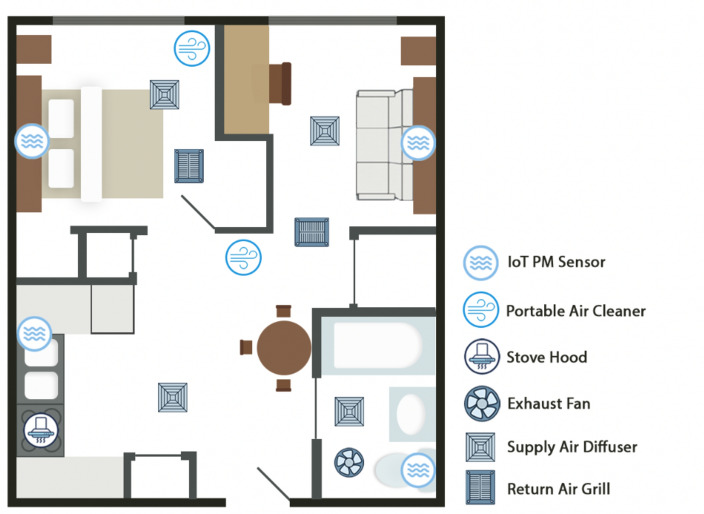
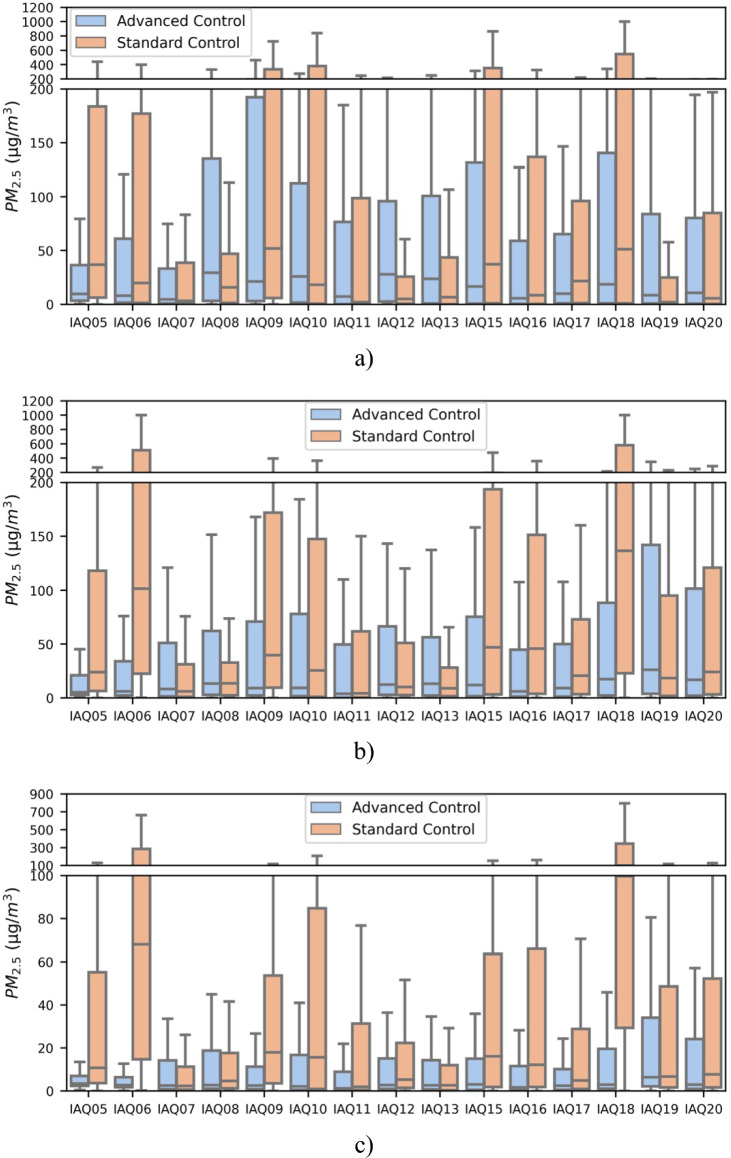
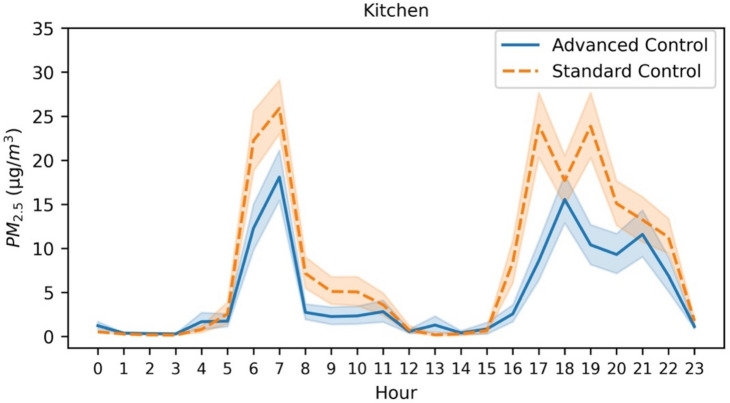
We implemented a crossover study design exposing 15 participants to two indoor air quality conditions in the Well Living Lab. The first condition, the Standard Control Condition, resembled the ventilation and air supply of a typical home in the USA with a manually operated stove hood. The second condition, Advanced Control, had an automated: (i) stove hood, (ii) two portable air cleaners (PAC), and (iii) bathroom exhaust. The PM sensors were placed in the kitchen, living room, bedroom, and bathroom. Once the sensor detected a PM level of 15 μg/m or higher, an air quality intervention (stove hood, PAC or bathroom exhaust) in that space was activated and turned off when the corresponding PM sensor had three consecutive readings below 6 μg/m. Advanced Control in the overall apartment reduced PM concentration by 40% compared to the Standard Control. The PM concentration difference between Advanced and Standard Control was ~ 20% in the kitchen. This can be attributed to using the stove hood manually in 66.5% of cooking PM emission events for 323.6 h compared to 88 h stove hood used in automated mode alongside 61.9 h and 33.7 h of PAC use in living room and bedroom, respectively.
我们实施了一项交叉研究设计,让 15 名参与者在健康生活实验室中体验两种室内空气质量条件。第一种条件是标准控制条件,类似于美国典型家庭的通风和空气供应情况,配备手动操作的炉灶罩。第二种条件是高级控制,具有自动化:(i)炉灶罩,(ii) 两个便携式空气净化器 (PAC),以及 (iii) 浴室排气扇。PM 传感器放置在厨房、客厅、卧室和浴室。一旦传感器检测到 PM 水平达到 15μg/m 或更高,该空间的空气质量干预措施(炉灶罩、PAC 或浴室排气扇)将被激活,并在相应的 PM 传感器连续三次读数低于 6μg/m 时关闭。与标准控制相比,整个公寓的高级控制将 PM 浓度降低了 40%。在厨房中,高级控制和标准控制之间的 PM 浓度差异约为 20%。这可以归因于在 323.6 小时的烹饪 PM 排放事件中手动使用炉灶罩,而在自动模式下仅使用 88 小时炉灶罩,同时在客厅和卧室分别使用 61.9 小时和 33.7 小时的 PAC。