Center for Primary Health Care Research. Department of Clinical Sciences. Malmö, Lund University, Malmö, Sweden.
, Costa Teguise, Spain.
BMC Endocr Disord. 2024 Sep 4;24(1):176. doi: 10.1186/s12902-024-01715-0.
Beneficial effects from practising a Paleolithic diet as compared to a diabetes diet on weight, waist circumference, satiety, leptin, HbA1c and glucose control in randomised controlled trial participants with type 2 diabetes could be due to lower leptin resistance. Support for this hypothesis comes from an in vitro experiment that showed that digested wheat gluten, which is excluded from a Paleolithic diet, inhibits leptin from binding to its receptor, thus indicating a possible dietary cause of leptin resistance. However, the clinical relevance of the latter finding is unclear since removal of enzyme activity from the gluten digest by heat treatment also abolished leptin binding inhibition. Assessment of leptin binding inhibition in vivo is possible by comparison of total leptin levels with those of 'biologically active' leptin bound to its receptor (bioLep).
To assess the effects of a Paleolithic diet compared to a diabetes diet on leptin binding inhibition and to replicate our in vitro study.
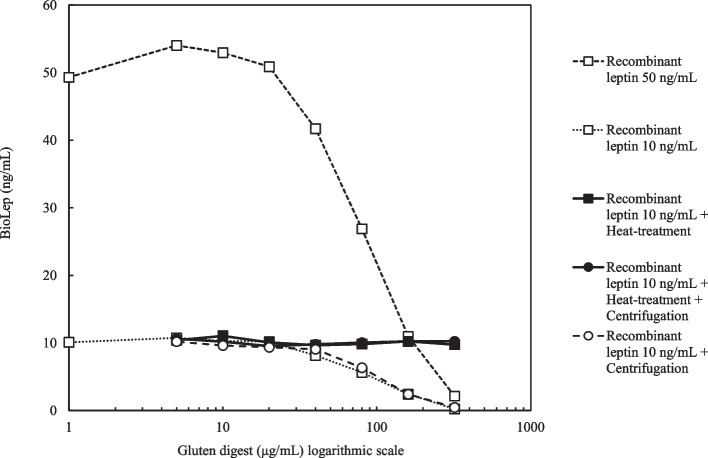
BioLep and total leptin levels were measured in secondary analysis of fasting plasma samples from our open label random order three plus three-month long cross-over trial performed in 2005-2007, that compared a Paleolithic diet with a diabetes diet in participants with type 2 diabetes without insulin treatment (per protocol). BioLep was also measured in vitro for known recombinant leptin concentrations incubated with a series of concentrations of 10 kDa spin-filtered digested wheat gluten, with or without prior heat treatment, at 100ºC for 30 min and centrifugation.
There was no difference between diets when comparing differences between bioLep and total leptin levels and their ratio in the 13 participants, three women and 10 men, aged 52-74 years with a mean BMI of 30 kg/m and a mean diabetes duration of eight years. We found no carry-over or period effect for bioLep and total leptin. In vitro, wheat gluten digest inhibited leptin binding in a dose-dependent manner but not after heat treatment.
We found no leptin binding inhibition after the Paleolithic or diabetes diet, possibly due to its abolishment from cooking-related heat treatment of wheat gluten.
Registered on 14/02/2007 at ClinicalTrials.gov Identifier: NCT00435240.
与糖尿病饮食相比,在 2 型糖尿病随机对照试验参与者中实践旧石器饮食对体重、腰围、饱腹感、瘦素、HbA1c 和葡萄糖控制的有益影响可能是由于瘦素抵抗降低所致。这一假设得到了一项体外实验的支持,该实验表明,从旧石器饮食中排除的消化小麦面筋抑制瘦素与其受体结合,这表明瘦素抵抗可能是一种饮食原因。然而,由于通过热处理从面筋消化物中去除酶活性也消除了瘦素结合抑制,因此后者发现的临床相关性尚不清楚。通过比较总瘦素水平与与受体结合的“生物活性”瘦素(bioLep)来评估体内瘦素结合抑制是可能的。
评估与糖尿病饮食相比,旧石器饮食对瘦素结合抑制的影响,并复制我们的体外研究。
在我们于 2005-2007 年进行的为期三个月的开放式标签随机三加三交叉试验的二次分析中测量了空腹血浆样本中的 bioLep 和总瘦素水平,该试验比较了 2 型糖尿病患者无胰岛素治疗的旧石器饮食与糖尿病饮食(按方案)。还在体外测量了已知重组瘦素浓度与一系列浓度为 10 kDa 过滤消化的小麦面筋孵育时的 bioLep,无论是否事先进行 100°C 30 分钟的热处理和离心。
在比较 13 名参与者(3 名女性和 10 名男性)的 bioLep 与总瘦素水平及其比值的差异时,饮食之间没有差异,这些参与者年龄在 52-74 岁之间,平均 BMI 为 30kg/m,平均糖尿病病程为 8 年。我们没有发现 bioLep 和总瘦素的交叉或周期效应。在体外,小麦面筋消化物以剂量依赖性方式抑制瘦素结合,但热处理后则不然。
我们在旧石器或糖尿病饮食后没有发现瘦素结合抑制,这可能是由于烹饪相关的小麦面筋热处理将其消除。
于 2007 年 2 月 14 日在 ClinicalTrials.gov 注册,标识符:NCT00435240。