Institute for Clinical and Translational Research, Baylor College of Medicine, Houston, TX, 77030, USA.
Section of Epidemiology and Population Sciences, Department of Medicine, Baylor College of Medicine, Houston, TX, 77030, USA.
Mol Cancer. 2024 Sep 4;23(1):185. doi: 10.1186/s12943-024-02080-1.
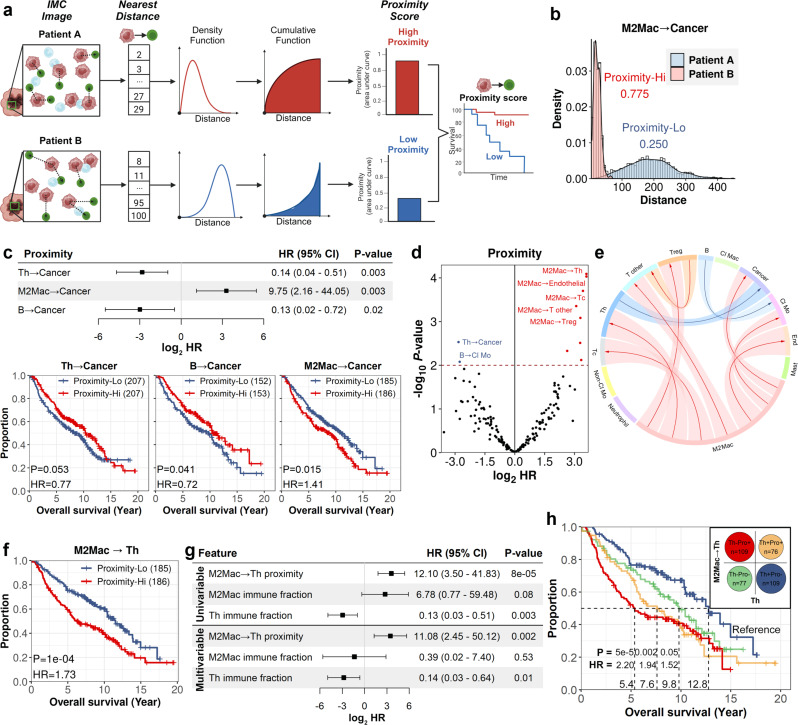
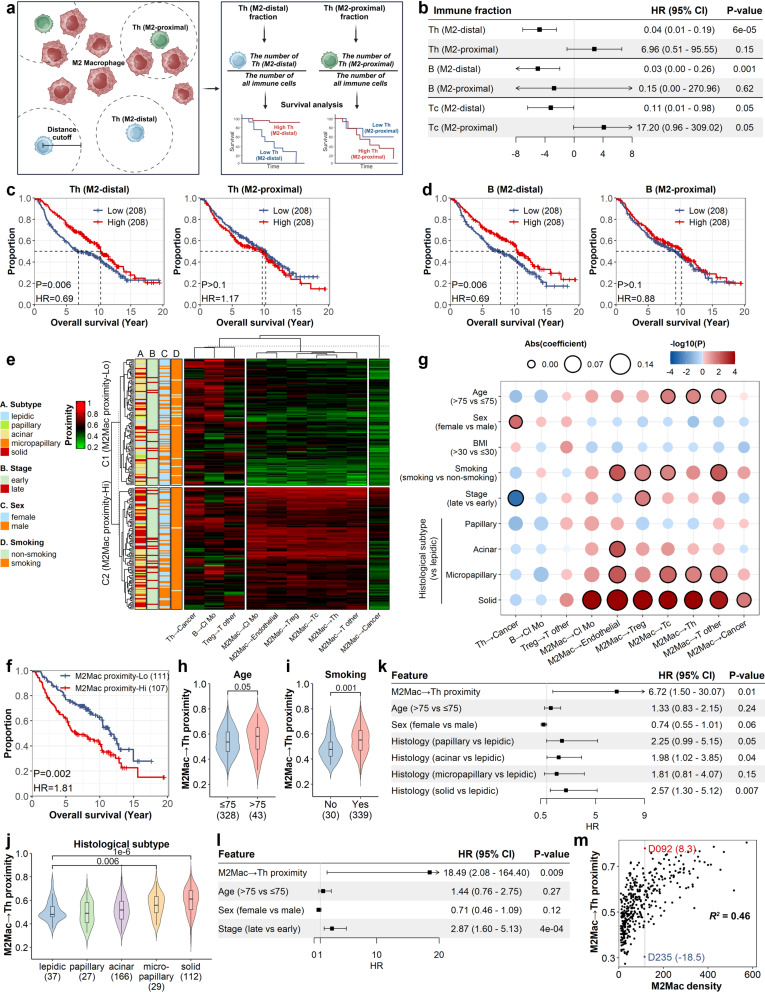
The spatial arrangement of immune cells within the tumor microenvironment (TME) and their interactions play critical roles in the initiation and development of cancer. Several advanced technologies such as imaging mass cytometry (IMC) providing the immunological landscape of the TME with single-cell resolution. In this study, we develop a new method to quantify the spatial proximity between different cell types based on single-cell spatial data. Using this method on IMC data from 416 lung adenocarcinoma patients, we show that the proximity between different cell types is more correlated with patient prognosis compared to the traditional features such immune cell density and fractions. Consistent with previous reports, our results validate that proximity of T helper (Th) and B cells to cancer cells is associated with survival benefits. More importantly, we discover that the proximity of M2 macrophages to multiple immune cells is associated with poor prognosis. When Th/B cells are stratified into M2-distal and M2-proximal, the abundance of the former but not the latter category of Th/B cells is correlated with enhanced patient survival. Additionally, the abundance of M2-distal and M2-proximal cytotoxic T cells (Tc) is respectively associated with good and poor prognosis. Our results indicate that the prognostic effect of Th, Tc, and B cells in the tumor microenvironment is modulated by the nearby M2 macrophages. The proposed new method proposed can be readily applied to all single-cell spatial data for revealing functional impact of immune cell interactions.
免疫细胞在肿瘤微环境(TME)中的空间排列及其相互作用在癌症的发生和发展中起着关键作用。几种先进的技术,如成像质谱细胞术(IMC),可以提供具有单细胞分辨率的 TME 免疫景观。在这项研究中,我们开发了一种新的方法,基于单细胞空间数据来量化不同细胞类型之间的空间接近程度。使用来自 416 例肺腺癌患者的 IMC 数据,我们表明不同细胞类型之间的接近程度与患者预后的相关性比传统特征(如免疫细胞密度和分数)更高。与之前的报告一致,我们的结果验证了 Th 和 B 细胞与癌细胞的接近程度与生存获益相关。更重要的是,我们发现 M2 巨噬细胞与多种免疫细胞的接近程度与预后不良相关。当 Th/B 细胞被分为 M2-远端和 M2-近端时,前者而不是后者的 Th/B 细胞的丰度与增强的患者生存相关。此外,M2-远端和 M2-近端细胞毒性 T 细胞(Tc)的丰度分别与良好和不良预后相关。我们的结果表明,TME 中 Th、Tc 和 B 细胞的预后效应受附近 M2 巨噬细胞的调节。所提出的新方法可以很容易地应用于所有单细胞空间数据,以揭示免疫细胞相互作用的功能影响。