College of Public Health, Ohio State University, Columbus, OH.
School of Management and Labor Relations, Rutgers University, Piscataway, NJ.
Ann Med. 2024 Dec;56(1):2399316. doi: 10.1080/07853890.2024.2399316. Epub 2024 Sep 5.
Medications for opioid use disorder (MOUD) are the gold standard. However, significant barriers limit their use in the primary care setting, including limited knowledge of the medications and stigmatizing attitudes. In this study, we assess knowledge levels among primary care-aligned professionals (PCPs) currently in practice, and whether knowledge of MOUD is associated with stigma and treatment attitudes.
Using rosters from the state of Ohio licensing boards, we surveyed 403 physicians, nurse practitioners, and physician associates in 2022, on the mechanism of different MOUD, as well as stigma and treatment attitudes. To assess MOUD knowledge, we employed descriptive and bivariate statistics. We fit four linear regression models, which controlled for empathy towards patients with OUD and provider demographics to assess the relationship between MOUD knowledge and four endpoints: stigma, perceived controllability of opioid use, perceived vulnerability to opioid use disorder, and support for abstinence-only treatment.
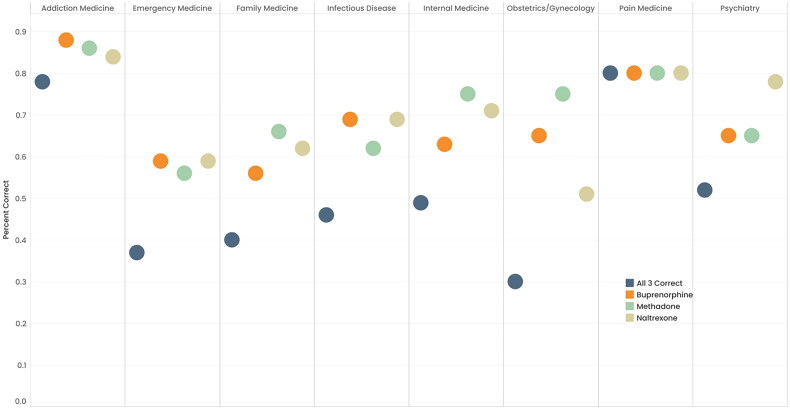
43% of participants correctly identified the mechanism of all 3 medications whereas 13% of participants did not identify the mechanism of any MOUD correctly. MOUD knowledge was higher among physicians as compared to nurse practitioners and physician associates. Lower MOUD knowledge was associated with more negative attitudes towards patients with OUD and MOUD treatment.
Expanding access to MOUD treatment requires a trained and willing health-care professional (HCP) workforce. Our findings highlight considerable variation in clinician knowledge of MOUD and suggest that knowledge levels are also related to negative attitudes towards patients with OUD and MOUD. Training interventions that increase knowledge, as well as focus on stigma reduction, are critical for reducing the longstanding treatment gap for opioid use disorder.
阿片类药物使用障碍(MOUD)的药物治疗是金标准。然而,在初级保健环境中,由于对这些药物的了解有限,以及对这些药物的污名化态度,它们的使用受到了很大的限制。在这项研究中,我们评估了目前正在执业的与初级保健相关的专业人员(PCPs)的知识水平,以及对 MOUD 的了解是否与污名化和治疗态度有关。
我们使用俄亥俄州执照委员会的名单,在 2022 年对 403 名医生、护士从业者和医师助理进行了调查,内容是关于不同 MOUD 的作用机制,以及污名化和治疗态度。为了评估 MOUD 的知识,我们采用了描述性和双变量统计。我们拟合了四个线性回归模型,这些模型控制了对患有 OUD 的患者的同理心和提供者的人口统计学特征,以评估 MOUD 知识与四个终点之间的关系:污名化、对阿片类药物使用的可控制性的看法、对阿片类药物使用障碍的易感性、以及对仅禁欲治疗的支持。
43%的参与者正确识别了所有 3 种药物的作用机制,而 13%的参与者没有正确识别任何 MOUD 的作用机制。与护士从业者和医师助理相比,医生对 MOUD 的了解更多。较低的 MOUD 知识与对患有 OUD 的患者和 MOUD 治疗的更负面的态度有关。
扩大 MOUD 治疗的机会需要有受过培训和愿意的医疗保健专业人员(HCP)队伍。我们的发现强调了临床医生对 MOUD 的了解存在相当大的差异,并表明知识水平也与对患有 OUD 的患者和 MOUD 治疗的负面态度有关。增加知识的培训干预措施,以及减少污名化的措施,对于减少长期存在的阿片类药物使用障碍治疗差距至关重要。