Guangdong Cardiovascular Institute, Guangdong Provincial People's Hospital, Guangdong Academy of Medical Sciences, Guangzhou, 510080, Guangdong, China.
Department of Cardiology, Peking University First Hospital, No. 8 Xishiku St, Xicheng District, Beijing, 100034, China.
Aging Clin Exp Res. 2024 Sep 5;36(1):183. doi: 10.1007/s40520-024-02838-z.
Epidemiology showed that the falling incidences increased with advanced age, and recent findings found link between nutritional intake and risk of falls. Nevertheless, the relationship between different plant-based diets and the risk of falls in older adults remains unclear. Our investigation aimed to evaluate the correlation between various plant-based diet indices and the occurrence of falls.
This study is a cross-sectional and post-hoc analysis from a national cohort study.
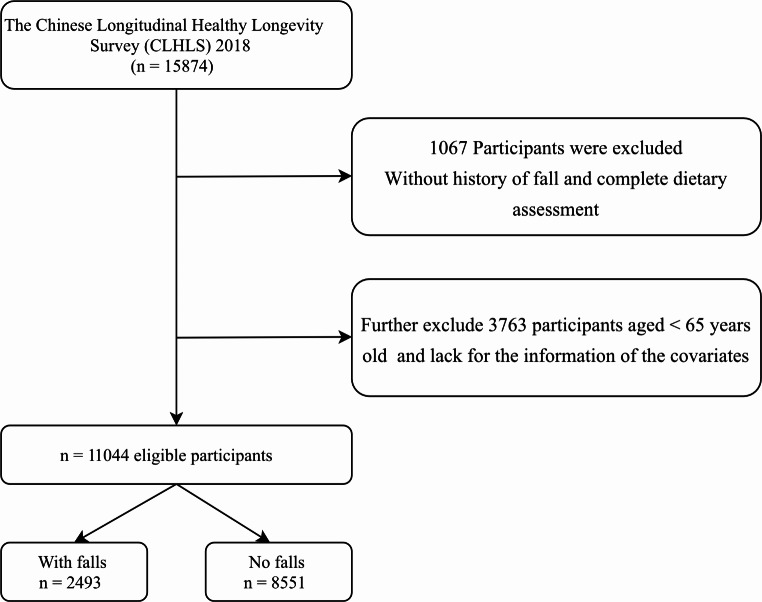
We included individuals over 65 years from the Chinese Longitudinal Healthy Longevity Survey (CLHLS) recruited in 2018 with information on falls and dietary assessments, finally 11,044 participants were eligible.
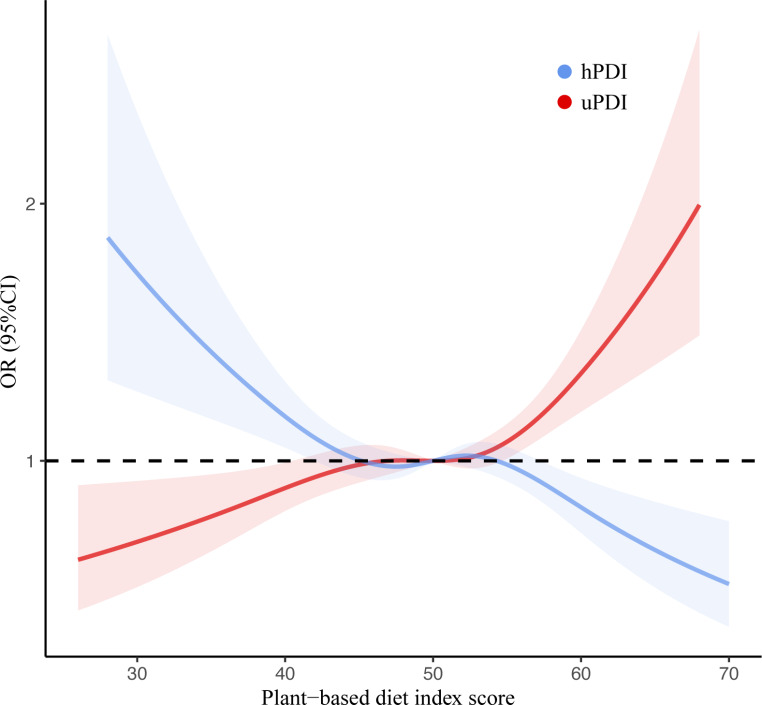
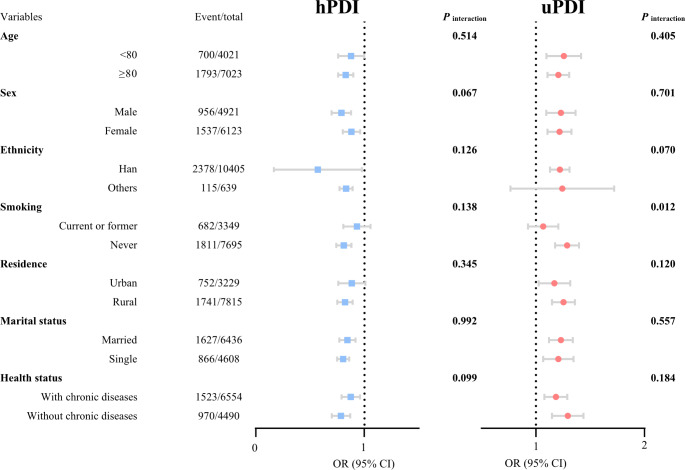
Using food frequency questionnaire (FFQ), we calculated plant-based index scores categorized as unhealthy plant-based index (uPDI) and healthy plant-based index (hPDI). The primary outcome was falls obtained from questionnaire. Statistical analysis was performed utilizing logistic regression model to investigate the relationship between the plant-based diet indices and falls. We also used the subgroup analysis to investigate the interaction of falls and plant-based diet index (PDI) among different status and used the restricted cubic spline (RCS) curves to investigate the connection between the PDI scores and falls risk.
Among 11,044 participants included in our study, a total of 2493 fall cases were observed. The logistic regression analysis revealed that the plant-based index related to falls. In the adjusted model, per 10-unit increment of hPDI has a significant decreased risk of falls (odd ratio [OR]: 0.85, 95% confidence interval [CI]: 0.79-0.91, P for trend < 0.001) and per 10-unit increment in uPDI increased the risk of falls (OR: 1.21, 95% CI: 1.13-1.30, P for trend < 0.001). We also revealed an interaction between smoking status and falls among the uPDI group (P = 0.012). Finally, we found that with plant-based index scores increased, the odds of falls among hPDI decreased (P for overall < 0.001, P nonlinear = 0.0239), and the odds of falls among uPDI increased (P for overall < 0.001, P nonlinear = 0.0332).
We found significant association between the Plant-based diet index and the risk of falls, highlighting the key role of the consumption of nutritious plant-based foods on the risk of falls, which needed take into account in developing intervention and prevention strategies to decrease falls among older Chinese adults.
流行病学研究表明,跌倒发生率随年龄增长而下降,最近的研究发现营养摄入与跌倒风险之间存在关联。然而,不同植物性饮食与老年人跌倒风险之间的关系仍不清楚。我们的研究旨在评估各种植物性饮食指数与跌倒发生之间的相关性。
这是一项来自全国队列研究的横断面和事后分析研究。
我们纳入了来自中国长寿纵向研究(CLHLS)中 2018 年招募的 65 岁以上的个体,这些个体有跌倒和饮食评估的信息,最终有 11044 名参与者符合条件。
使用食物频率问卷(FFQ),我们计算了植物性饮食指数评分,分为不健康植物性饮食指数(uPDI)和健康植物性饮食指数(hPDI)。主要结局是通过问卷获得的跌倒。使用逻辑回归模型分析植物性饮食指数与跌倒之间的关系。我们还使用亚组分析来研究不同状态下跌倒和植物性饮食指数(PDI)之间的相互作用,并使用限制立方样条(RCS)曲线来研究 PDI 评分与跌倒风险之间的关系。
在我们的研究中,纳入了 11044 名参与者,其中共有 2493 例跌倒事件。逻辑回归分析显示,植物性饮食指数与跌倒有关。在调整模型中,hPDI 每增加 10 个单位,跌倒的风险显著降低(比值比 [OR]:0.85,95%置信区间 [CI]:0.79-0.91,P 趋势<0.001),而 uPDI 每增加 10 个单位,跌倒的风险增加(OR:1.21,95%CI:1.13-1.30,P 趋势<0.001)。我们还发现 uPDI 组中吸烟状况与跌倒之间存在交互作用(P=0.012)。最后,我们发现随着植物性饮食指数得分的增加,hPDI 组的跌倒风险降低(整体 P<0.001,非线性 P=0.0239),uPDI 组的跌倒风险增加(整体 P<0.001,非线性 P=0.0332)。
我们发现植物性饮食指数与跌倒风险之间存在显著关联,这强调了摄入营养丰富的植物性食物对降低中国老年人跌倒风险的重要作用,在制定干预和预防策略时需要考虑这一点,以降低中国老年人的跌倒风险。