Institute for Health & Equity, Medical College of Wisconsin, Milwaukee, 8701 W Watertown Plank Rd, Milwaukee, WI 53226 (
Institute for Health & Equity, Medical College of Wisconsin, Milwaukee.
Prev Chronic Dis. 2024 Sep 5;21:E68. doi: 10.5888/pcd21.240020.
Colorectal cancer (CRC) is the third most-diagnosed cancer among men and women in the US. This study aimed to evaluate the influence of an interactive inflatable colon exhibit on CRC knowledge and screening intent among men attending state fairs in 2 midwestern states.
At the 2023 state fairs in 2 midwestern states, eligible participants (men aged 18-75 y who could speak and read English and resided in 1 of the 2 states) completed a presurvey, an unguided tour of the inflatable Super Colon, and a postsurvey. Primary outcomes were changes in knowledge (actual and perceived) and CRC screening intent from presurvey to postsurvey. We used χ tests to examine differences in survey results between the 2 sites and the association between demographic characteristics and behaviors (knowledge and intentions) before entering the Super Colon exhibit. We used the McNemar test to examine differences in presurvey to postsurvey distributions.
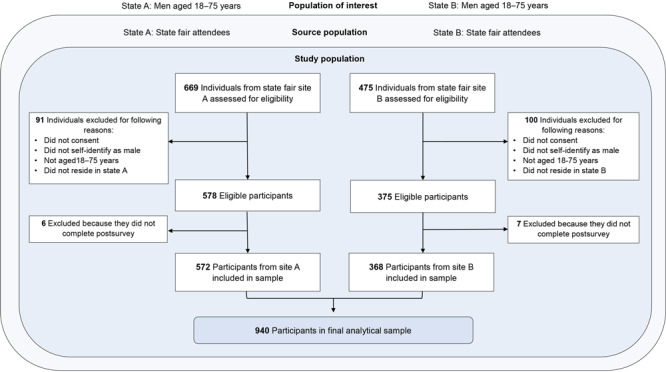
The study sample (N = 940) comprised 572 men at site A (60.8%) and 368 men at site B (39.2%). Except for 1 question, baseline CRC knowledge was relatively high. Greater perceived knowledge was inversely associated with greater actual knowledge. After touring the Super Colon, participants improved their actual knowledge of CRC prevention and self-perceived CRC knowledge. Most participants (95.4%) agreed that the Super Colon was effective for teaching people about CRC.
These findings emphasize the role of community-based educational initiatives in encouraging CRC screening uptake and increasing research participation among men and affirm that the inflatable colon is as an effective educational tool for increasing CRC knowledge and encouraging early-detection screening behavior among men.
在美国,男性和女性中结肠癌(CRC)是第三大常见癌症。本研究旨在评估互动式可充气结肠展览对参加中西部 2 个州博览会的男性 CRC 知识和筛查意向的影响。
在中西部 2 个州的 2023 年博览会上,符合条件的参与者(年龄在 18-75 岁之间,能够说和读英语,并且居住在这 2 个州中的 1 个州的男性)完成了预调查、对充气超级结肠的无指导参观和后调查。主要结果是从预调查到后调查知识(实际和感知)和 CRC 筛查意向的变化。我们使用 χ 检验来检验 2 个地点之间调查结果的差异,以及进入超级结肠展览之前人口统计学特征和行为(知识和意向)之间的关联。我们使用 McNemar 检验来检验预调查到后调查分布的差异。
研究样本(N = 940)包括 A 点的 572 名男性(60.8%)和 B 点的 368 名男性(39.2%)。除了 1 个问题外,CRC 知识的基线相对较高。感知知识的增加与实际知识的增加呈反比。参观超级结肠后,参与者提高了对 CRC 预防的实际知识和自我感知的 CRC 知识。大多数参与者(95.4%)认为超级结肠在教授人们有关 CRC 方面是有效的。
这些发现强调了基于社区的教育计划在鼓励 CRC 筛查参与和增加男性参与研究方面的作用,并肯定了充气结肠是一种有效的教育工具,可提高男性对 CRC 的知识,并鼓励早期检测筛查行为。