Petrick Jessica L, Barber Lauren E, Warren Andersen Shaneda, Florio Andrea A, Palmer Julie R, Rosenberg Lynn
Slone Epidemiology Center at Boston University, Boston, MA, United States.
Department of Epidemiology, Boston University School of Public Health, Boston, MA, United States.
Front Oncol. 2021 Sep 9;11:734998. doi: 10.3389/fonc.2021.734998. eCollection 2021.
Colorectal cancer (CRC) incidence rates have increased in younger individuals worldwide. We examined the most recent early- and late-onset CRC rates for the US.
Age-standardized incidence rates (ASIR, per 100,000) of CRC were calculated using the US Cancer Statistics Database's high-quality population-based cancer registry data from the entire US population. Results were cross-classified by age (20-49 [early-onset] and 50-74 years [late-onset]), race/ethnicity (non-Hispanic White, non-Hispanic Black, Hispanic, American Indian/Alaskan Native, Asian/Pacific Islander), sex, anatomic location (proximal, distal, rectal), and histology (adenocarcinoma, neuroendocrine).
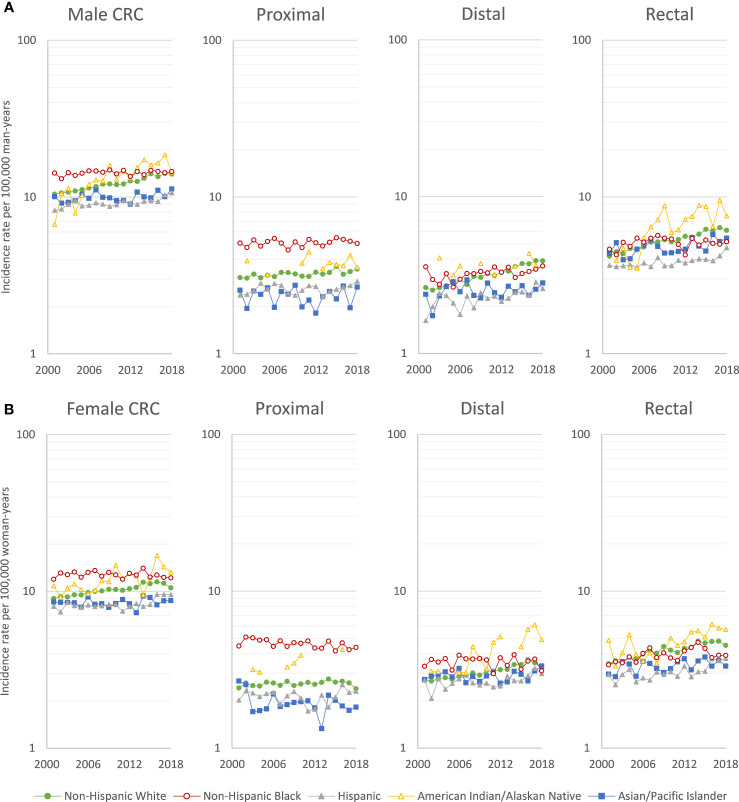
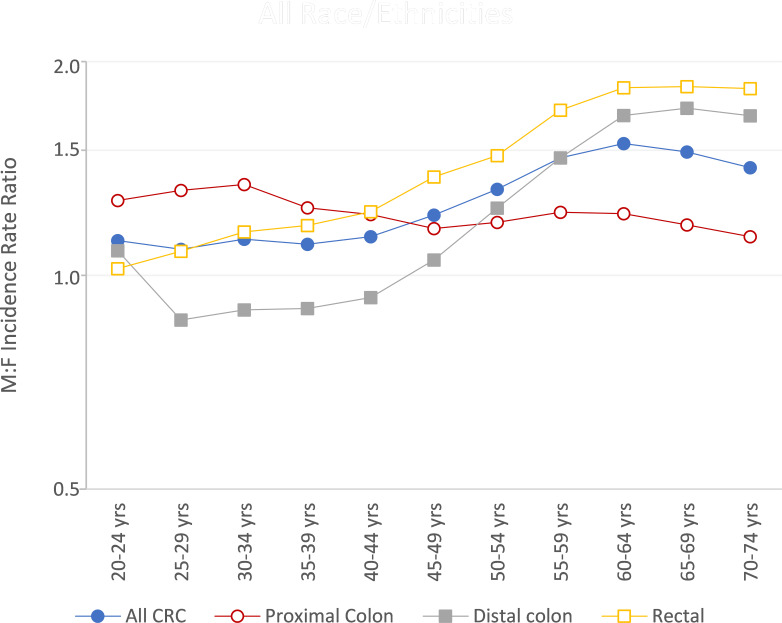
During 2001 through 2018, early-onset CRC rates significantly increased among American Indians/Alaskan Natives, Hispanics, and Whites. Compared to Whites, early-onset CRC rates are now 21% higher in American Indians/Alaskan Natives and 6% higher in Blacks. Rates of early-onset colorectal neuroendocrine tumors have increased in Whites, Blacks, and Hispanics; early-onset colorectal neuroendocrine tumor rates are 2-times higher in Blacks compared to Whites. Late-onset colorectal adenocarcinoma rates are decreasing, while late-onset colorectal neuroendocrine tumor rates are increasing, in all racial/ethnic groups. Late-onset CRC rates remain 29% higher in Blacks and 15% higher in American Indians/Alaskan Natives compared to Whites. Overall, CRC incidence was higher in men than women, but incidence of early-onset distal colon cancer was higher in women.
The early-onset CRC disparity between Blacks and Whites has decreased, due to increasing rates in Whites-rates in Blacks have remained stable. However, rates of colorectal neuroendocrine tumors are increasing in Blacks. Blacks and American Indians/Alaskan Natives have the highest rates of both early- and late-onset CRC.
Ongoing prevention efforts must ensure access to and uptake of CRC screening for Blacks and American Indians/Alaskan Natives.
全球范围内,年轻个体的结直肠癌(CRC)发病率有所上升。我们研究了美国最新的早发性和晚发性CRC发病率。
使用美国癌症统计数据库中来自全美国人口的高质量基于人群的癌症登记数据,计算CRC的年龄标准化发病率(ASIR,每10万人)。结果按年龄(20 - 49岁[早发性]和50 - 74岁[晚发性])、种族/族裔(非西班牙裔白人、非西班牙裔黑人、西班牙裔、美国印第安人/阿拉斯加原住民、亚裔/太平洋岛民)、性别、解剖位置(近端、远端、直肠)和组织学(腺癌、神经内分泌)进行交叉分类。
在2001年至2018年期间,美国印第安人/阿拉斯加原住民、西班牙裔和白人的早发性CRC发病率显著上升。与白人相比,美国印第安人/阿拉斯加原住民的早发性CRC发病率现在高出21%,黑人高出6%。白人、黑人和西班牙裔的早发性结直肠神经内分泌肿瘤发病率均有所上升;黑人的早发性结直肠神经内分泌肿瘤发病率是白人的2倍。在所有种族/族裔群体中,晚发性结直肠腺癌发病率在下降,而晚发性结直肠神经内分泌肿瘤发病率在上升。与白人相比,黑人的晚发性CRC发病率仍高出29%,美国印第安人/阿拉斯加原住民高出15%。总体而言,CRC发病率男性高于女性,但早发性远端结肠癌发病率女性更高。
由于白人发病率上升而黑人发病率保持稳定,黑人和白人之间的早发性CRC差距有所缩小。然而,黑人的结直肠神经内分泌肿瘤发病率在上升。黑人和美国印第安人/阿拉斯加原住民的早发性和晚发性CRC发病率最高。
正在进行的预防工作必须确保黑人和美国印第安人/阿拉斯加原住民能够获得并接受CRC筛查。