Department of Public Health, Mohammed VI Center for Research and Innovation, Rabat, Morocco.
Mohammed VI International School of Public Health, Mohammed VI University of Sciences and Health, Casablanca, Morocco.
BMC Geriatr. 2024 Sep 5;24(1):737. doi: 10.1186/s12877-024-05288-4.
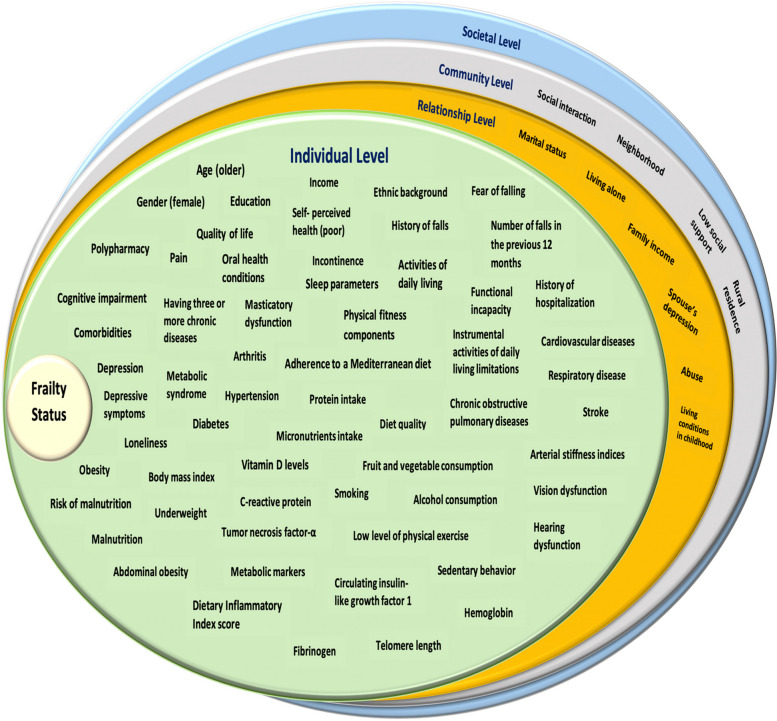
The number of frail older people is increasing worldwide, and all countries will be confronted with their growing needs for healthcare and social support. The aim of this umbrella review was to summarize the evidence on the factors associated with frailty in older people, using a socioecological approach.
PubMed (MEDLINE), Scopus, Web of Science, ScienceDirect, Hinari (research4life), and the Trip database were systematically searched up to April 2023. Systematic reviews of observational studies that explored factors associated with frailty in older adults aged 60 years and over were considered for inclusion. No language, geographical or setting restrictions were applied. However, we excluded systematic reviews that investigated frailty factors in the context of specific diseases. The Joanna Briggs Institute Critical Appraisal Checklist for Systematic Reviews and Research Syntheses and the ROBIS tool were used to assess the quality and risk of bias in the included studies.
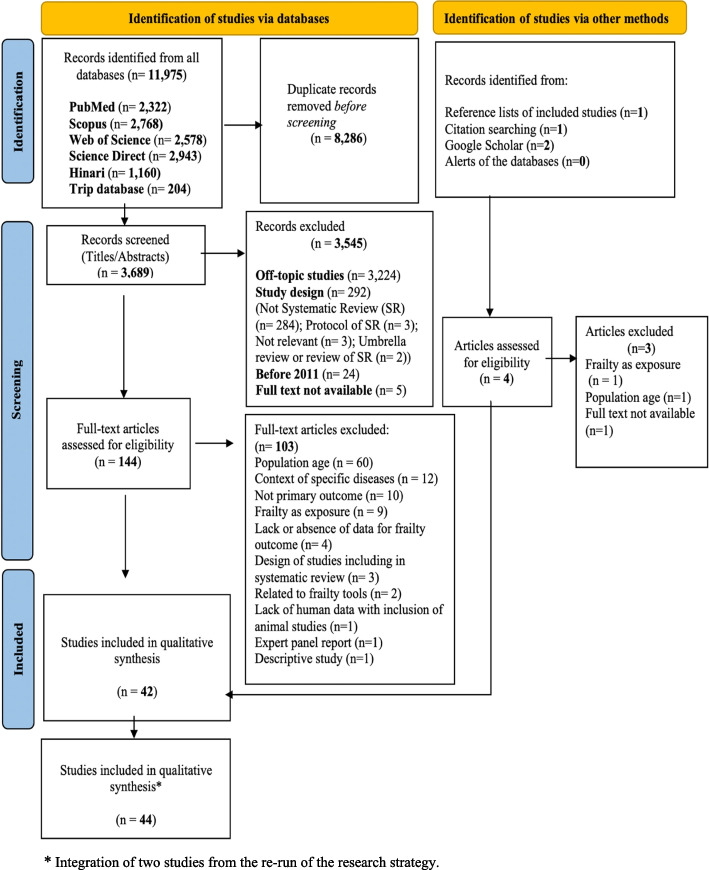
Forty-four systematic reviews were included, covering 1,150 primary studies with approximately 2,687,911 participants overall. Several risk factors, protective factors and biomarkers were found to be associated with frailty, especially in community-dwelling older people, including 67 significant associations from meta-analyses. The certainty of the evidence was rated as moderate or reached moderate levels for seven factors relevant to older people. These factors include depression (OR 4.66, 95% CI 4.07 to 5.34), loneliness (OR 3.51, 95% CI 2.70 to 4.56), limitations in activities of daily living (OR 2.59, 95% CI 1.71 to 3.48), risk of malnutrition (OR 3.52, 95% CI 2.96 to 4.17), Dietary Inflammatory Index score (OR 1.24, 95% CI 1.16 to 1.33), maximal walking speed (Standardized Mean Difference (SMD) -0.97, 95% CI -1.25 to -0.68), and self-reported masticatory dysfunction (OR 1.83, 95% CI 1.55 to 2.18). Additionally, only greater adherence to a Mediterranean diet showed a high level of evidence (OR 0.44, 95% CI 0.31 to 0.64).
This umbrella review will provide guidance for prevention strategies and clinical practice by promoting healthy lifestyles and addressing all modifiable risk factors associated with frailty. Future systematic reviews should consider heterogeneity and publication bias, as these were the main reasons for downgrading the level of evidence in our review.
PROSPERO 2022, CRD42022328902.
全球衰弱老年人的数量正在增加,所有国家都将面临他们对医疗保健和社会支持日益增长的需求。本伞式综述的目的是使用社会生态学方法总结与老年人衰弱相关的因素的证据。
系统检索了PubMed(医学文献在线数据库)、Scopus、Web of Science、ScienceDirect、Hinari(研究共享)和 Trip 数据库,截至 2023 年 4 月。纳入了系统综述观察性研究,探讨了 60 岁及以上老年人衰弱的相关因素。未对语言、地理或研究环境进行限制。但是,我们排除了专门研究特定疾病背景下衰弱因素的系统综述。采用 Joanna Briggs 研究所的系统评价和综合研究的批判性评估清单以及 ROBIS 工具来评估纳入研究的质量和偏倚风险。
共纳入 44 项系统综述,涵盖了 1150 项初级研究,总共有大约 2687911 名参与者。发现了一些与衰弱相关的风险因素、保护因素和生物标志物,尤其是在社区居住的老年人中,包括 67 项来自荟萃分析的显著关联。与老年人相关的七个因素的证据确定性被评为中度或达到中度水平。这些因素包括抑郁(OR 4.66,95%CI 4.07 至 5.34)、孤独(OR 3.51,95%CI 2.70 至 4.56)、日常生活活动受限(OR 2.59,95%CI 1.71 至 3.48)、营养不良风险(OR 3.52,95%CI 2.96 至 4.17)、饮食炎症指数评分(OR 1.24,95%CI 1.16 至 1.33)、最大步行速度(标准化均数差(SMD)-0.97,95%CI -1.25 至 -0.68)和自我报告的咀嚼功能障碍(OR 1.83,95%CI 1.55 至 2.18)。此外,只有更高的地中海饮食依从性显示出高水平的证据(OR 0.44,95%CI 0.31 至 0.64)。
本伞式综述将通过促进健康的生活方式和解决与衰弱相关的所有可改变的风险因素,为预防策略和临床实践提供指导。未来的系统综述应考虑异质性和发表偏倚,因为这是我们综述中降低证据水平的主要原因。
PROSPERO 2022,CRD42022328902。