University of Vermont Tobacco Center of Regulatory Science, University of Vermont, Burlington.
Center for Alcohol and Addiction Studies, Brown University, Providence, Rhode Island.
JAMA Netw Open. 2024 Sep 3;7(9):e2431731. doi: 10.1001/jamanetworkopen.2024.31731.
Prohibiting the sale of commonly preferred e-cigarette flavors (eg, fruity and sweet) to discourage use among youths poses a risk of diminishing efforts to decrease smoking in adults.
To compare reductions in smoking achieved in adults with psychiatric conditions or lower educational level using very low nicotine content (VLNC) cigarettes alone, combined with e-cigarettes limited to tobacco flavor (TF), or combined with e-cigarettes in participant-preferred flavors.
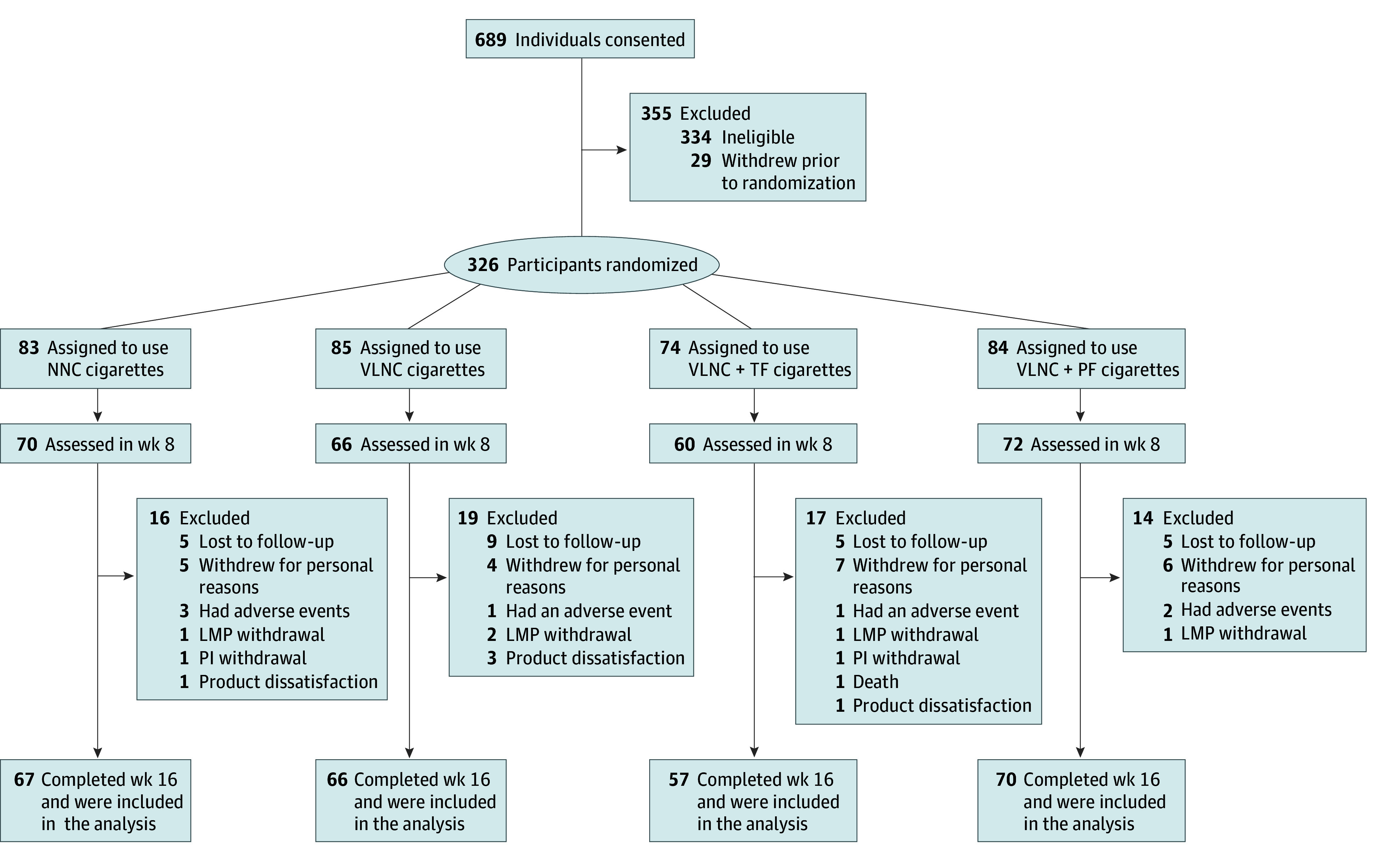
DESIGN, SETTING, AND PARTICIPANTS: Three randomized clinical trials were conducted for 16 weeks from October 2020 through November 2023 at the University of Vermont, Brown University, and Johns Hopkins University. Participants were adults who smoked daily and were not planning to quit in the next 30 days. These participants were from 3 at-risk populations: those with affective disorders, exemplifying mental illness; those with opioid use disorder, exemplifying substance use disorders; and females of reproductive age with a high-school education or less, exemplifying lower educational level. Participants were randomly assigned to 1 of 4 experimental conditions: (1) normal nicotine content (NNC) cigarettes only; (2) VLNC cigarettes only; (3) VLNC cigarettes plus e-cigarettes with classic TF (hereafter, VLNC + TF); and (4) VLNC cigarettes plus e-cigarettes with preferred flavors (hereafter, VLNC + PF).
The NNC cigarettes contained 15.8 mg nicotine/g tobacco, the VLNC cigarettes contained 0.4 mg nicotine/g tobacco, the VLNC + TF had pods containing 5% nicotine by weight and only classic TF, and the VLNC + PF had pods containing 5% nicotine in 8 flavors (including fruity and sweet) from which participants selected 3 flavors.
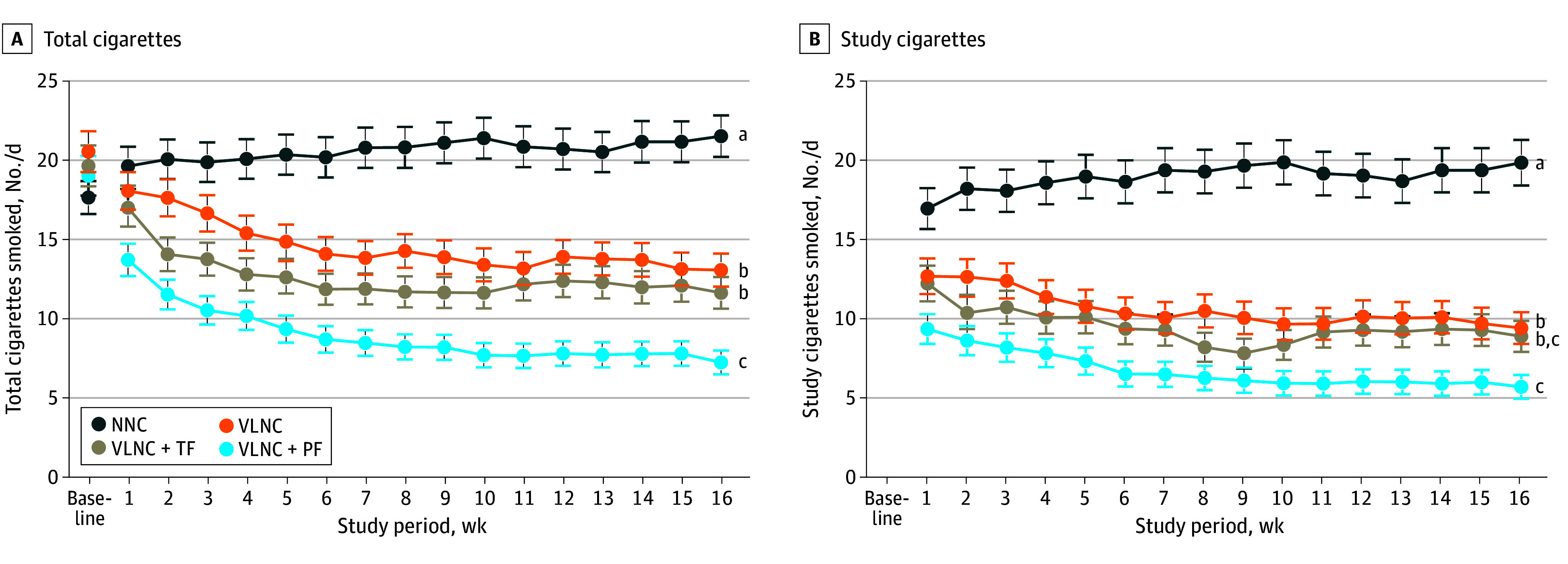
The primary outcome was mean total cigarettes smoked per day (CPD) during week 16. Tobacco-related biomarkers were assessed, including total 4-(methylnitrosamino)-1-(3-pyridyl)-1-butanol (NNAL), a tobacco-specific carcinogen.
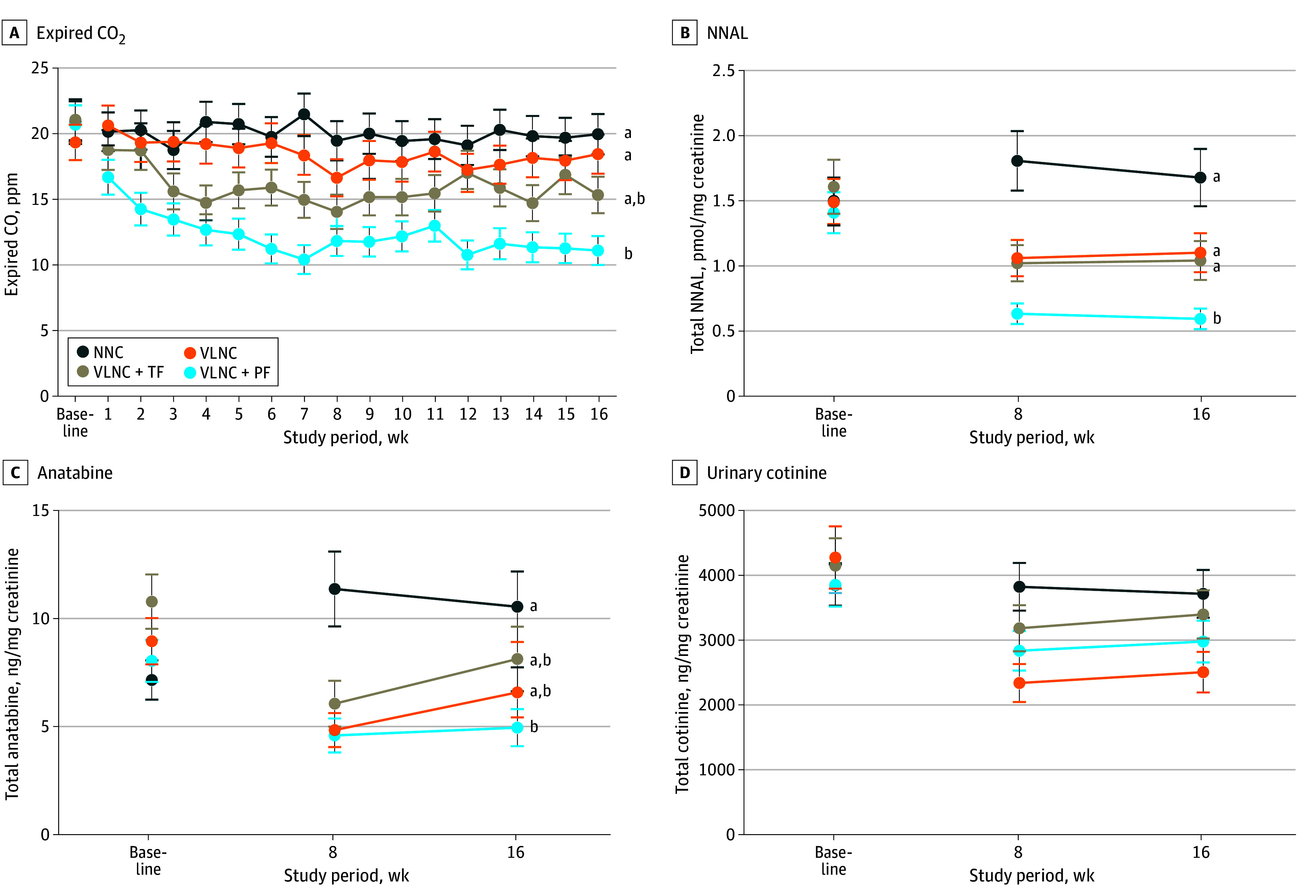
A total of 326 participants (mean [SD] age, 40.09 [10.79] years; 243 females [74.5%]) from 3 randomized clinical trials were included. The VLNC cigarettes decreased total CPD, with least square (LS) means (SEMs) of 22.54 (1.59) in the NNC, 14.32 (1.32) in the VLNC, 11.76 (1.18) in the VLNC + TF, and 7.63 (0.90) in the VLNC + PF conditions. Each VLNC condition differed significantly from NNC, with an adjusted mean difference (AMD) of -8.21 (95% CI, -12.27 to -4.16; P < .001) in the VLNC, -10.78 (95% CI, -14.67 to -6.90; P < .001) in the VLNC + TF, and -14.91 (95% CI, -18.49 to -11.33; P < .001) in the VLNC + PF conditions. Participants in the VLNC + PF condition also decreased smoking below the VLNC and the VLNC + TF conditions (AMDs, -6.70 [95% CI, -9.84 to -3.55; P < .001] and -4.13 [95% CI, -7.05 to -1.21; P = .02]); the VLNC and VLNC + TF conditions did not differ significantly. Consistent with decreases in CPD, NNAL levels in the VLNC + PF condition were lower than in all other conditions, with AMDs (in pmol/mg creatinine) of -0.94 (95% CI, -1.41 to -0.47; P < .001) compared with the NNC condition, -0.47 (95% CI, -0.87 to -0.08; P = .03) compared with the VLNC condition, and -0.46 (95% CI, -0.83 to -0.10; P = .04) compared with the VLNC + TF condition.
These results provide further evidence that a reduced-nicotine standard for cigarettes has the potential to decrease smoking and tobacco-toxicant exposure in high-risk populations and that these effects may be enhanced when adults can access e-cigarettes in commonly preferred flavors.
ClinicalTrials.gov Identifiers: NCT04092387, NCT04090879, NCT04092101.
禁止销售通常更受青少年欢迎的电子烟口味(例如水果味和甜味),以阻止青少年使用电子烟,这可能会减少成年人的吸烟率。
比较使用极低尼古丁含量(VLNC)香烟单独、与仅限于烟草口味(TF)的电子烟结合、或与参与者偏好的口味电子烟结合,在有精神疾病或教育程度较低的成年人中减少吸烟的效果。
设计、地点和参与者:三项随机临床试验于 2020 年 10 月至 2023 年 11 月在佛蒙特大学、布朗大学和约翰霍普金斯大学进行了 16 周。参与者是每天吸烟且计划在未来 30 天内不戒烟的成年人。这些参与者来自三个高风险人群:有情感障碍的人群,代表有精神疾病;有阿片类药物使用障碍的人群,代表有物质使用障碍;以及有高中教育或以下学历的育龄女性,代表教育程度较低。参与者被随机分配到以下 4 个实验组之一:(1)仅含尼古丁含量正常的香烟;(2)仅含 VLNC 香烟;(3)VLNC 香烟加经典 TF 电子烟;(4)VLNC 香烟加参与者偏好的口味电子烟。
含尼古丁含量正常的香烟含有 15.8mg 尼古丁/克烟草,VLNC 香烟含有 0.4mg 尼古丁/克烟草,VLNC+TF 电子烟含有 5%尼古丁(按重量计),仅含经典 TF 口味,VLNC+PF 电子烟含有 5%尼古丁,有 8 种口味(包括水果味和甜味)供参与者选择 3 种口味。
主要结果是第 16 周时平均每天吸烟量(CPD)。评估了与烟草相关的生物标志物,包括总 4-(甲基亚硝氨基)-1-(3-吡啶基)-1-丁醇(NNAL),一种烟草特异性致癌物质。
共纳入了来自 3 项随机临床试验的 326 名参与者(平均年龄 [标准差],40.09 [10.79] 岁;243 名女性 [74.5%])。VLNC 香烟减少了总 CPD,在 NNC 条件下的 LS 均值(SEM)为 22.54(1.59),在 VLNC 条件下为 14.32(1.32),在 VLNC+TF 条件下为 11.76(1.18),在 VLNC+PF 条件下为 7.63(0.90)。VLNC 条件下的每种情况与 NNC 条件下的情况均有显著差异,调整后的平均差异(AMD)为-8.21(95%CI,-12.27 至-4.16;P<0.001)在 VLNC 条件下,-10.78(95%CI,-14.67 至-6.90;P<0.001)在 VLNC+TF 条件下,和-14.91(95%CI,-18.49 至-11.33;P<0.001)在 VLNC+PF 条件下。VLNC+PF 条件下的参与者的吸烟量也低于 VLNC 和 VLNC+TF 条件(AMDs,-6.70 [95%CI,-9.84 至-3.55;P<0.001] 和-4.13 [95%CI,-7.05 至-1.21;P=0.02]);VLNC 和 VLNC+TF 条件之间没有显著差异。与 CPD 的减少一致,VLNC+PF 条件下的 NNAL 水平低于其他所有条件,与 NNC 条件相比,AMDs(pmol/mg 肌酐)为-0.94(95%CI,-1.41 至-0.47;P<0.001),与 VLNC 条件相比为-0.47(95%CI,-0.87 至-0.08;P=0.03),与 VLNC+TF 条件相比为-0.46(95%CI,-0.83 至-0.10;P=0.04)。
这些结果进一步证明,降低香烟中的尼古丁标准有可能减少高危人群的吸烟和烟草毒性暴露,当成年人可以获得他们通常喜欢的电子烟口味时,这些效果可能会增强。
ClinicalTrials.gov 标识符:NCT04092387、NCT04090879、NCT04092101。