Department of International Health, Johns Hopkins Bloomberg School of Public Health, Baltimore, MD, USA.
Department of Epidemiology, Johns Hopkins Bloomberg School of Public Health, Baltimore, MD, USA.
Int J Epidemiol. 2024 Aug 14;53(5). doi: 10.1093/ije/dyae118.
The impact of migration on HIV risk among non-migrating household members is poorly understood. We measured HIV incidence among non-migrants living in households with and without migrants in Uganda.
We used four survey rounds of data collected from July 2011 to May 2018 from non-migrant participants aged 15-49 years in the Rakai Community Cohort Study. Non-migrants were individuals with no-migration between surveys or at the prior survey. Household migration was defined as ≥1 household member migrating into or out of the house from another community between surveys (∼18 months). Incident HIV was defined as testing HIV seropositive following a negative result. Incidence rate ratios (IRRs) were estimated using Poisson regression with generalized estimating equations. Analyses were stratified by gender, migration into or out of the household and the relationship between non-migrants and migrants (e.g. spouse, child).
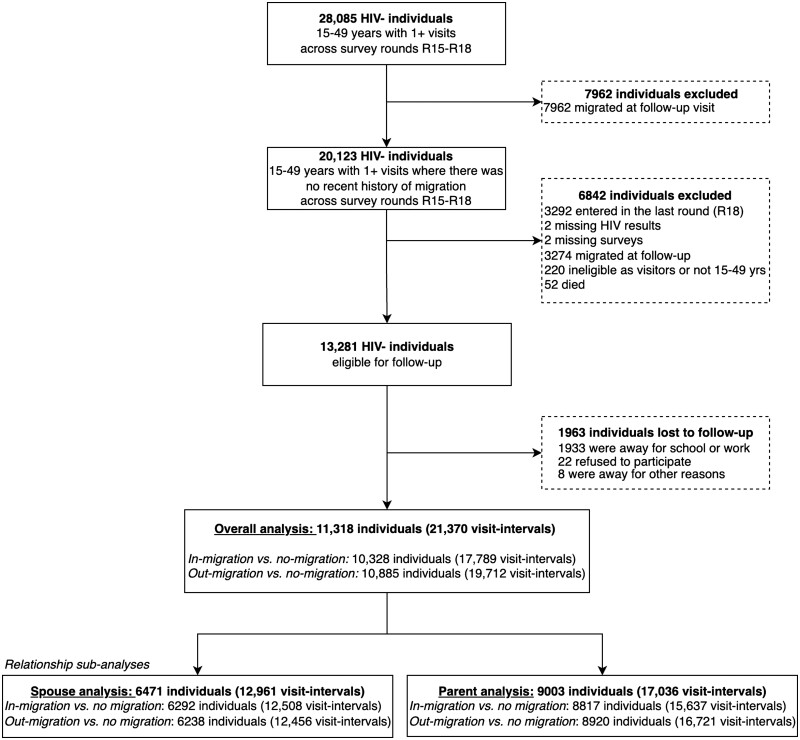
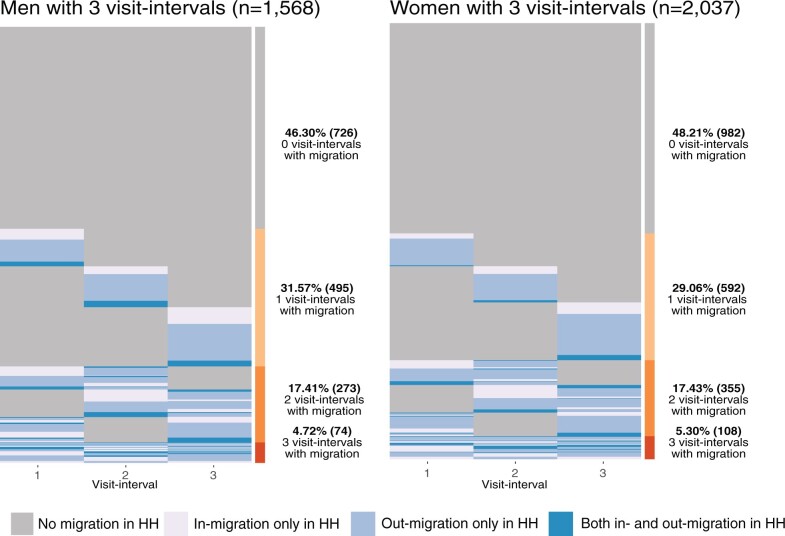
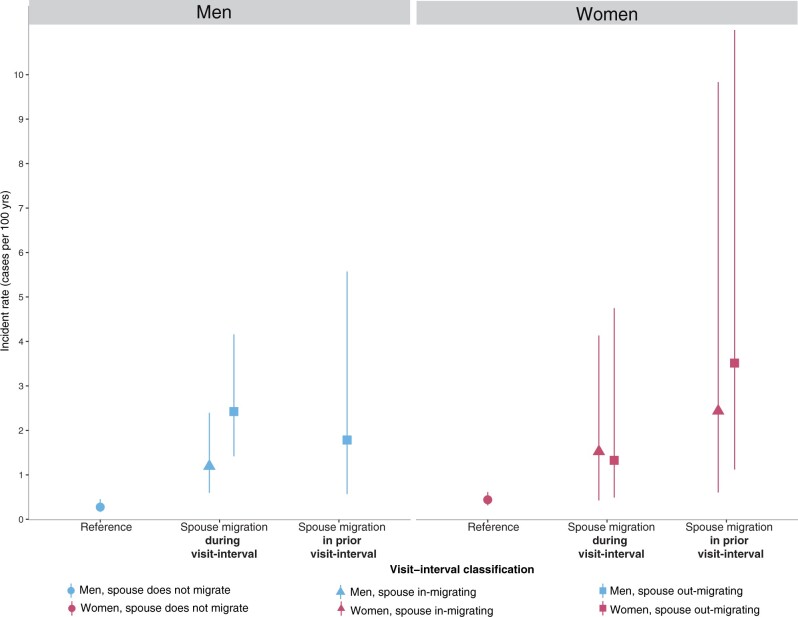
About 11 318 non-migrants (5674 women) were followed for 37 320 person-years. Twenty-eight percent (6059/21 370) of non-migrant person-visits had recent migration into or out of the household, and 240 HIV incident cases were identified. Overall, non-migrants in migrant households were not at greater risk of acquiring HIV than non-migrants in households without any migration. However, men were significantly more likely to acquire HIV if their spouse had recently migrated in [adjusted IRR: 2.12; 95% confidence interval (CI): 1.05-4.27] or out (adjusted IRR: 4.01; 95% CI, 2.16-7.44) compared with men with no spousal migration.
HIV incidence is higher among non-migrant men with migrant spouses. Targeted HIV testing and prevention interventions like pre-exposure prophylaxis could be considered for men with migrant spouses.
移民对非移民家庭成员中 HIV 风险的影响尚未得到充分了解。我们在乌干达,对居住在有移民和无移民家庭中的非移民人群,测量了 HIV 发病率。
我们使用了 2011 年 7 月至 2018 年 5 月期间,从 Rakai 社区队列研究中,收集的四组非移民参与者的调查数据,参与者年龄在 15-49 岁之间。非移民是指在调查之间或在上一次调查中没有迁移的个体。家庭迁移定义为在调查期间(约 18 个月),≥1 名家庭成员从另一个社区迁入或迁出家庭。新发 HIV 定义为在阴性结果后 HIV 血清学检测呈阳性。使用广义估计方程的泊松回归估计发病率比值比(IRR)。分析按照性别、家庭内迁入或迁出以及非移民和移民(如配偶、子女)之间的关系进行分层。
大约有 11318 名非移民(5674 名女性)随访了 37320 人年。28%(6059/21370)的非移民人次访中有最近的家庭内迁入或迁出,发现了 240 例 HIV 新发感染病例。总体而言,与没有任何迁移的家庭中的非移民相比,非移民在移民家庭中感染 HIV 的风险没有增加。然而,与没有配偶迁移的男性相比,如果其配偶最近有迁入(调整后的 IRR:2.12;95%置信区间[CI]:1.05-4.27)或迁出(调整后的 IRR:4.01;95% CI,2.16-7.44),男性感染 HIV 的风险显著更高。
有移民配偶的非移民男性 HIV 发病率更高。针对有移民配偶的男性,可以考虑进行 HIV 检测和预防干预措施,如暴露前预防。