• 文献检索
  • 文档翻译
  • 深度研究
  • 学术资讯
  • Suppr Zotero 插件Zotero 插件
  • 邀请有礼
  • 套餐&价格
  • 历史记录
应用&插件
Suppr Zotero 插件Zotero 插件浏览器插件Mac 客户端Windows 客户端微信小程序
定价
高级版会员购买积分包购买API积分包
服务
文献检索文档翻译深度研究API 文档MCP 服务
关于我们
关于 Suppr公司介绍联系我们用户协议隐私条款
关注我们

Suppr 超能文献

核心技术专利:CN118964589B侵权必究
粤ICP备2023148730 号-1Suppr @ 2026

文献检索

告别复杂PubMed语法,用中文像聊天一样搜索,搜遍4000万医学文献。AI智能推荐,让科研检索更轻松。

立即免费搜索

文件翻译

保留排版,准确专业,支持PDF/Word/PPT等文件格式,支持 12+语言互译。

免费翻译文档

深度研究

AI帮你快速写综述,25分钟生成高质量综述,智能提取关键信息,辅助科研写作。

立即免费体验

使用更短的扫描协议、优化的磁体冷却模式和深度学习序列来降低肌肉骨骼MRI中的能量消耗。

Reducing energy consumption in musculoskeletal MRI using shorter scan protocols, optimized magnet cooling patterns, and deep learning sequences.

作者信息

Afat Saif, Wohlers Julian, Herrmann Judith, Brendlin Andreas S, Gassenmaier Sebastian, Almansour Haidara, Werner Sebastian, Brendel Jan M, Mika Alexander, Scherieble Christoph, Notohamiprodjo Mike, Gatidis Sergios, Nikolaou Konstantin, Küstner Thomas

机构信息

Department of Radiology, Tuebingen University Hospital, University of Tuebingen, Tuebingen, Germany.

Department of Magnetic Resonance Product Management, Siemens Healthineers, Erlangen, Germany.

出版信息

Eur Radiol. 2025 Apr;35(4):1993-2004. doi: 10.1007/s00330-024-11056-0. Epub 2024 Sep 7.

DOI:10.1007/s00330-024-11056-0
PMID:39242400
原文链接:https://pmc.ncbi.nlm.nih.gov/articles/PMC11914325/
Abstract

OBJECTIVES

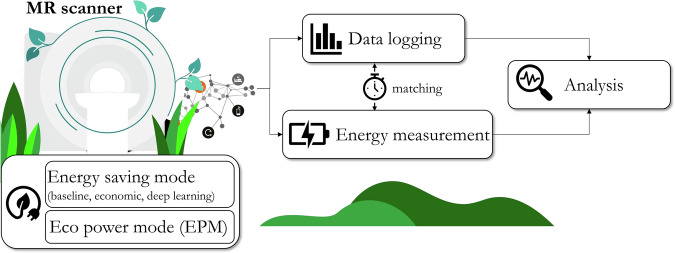
The unprecedented surge in energy costs in Europe, coupled with the significant energy consumption of MRI scanners in radiology departments, necessitates exploring strategies to optimize energy usage without compromising efficiency or image quality. This study investigates MR energy consumption and identifies strategies for improving energy efficiency, focusing on musculoskeletal MRI. We assess the potential savings achievable through (1) optimizing protocols, (2) incorporating deep learning (DL) accelerated acquisitions, and (3) optimizing the cooling system.

MATERIALS AND METHODS

Energy consumption measurements were performed on two MRI scanners (1.5-T Aera, 1.5-T Sola) in practices in Munich, Germany, between December 2022 and March 2023. Three levels of energy reduction measures were implemented and compared to the baseline. Wilcoxon signed-rank test with Bonferroni correction was conducted to evaluate the impact of sequence scan times and energy consumption.

RESULTS

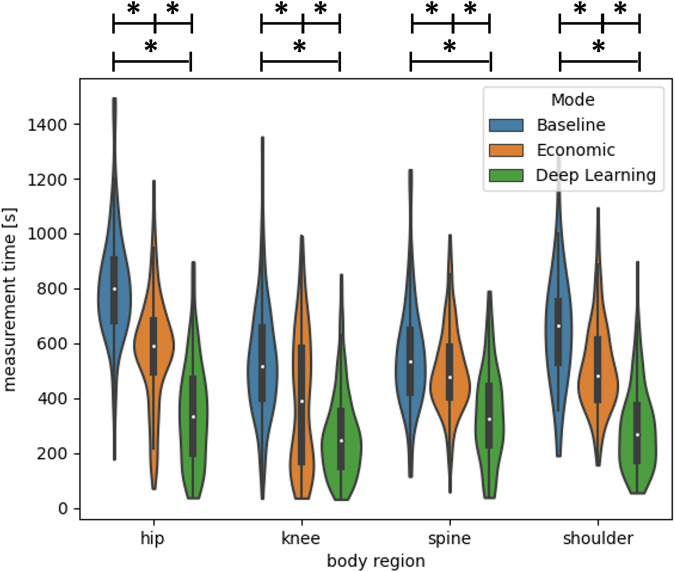
Our findings showed significant energy savings by optimizing protocol settings and implementing DL technologies. Across all body regions, the average reduction in energy consumption was 72% with DL and 31% with economic protocols, accompanied by time reductions of 71% (DL) and 18% (economic protocols) compared to baseline. Optimizing the cooling system during the non-scanning time showed a 30% lower energy consumption.

CONCLUSION

Implementing energy-saving strategies, including economic protocols, DL accelerated sequences, and optimized magnet cooling, can significantly reduce energy consumption in MRI scanners. Radiology departments and practices should consider adopting these strategies to improve energy efficiency and reduce costs.

CLINICAL RELEVANCE STATEMENT

MRI scanner energy consumption can be substantially reduced by incorporating protocol optimization, DL accelerated acquisition, and optimized magnetic cooling into daily practice, thereby cutting costs and environmental impact.

KEY POINTS

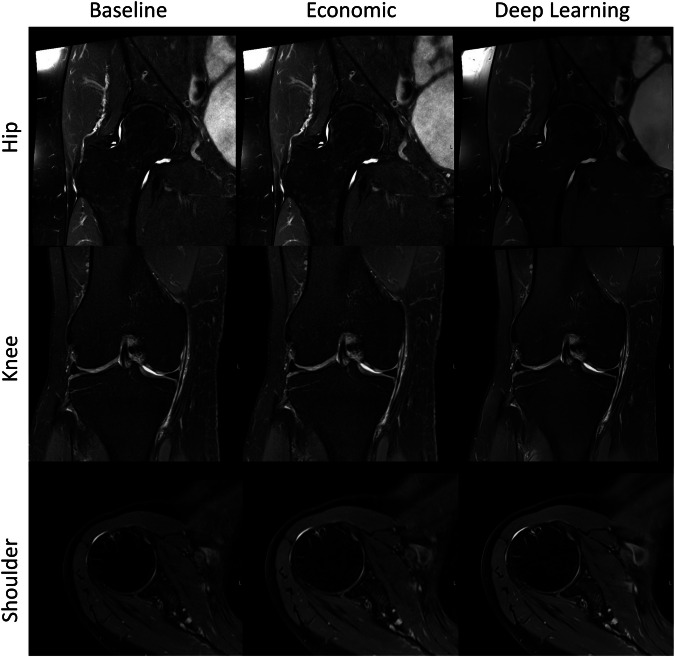
Optimization of protocol settings reduced energy consumption by 31% and imaging time by 18%. DL technologies led to a 72% reduction in energy consumption of and a 71% reduction in time, compared to the standard MRI protocol. During non-scanning times, activating Eco power mode (EPM) resulted in a 30% reduction in energy consumption, saving 4881 € ($5287) per scanner annually.

摘要

目的

欧洲能源成本前所未有的飙升,再加上放射科MRI扫描仪的大量能源消耗,使得有必要探索在不影响效率或图像质量的情况下优化能源使用的策略。本研究调查了MR能源消耗,并确定了提高能源效率的策略,重点是肌肉骨骼MRI。我们评估了通过以下方式可实现的潜在节能效果:(1)优化协议;(2)纳入深度学习(DL)加速采集;(3)优化冷却系统。

材料与方法

2022年12月至2023年3月期间,在德国慕尼黑的两家医疗机构对两台MRI扫描仪(1.5-T Aera、1.5-T Sola)进行了能源消耗测量。实施了三个级别的节能措施,并与基线进行比较。采用Bonferroni校正的Wilcoxon符号秩检验来评估序列扫描时间和能源消耗的影响。

结果

我们的研究结果表明,通过优化协议设置和实施DL技术可显著节能。在所有身体部位,DL使能源消耗平均降低72%,经济协议使能源消耗平均降低31%,与基线相比,时间分别减少了71%(DL)和18%(经济协议)。在非扫描时间优化冷却系统,能源消耗降低了30%。

结论

实施节能策略,包括经济协议、DL加速序列和优化的磁体冷却,可显著降低MRI扫描仪的能源消耗。放射科和医疗机构应考虑采用这些策略来提高能源效率并降低成本。

临床相关性声明

将协议优化、DL加速采集和优化的磁体冷却纳入日常实践可大幅降低MRI扫描仪的能源消耗,从而降低成本和环境影响。

关键点

协议设置的优化使能源消耗降低了31%,成像时间缩短了18%。与标准MRI协议相比,DL技术使能源消耗降低了72%,时间减少了71%。在非扫描时间激活节能模式(EPM)可使能源消耗降低30%,每台扫描仪每年节省4881欧元(5287美元)。
https://cdn.ncbi.nlm.nih.gov/pmc/blobs/1dbf/11914325/41995d34756c/330_2024_11056_Fig5_HTML.jpg
https://cdn.ncbi.nlm.nih.gov/pmc/blobs/1dbf/11914325/a083861718f1/330_2024_11056_Fig1_HTML.jpg
https://cdn.ncbi.nlm.nih.gov/pmc/blobs/1dbf/11914325/9505ff7e51d9/330_2024_11056_Fig2_HTML.jpg
https://cdn.ncbi.nlm.nih.gov/pmc/blobs/1dbf/11914325/33086924babe/330_2024_11056_Fig3_HTML.jpg
https://cdn.ncbi.nlm.nih.gov/pmc/blobs/1dbf/11914325/d2bd2b1dcbff/330_2024_11056_Fig4_HTML.jpg
https://cdn.ncbi.nlm.nih.gov/pmc/blobs/1dbf/11914325/41995d34756c/330_2024_11056_Fig5_HTML.jpg
https://cdn.ncbi.nlm.nih.gov/pmc/blobs/1dbf/11914325/a083861718f1/330_2024_11056_Fig1_HTML.jpg
https://cdn.ncbi.nlm.nih.gov/pmc/blobs/1dbf/11914325/9505ff7e51d9/330_2024_11056_Fig2_HTML.jpg
https://cdn.ncbi.nlm.nih.gov/pmc/blobs/1dbf/11914325/33086924babe/330_2024_11056_Fig3_HTML.jpg
https://cdn.ncbi.nlm.nih.gov/pmc/blobs/1dbf/11914325/d2bd2b1dcbff/330_2024_11056_Fig4_HTML.jpg
https://cdn.ncbi.nlm.nih.gov/pmc/blobs/1dbf/11914325/41995d34756c/330_2024_11056_Fig5_HTML.jpg

相似文献

1
Reducing energy consumption in musculoskeletal MRI using shorter scan protocols, optimized magnet cooling patterns, and deep learning sequences.使用更短的扫描协议、优化的磁体冷却模式和深度学习序列来降低肌肉骨骼MRI中的能量消耗。
Eur Radiol. 2025 Apr;35(4):1993-2004. doi: 10.1007/s00330-024-11056-0. Epub 2024 Sep 7.
2
Deep Learning-Enhanced Accelerated 2D TSE and 3D Superresolution Dixon TSE for Rapid Comprehensive Knee Joint Assessment.深度学习增强的加速二维快速自旋回波成像和三维超分辨率狄克逊快速自旋回波成像用于膝关节快速综合评估
Invest Radiol. 2025 Mar 1;60(3):220-233. doi: 10.1097/RLI.0000000000001118. Epub 2024 Aug 28.
3
The Energy Consumption of Radiology: Energy- and Cost-saving Opportunities for CT and MRI Operation.放射科的能源消耗:CT 和 MRI 运行的节能和成本节约机会。
Radiology. 2020 Jun;295(3):593-605. doi: 10.1148/radiol.2020192084. Epub 2020 Mar 24.
4
Deep learning-based reconstruction for acceleration of lumbar spine MRI: a prospective comparison with standard MRI.基于深度学习的加速腰椎磁共振成像重建:与标准磁共振成像的前瞻性比较。
Eur Radiol. 2023 Dec;33(12):8656-8668. doi: 10.1007/s00330-023-09918-0. Epub 2023 Jul 27.
5
Prospective Evaluation of Accelerated Brain MRI Using Deep Learning-Based Reconstruction: Simultaneous Application to 2D Spin-Echo and 3D Gradient-Echo Sequences.基于深度学习重建的加速脑磁共振成像的前瞻性评估:同时应用于二维自旋回波和三维梯度回波序列
Korean J Radiol. 2025 Jan;26(1):54-64. doi: 10.3348/kjr.2024.0653.
6
Optimizing hip MRI: enhancing image quality and elevating inter-observer consistency using deep learning-powered reconstruction.优化髋关节磁共振成像:利用深度学习驱动的重建技术提高图像质量并提升观察者间的一致性
BMC Med Imaging. 2025 Jan 13;25(1):17. doi: 10.1186/s12880-025-01554-y.
7
Reducing the Energy Consumption of Magnetic Resonance Imaging and Computed Tomography Scanners: Integrating Ecodesign and Sustainable Operations.降低磁共振成像和计算机断层扫描扫描仪的能耗:整合生态设计与可持续运营
J Comput Assist Tomogr. 2025;49(2):191-202. doi: 10.1097/RCT.0000000000001700. Epub 2024 Dec 5.
8
Performance of an ultra-fast deep-learning accelerated MRI screening protocol for prostate cancer compared to a standard multiparametric protocol.超快速深度学习加速 MRI 筛查前列腺癌方案与标准多参数方案的性能比较。
Eur Radiol. 2024 Nov;34(11):7053-7062. doi: 10.1007/s00330-024-10776-7. Epub 2024 May 23.
9
Deep learning reconstruction for lumbar spine MRI acceleration: a prospective study.深度学习重建在腰椎 MRI 加速中的应用:一项前瞻性研究。
Eur Radiol Exp. 2024 Jun 21;8(1):67. doi: 10.1186/s41747-024-00470-0.
10
Modern acceleration in musculoskeletal MRI: applications, implications, and challenges.肌肉骨骼 MRI 的现代加速:应用、影响和挑战。
Skeletal Radiol. 2024 Sep;53(9):1799-1813. doi: 10.1007/s00256-024-04634-2. Epub 2024 Mar 5.

本文引用的文献

1
Deep learning for accelerated and robust MRI reconstruction.深度学习在加速和稳健 MRI 重建中的应用。
MAGMA. 2024 Jul;37(3):335-368. doi: 10.1007/s10334-024-01173-8. Epub 2024 Jul 23.
2
Shortening Acquisition Time and Improving Image Quality for Pelvic MRI Using Deep Learning Reconstruction for Diffusion-Weighted Imaging at 1.5 T.使用深度学习重建技术在 1.5T 磁共振设备上进行盆腔弥散加权成像,可缩短采集时间并提高图像质量。
Acad Radiol. 2024 Mar;31(3):921-928. doi: 10.1016/j.acra.2023.06.035. Epub 2023 Jul 25.
3
Novel deep-learning-based diffusion weighted imaging sequence in 1.5 T breast MRI.
1.5T 乳腺 MRI 的新型基于深度学习的扩散加权成像序列。
Eur J Radiol. 2023 Sep;166:110948. doi: 10.1016/j.ejrad.2023.110948. Epub 2023 Jun 25.
4
Accelerated diffusion-weighted imaging of the prostate using deep learning image reconstruction: A retrospective comparison with standard diffusion-weighted imaging.使用深度学习图像重建的前列腺加速扩散加权成像:与标准扩散加权成像的回顾性比较。
Eur J Radiol. 2023 Aug;165:110953. doi: 10.1016/j.ejrad.2023.110953. Epub 2023 Jun 28.
5
Physics-Driven Deep Learning for Computational Magnetic Resonance Imaging: Combining physics and machine learning for improved medical imaging.用于计算磁共振成像的物理驱动深度学习:结合物理与机器学习以改善医学成像。
IEEE Signal Process Mag. 2023 Jan;40(1):98-114. doi: 10.1109/msp.2022.3215288. Epub 2023 Jan 2.
6
Small Steps toward a More Sustainable and Energy-efficient Operation of MRI.迈向更可持续、更节能的磁共振成像(MRI)操作的小步骤。
Radiology. 2023 May;307(4):e230874. doi: 10.1148/radiol.230874. Epub 2023 Apr 25.
7
Ecodesign and Operational Strategies to Reduce the Carbon Footprint of MRI for Energy Cost Savings.生态设计和运营策略以降低 MRI 的碳足迹以节省能源成本。
Radiology. 2023 May;307(4):e230441. doi: 10.1148/radiol.230441. Epub 2023 Apr 25.
8
Turn It Off! A Simple Method to Save Energy and CO Emissions in a Hospital Setting with Focus on Radiology by Monitoring Nonproductive Energy-consuming Devices.关闭它!一种通过监测非生产性耗能设备在医院环境中(重点针对放射科)节约能源和减少一氧化碳排放的简单方法。
Radiology. 2023 May;307(4):e230162. doi: 10.1148/radiol.230162. Epub 2023 Apr 18.
9
Climate Change and Radiology: Impetus for Change and a Toolkit for Action.气候变化与放射学:变革的动力与行动工具包。
Radiology. 2023 May;307(4):e230229. doi: 10.1148/radiol.230229. Epub 2023 Apr 18.
10
Deep Learning MRI Reconstruction for Accelerating Turbo Spin Echo Hand and Wrist Imaging: A Comparison of Image Quality, Visualization of Anatomy, and Detection of Common Pathologies with Standard Imaging.用于加速涡轮自旋回波手部和腕部成像的深度学习MRI重建:图像质量、解剖结构可视化以及与标准成像相比对常见病变的检测比较
Acad Radiol. 2023 Nov;30(11):2606-2615. doi: 10.1016/j.acra.2022.12.042. Epub 2023 Feb 14.