Hui Cang, Pyšek Petr, Richardson David M
Centre for Invasion Biology, Department of Mathematical Sciences, Stellenbosch University, Stellenbosch, South Africa.
Biodiversity Informatics Unit, African Institute for Mathematical Sciences, Muizenberg, South Africa.
NPJ Biodivers. 2023 Jun 9;2(1):13. doi: 10.1038/s44185-023-00019-1.
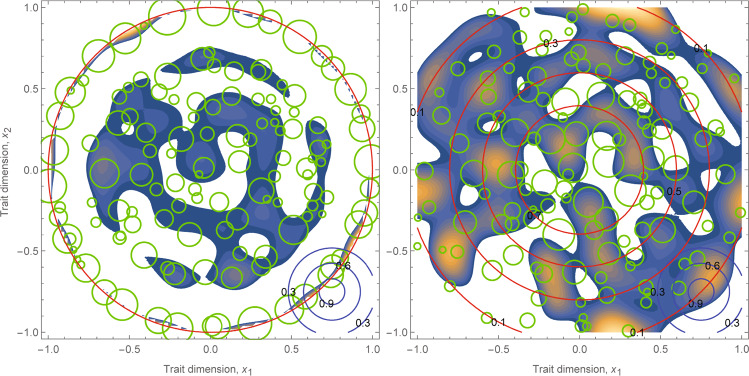
Identifying conditions and traits that allow an introduced species to grow and spread, from being initially rare to becoming abundant (defined as invasiveness), is the crux of invasion ecology. Invasiveness and abundance are related but not the same, and we need to differentiate these concepts. Predicting both species abundance and invasiveness and their relationship in an invaded community is highly contextual, being contingent on the community trait profile and its invasibility. We operationalised a three-pronged invasion framework that considers traits, environmental context, and propagule pressure. Specifically, we measure the invasiveness of an alien species by combining three components (performance reflecting environmental suitability, product of species richness and the covariance between interaction strength and species abundance, and community-level interaction pressure); the expected population growth rate of alien species simply reflects the total effect of propagule pressure and the product of their population size and invasiveness. The invasibility of a community reflects the size of opportunity niches (the integral of positive invasiveness in the trait space) under the given abiotic conditions of the environment. Both species abundance and the surface of invasiveness over the trait space can be dynamic and variable. Whether an introduced species with functional traits similar to those of an abundant species in the community exhibits high or low invasiveness depends largely on the kernel functions of performance and interaction strength with respect to traits and environmental conditions. Knowledge of the covariance between interaction strength and species abundance and these kernel functions, thus, holds the key to accurate prediction of invasion dynamics.
识别那些能使外来物种从最初稀少发展到大量繁殖(定义为入侵性)并扩散的条件和特征,是入侵生态学的关键所在。入侵性和丰富度相关但并不相同,我们需要区分这些概念。预测入侵群落中物种的丰富度、入侵性及其关系高度依赖具体情境,这取决于群落的特征概况及其可入侵性。我们实施了一个三方面的入侵框架,该框架考虑了特征、环境背景和繁殖体压力。具体而言,我们通过结合三个组成部分来衡量外来物种的入侵性(反映环境适宜性的表现、物种丰富度与相互作用强度和物种丰富度之间协方差的乘积,以及群落水平的相互作用压力);外来物种的预期种群增长率简单地反映了繁殖体压力的总体效应及其种群规模与入侵性的乘积。群落的可入侵性反映了在给定环境非生物条件下机会生态位的大小(特征空间中正向入侵性的积分)。物种丰富度和特征空间上的入侵性表面都可能是动态且可变的。一个具有与群落中丰富物种相似功能特征的外来物种,其入侵性是高还是低,很大程度上取决于关于特征和环境条件的表现及相互作用强度的核函数。因此,了解相互作用强度与物种丰富度之间的协方差以及这些核函数,是准确预测入侵动态的关键。