Department of Family Medicine, School of Medicine, Faculty of Medicine and Health Sciences, McGill University, Montréal, Canada.
Institute of Health Sciences Education, Faculty of Medicine and Health Sciences, McGill University, Montreal, Canada.
BMC Med Educ. 2024 Sep 9;24(1):975. doi: 10.1186/s12909-024-05874-5.
During the coronavirus disease of 2019 (COVID-19) pandemic, in-person interviews for the recruitment of family medicine residents shifted to online (virtual) interviews. The purpose of this study was twofold: (1) to gather the ideas about virtual interviews of family medicine applicants (interviewees), and faculty and staff who interviewed these applicants (interviewers), and (2) to describe interviewers' and interviewees' opinions of use of emerging technologies such as artificial intelligence (AI) and virtual reality (VR) in the recruitment process as well as during clinical practice.
This was a cross-sectional survey study. Participants were both interviewers and candidates who applied to the McGill University Family Medicine Residency Program for the 2020-2021 and 2021-2022 cycles.
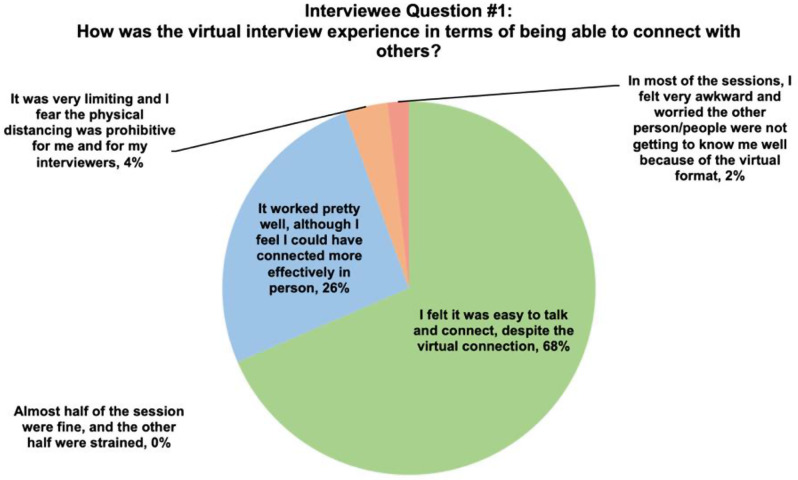
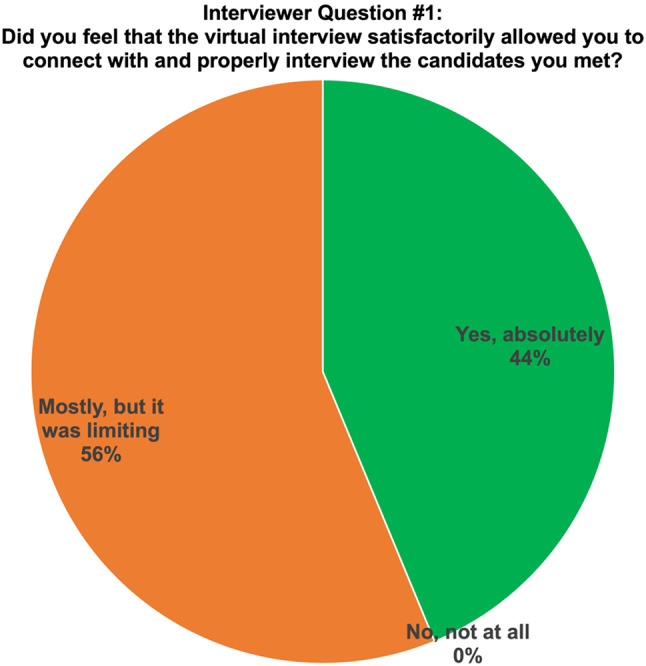
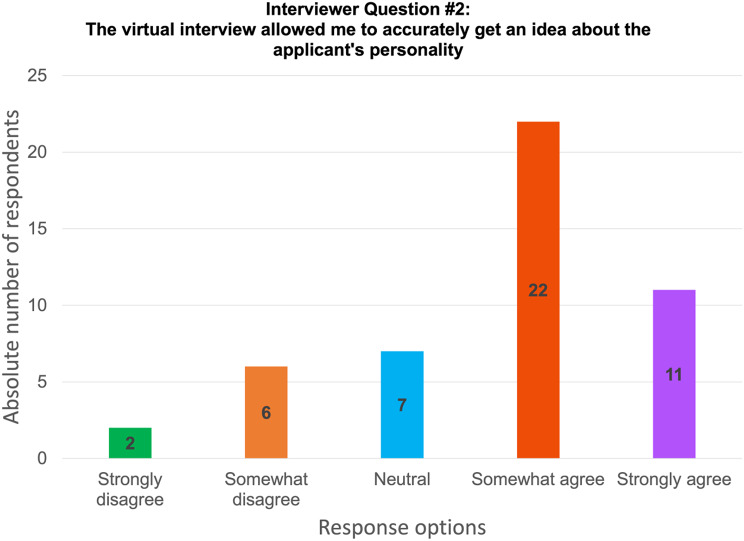
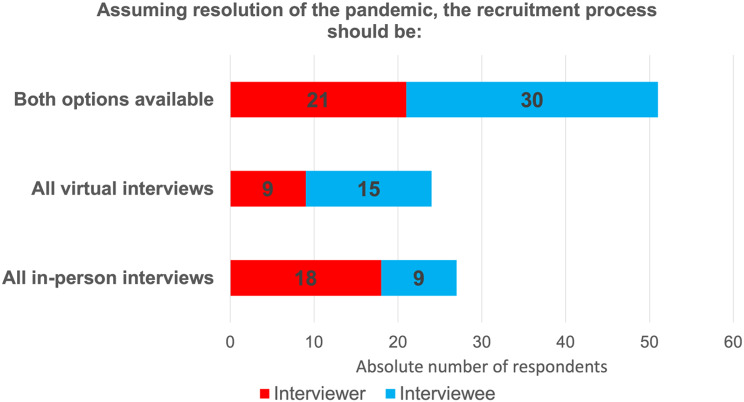
The study population was constituted by N = 132 applicants and N = 60 interviewers. The response rate was 91.7% (55/60) for interviewers and 43.2% (57/132) for interviewees. Both interviewers (43.7%) and interviewees (68.5%) were satisfied with connecting through virtual interviews. Interviewers (43.75%) and interviewees (55.5%) would prefer for both options to be available. Both interviewers (50%) and interviewees (72%) were interested in emerging technologies. Almost all interviewees (95.8%) were interested in learning about AI and VR and its application in clinical practice with the majority (60.8%) agreeing that it should be taught within medical training.
Although experience of virtual interviewing during the COVID-19 pandemic has been positive for both interviewees and interviewers, the findings of this study suggest that it will be unlikely that virtual interviews completely replace in-person interviews for selecting candidates for family medicine residency programs in the long term as participants value aspects of in-person interviews and would want a choice in format. Since incoming family medicine physicians seem to be eager to learn and utilize emerging technologies such as AI and VR, educators and institutions should consider family physicians' needs due to the changing technological landscape in family medicine education.
在 2019 年冠状病毒病(COVID-19)大流行期间,家庭医学住院医师招聘的现场面试转为在线(虚拟)面试。本研究的目的有两个:(1)收集家庭医学申请人(面试者)和面试这些申请人的教职员工的虚拟面试想法;(2)描述面试者和面试者对在招聘过程中以及临床实践中使用人工智能(AI)和虚拟现实(VR)等新兴技术的看法。
这是一项横断面调查研究。参与者既是面试者,也是申请 2020-2021 年和 2021-2022 年麦吉尔大学家庭医学住院医师项目的候选人。
研究人群由 N=132 名申请人和 N=60 名面试者组成。面试者的回应率为 91.7%(55/60),面试者的回应率为 43.2%(57/132)。面试者(43.7%)和面试者(68.5%)都对通过虚拟面试进行联系感到满意。面试者(43.75%)和面试者(55.5%)都希望这两种选择都可用。面试者(50%)和面试者(72%)都对新兴技术感兴趣。几乎所有的面试者(95.8%)都有兴趣了解 AI 和 VR 及其在临床实践中的应用,其中大多数(60.8%)人认为应该在医学培训中教授这些技术。
尽管 COVID-19 大流行期间虚拟面试的经验对面试者和面试者都是积极的,但这项研究的结果表明,从长期来看,虚拟面试不太可能完全取代面对面面试来选择家庭医学住院医师项目的候选人,因为参与者重视面对面面试的各个方面,并希望有选择面试方式的机会。由于未来的家庭医生似乎渴望学习和利用人工智能和 VR 等新兴技术,教育者和机构应该考虑家庭医生的需求,因为家庭医学教育中的技术环境正在发生变化。