Department of Cognitive Neuroscience, Institute for Cognitive Science Studies, Tehran, Iran.
Department of Dental Anatomy, Dental School, Azad University of Medical Sciences, Tehran, Iran.
Sci Rep. 2024 Sep 8;14(1):20900. doi: 10.1038/s41598-024-71262-0.
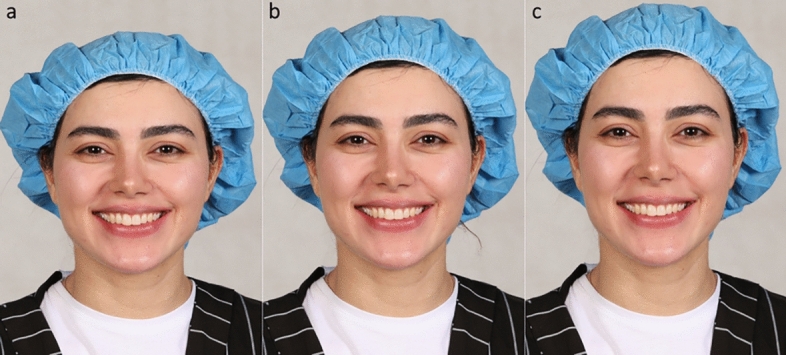
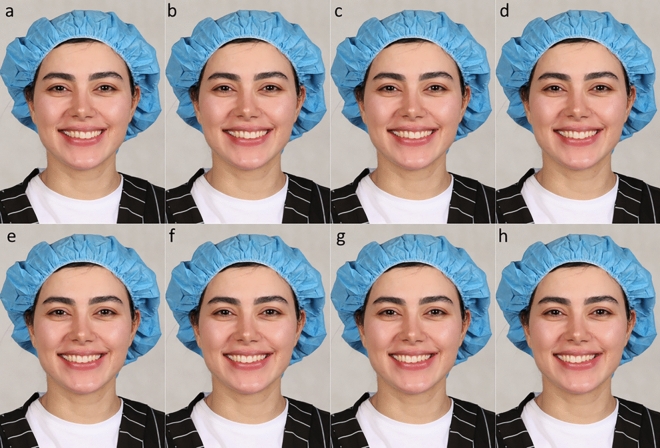
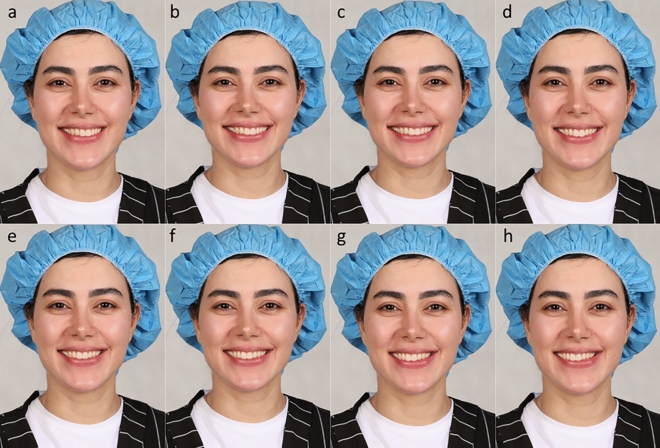
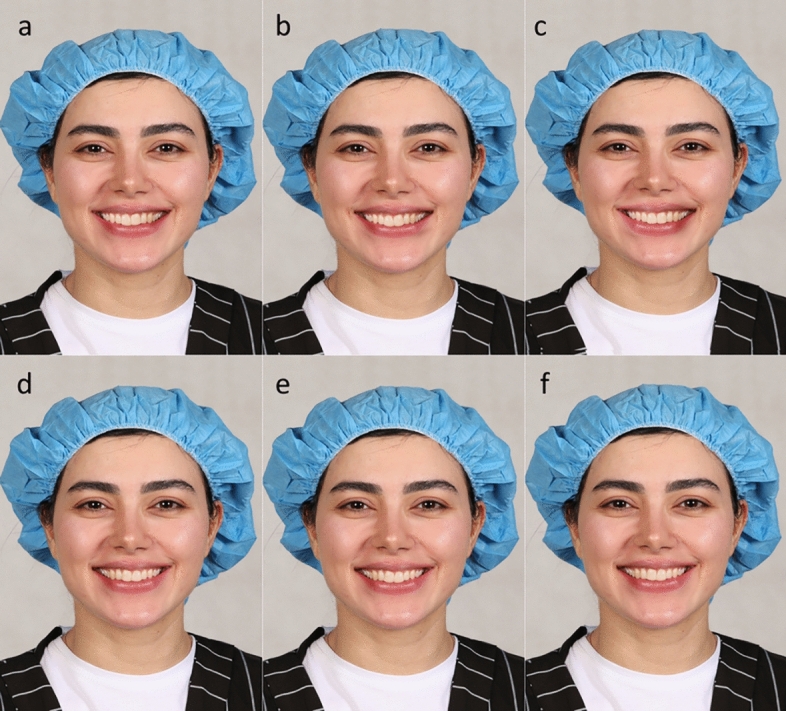
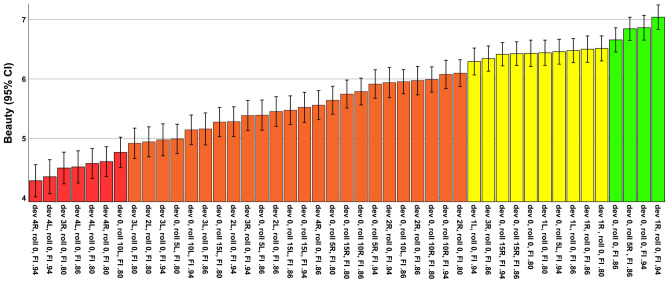
No study has examined the simultaneous effect of facial forms, midline deviations and midline angulations on facial beauty. Therefore, this comprehensive study aimed to evaluate these and many other hypotheses. This psychometric study was performed on 15,042 observations. A female frontal photograph was edited to 45 perceptometric images with controlled anatomical alteration: 3 facial forms (euryprosopic [brachyfacial], mesoprosopic [mesofacial], leptoprosopic [dolichofacial]), each having either 9 bidirectional midline deviations (0, 1, 2, 3, and 4 mm deviated to the left and right) or 7 bidirectional midline angular deviations (0°, 5°, 10°, and 15° deviated to the left and right). One of the photographs were repeated. These 46 images were esthetically judged by 327 participants (243 laypeople, 49 orthodontists, and 35 'prosthodontists or restorative dentists'). Hierarchical mixed-model multiple linear regressions and post hoc tests were adopted to evaluate the simultaneous impacts of the photomodel's facial forms, midline deviations to the right or left, and midline rolls to the right or left plus sex, age, experience, and dental specialty of the referees on their perception of facial beauty as well as the tolerable zones of midline alterations. These were also done separately for each specialty group, and also for each facial face. Ideal combinations of anatomic features were determined using repeated-measures ANOVAs. Differences between esthetic preferences of different groups in terms of each image were assessed using one-way ANOVAs and t-tests (α = 0.05, α = 0.008, α = 0.001). All 5 anatomical features significantly and independently influenced perception of facial beauty. The tolerance threshold for midline deviations was 1 mm deviations to the right and left sides. For midline rolls, the only tolerable form was the no-roll ('on') midline; the judges preferred right-oriented defects over left-sided ones. The most beautiful facial form was mesoprosopic, followed by leptoprosopic. Men perceived the female face slightly more attractive than did women. The viewers' specialty (or lack of it), their age, or their experience did not affect their esthetic preferences. Predictors of esthetic preferences were all 5 anatomical features plus views' sex, but not their dental specialty, age, or experience. Zones of acceptability and also the ideal range of anatomical features were determined.
尚无研究同时考察面型、中线偏斜和中线倾斜对面部美观的影响。因此,本全面研究旨在评估这些以及许多其他假设。本计量研究对 15042 个观测值进行了分析。对一名女性的正面照片进行了 45 次知觉测量图像的编辑,这些图像通过控制解剖学改变:3 种面型(阔面型[短面型]、中面型[中面型]、狭面型[长面型]),每个面型都有 9 种双向中线偏斜(向左侧或右侧偏斜 0、1、2、3、4mm)或 7 种双向中线倾斜(向左或向右偏斜 0°、5°、10°、15°)。其中一张照片重复。327 名参与者(243 名非专业人士、49 名正畸医生和 35 名“修复医生或修复牙医”)对这些 46 张照片进行了美学判断。采用分层混合模型多元线性回归和事后检验来评估照片中模特的面型、向左侧或右侧的中线偏斜以及向左侧或右侧的中线倾斜,以及观察者的性别、年龄、经验和牙科专业对他们对面部美观的感知以及中线改变的可接受范围的综合影响。这些也分别在每个专业组和每个面型中进行了评估。使用重复测量方差分析确定理想的解剖特征组合。使用单向方差分析和 t 检验(α=0.05、α=0.008、α=0.001)评估不同图像中不同组之间的美学偏好差异。所有 5 个解剖特征对面部美观的感知都有显著的独立影响。中线偏斜的可容忍阈值为向左右两侧各偏斜 1mm。对于中线倾斜,唯一可容忍的形式是无倾斜(“无”)中线;评判者更喜欢右侧缺陷而不是左侧缺陷。最美丽的面型是中面型,其次是狭面型。男性认为女性的脸比女性自己认为的更有吸引力。观察者的专业(或缺乏专业知识)、年龄或经验不会影响他们的审美偏好。审美偏好的预测因子是所有 5 个解剖特征加上观察者的性别,但不包括他们的牙科专业、年龄或经验。确定了可接受的范围和理想的解剖特征范围。