Yoshida Ryuto, Azegami Tatsuhiko, Yamaguchi Shintaro, Hagiwara Aika, Hishikawa Akihito, Yoshimoto Norifumi, Hashiguchi Akinori, Hayashi Kaori
Division of Nephrology, Endocrinology and Metabolism, Department of Internal Medicine, Keio University School of Medicine, Tokyo, Japan.
Department of Pathology, Keio University School of Medicine, Tokyo, Japan.
Kidney Med. 2024 Jul 25;6(10):100880. doi: 10.1016/j.xkme.2024.100880. eCollection 2024 Oct.
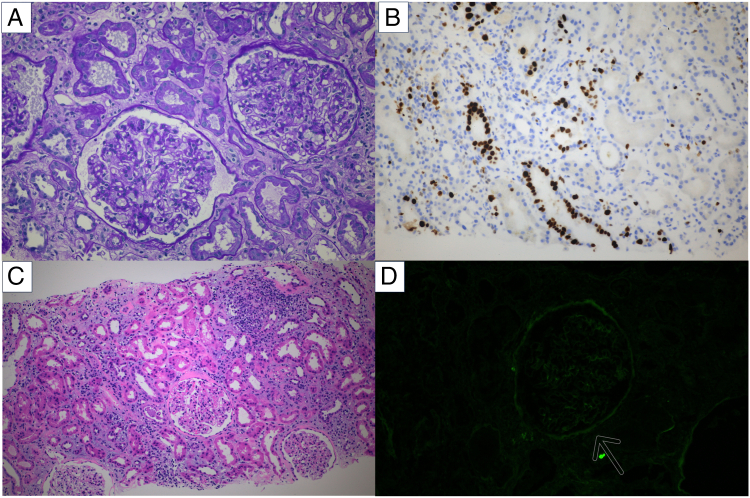
Antiglomerular basement membrane (GBM) disease has a poor prognosis. The rapid detection of serum anti-GBM antibody using an enzyme immunoassay, which has a high sensitivity and specificity, leads to an early diagnosis and improved prognosis. We report a case of acute kidney injury with false-positive anti-GBM antibody. A man in his early fifties underwent aortic arch replacement using bovine serum albumin (BSA)-containing surgical adhesion. After intravenous administration of vancomycin for a fever, he developed acute kidney injury without an abnormal urinalysis, and his anti-GBM antibody titer (fluorescence enzyme immunoassay [FEIA]) was 70.4 IU/mL. A kidney biopsy showed acute tubular injury and minor glomerular abnormalities without immunoglobulin G deposits, suggesting no evidence of anti-GBM glomerulonephritis. Consistent with the false-positive anti-GBM antibody test results, anti-GBM antibody determined using a chemiluminescent enzyme immunoassay was negative. A serum sample showed crossbinding to the FEIA plate from which the GBM antigen was removed. This finding indicated a nonspecific reaction to BSA, which contains a coating solution for the FEIA plate. This reaction was likely caused by anti-BSA antibody produced using BSA-containing surgical adhesion. Our findings suggest emerging challenges in diagnosing anti-GBM disease. Nephrologists must remain vigilant regarding false-positive anti-GBM antibody test results, particularly in cases evaluated with immunoassays that contain BSA.
抗肾小球基底膜(GBM)病预后较差。使用酶免疫测定法快速检测血清抗GBM抗体,该方法具有高灵敏度和特异性,可实现早期诊断并改善预后。我们报告一例抗GBM抗体假阳性的急性肾损伤病例。一名五十岁出头的男性接受了使用含牛血清白蛋白(BSA)的手术粘连剂进行的主动脉弓置换术。静脉注射万古霉素治疗发热后,他出现了急性肾损伤,尿常规检查无异常,其抗GBM抗体滴度(荧光酶免疫测定法[FEIA])为70.4 IU/mL。肾活检显示急性肾小管损伤和轻微的肾小球异常,无免疫球蛋白G沉积,提示无抗GBM肾小球肾炎证据。与抗GBM抗体检测结果假阳性一致,使用化学发光酶免疫测定法测定的抗GBM抗体为阴性。血清样本显示与去除GBM抗原的FEIA板发生交叉结合。这一发现表明对BSA存在非特异性反应,BSA是FEIA板的包被液成分。这种反应可能是由含BSA的手术粘连剂产生的抗BSA抗体引起的。我们的研究结果提示抗GBM病诊断中出现了新的挑战。肾科医生必须对抗GBM抗体检测结果假阳性保持警惕,尤其是在用含BSA的免疫测定法评估的病例中。