Departments of Clinical and Experimental Cardiology and Cardiothoracic Surgery, Heart Centre, University of Amsterdam, Amsterdam UMC, Amsterdam, The Netherlands.
Heart Failure and Arrhythmias, Amsterdam Cardiovascular Sciences, Amsterdam, The Netherlands.
Adipocyte. 2024 Dec;13(1):2395565. doi: 10.1080/21623945.2024.2395565. Epub 2024 Sep 9.
Obesity increases the risk of atrial fibrillation (AF). We hypothesize that 'obese' epicardial adipose tissue (EAT) is, regardless of comorbidities, associated with markers of AF vulnerability.
Patients >40y of age undergoing bariatric surgery and using <2 antihypertensive drugs and no insulin were prospectively included. Study investigations were conducted before and 1y after surgery. Heart rhythm and p-wave duration were measured through ECGs and 7-d-holters. EAT-volume and attenuation were determined on non-enhanced CT scans. Serum markers were quantified by ELISA.
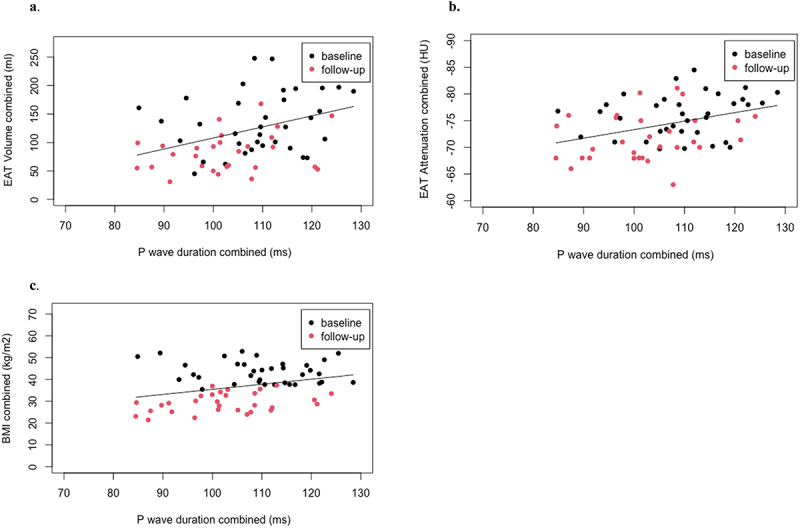
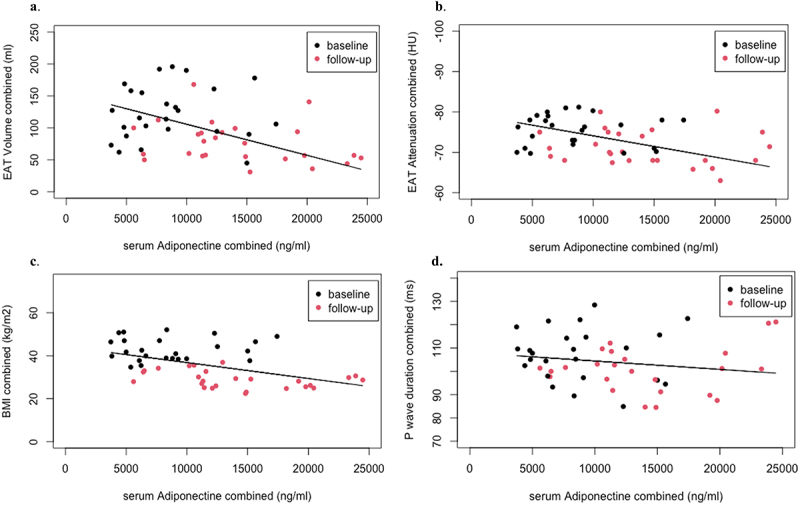
Thirty-seven patients underwent surgery (age: 52.1 ± 5.9y; 27 women; no AF). Increased p-wave duration correlated with higher BMI, larger EAT volumes, and lower EAT attenuations (p < 0.05). Post-surgery, p-wave duration decreased from 109 ± 11 to 102 ± 11ms. Concurrently, EAT volume decreased from 132 ± 49 to 87 ± 52ml, BMI from 43.2 ± 5.2 to 28.9 ± 4.6kg/m, and EAT attenuation increased from -76.1 ± 4.0 to -71.7 ± 4.4HU (p <0.001). Adiponectin increased from 8.7 ± 0.8 to 14.2 ± 1.0 μg/ml (p <0.001). However, decreased p-wave durations were not related to changed EAT characteristics, BMI or adiponectin.
In this explorative study, longer p-wave durations related to higher BMIs, larger EAT volume, and lower EAT attenuations. P-wave duration and EAT volume decreased, and EAT attenuation increased upon drastic weightloss. However, there was no relation between decreased p-wave duration and changed BMI or EAT characteristics.
肥胖会增加心房颤动(AF)的风险。我们假设,无论是否存在合并症,“肥胖”的心外膜脂肪组织(EAT)与 AF 易损性标志物相关。
前瞻性纳入年龄>40 岁、正在接受减重手术且仅使用<2 种降压药和无胰岛素的患者。研究调查在手术前和手术后 1 年进行。通过心电图和 7 天动态心电图监测心律和 P 波持续时间。使用非增强 CT 扫描确定 EAT 体积和衰减。通过 ELISA 定量血清标志物。
37 例患者接受了手术(年龄:52.1±5.9 岁;27 名女性;无 AF)。P 波持续时间增加与 BMI 更高、EAT 体积更大和 EAT 衰减更低相关(p<0.05)。手术后,P 波持续时间从 109±11 降至 102±11ms。同时,EAT 体积从 132±49 降至 87±52ml,BMI 从 43.2±5.2 降至 28.9±4.6kg/m,EAT 衰减从-76.1±4.0 升至-71.7±4.4HU(p<0.001)。脂联素从 8.7±0.8 升至 14.2±1.0μg/ml(p<0.001)。然而,P 波持续时间的降低与 EAT 特征、BMI 或脂联素的改变无关。
在这项探索性研究中,更长的 P 波持续时间与更高的 BMI、更大的 EAT 体积和更低的 EAT 衰减有关。体重明显减轻后,P 波持续时间和 EAT 体积降低,EAT 衰减增加。然而,P 波持续时间的降低与 BMI 或 EAT 特征的改变之间没有关系。