Amsterdam UMC, Heart Center, Department of Clinical and Experimental Cardiology and Cardiothoracic Surgery, University of Amsterdam, Amsterdam, The Netherlands.
Amsterdam Cardiovascular Sciences, Heart Failure and Arrhythmias, Amsterdam, The Netherlands.
J Transl Med. 2023 Jun 6;21(1):366. doi: 10.1186/s12967-023-04231-2.
Epicardial adipose tissue (EAT) secretome induces fibrosis. Fibrosis, primarily extracellular matrix (ECM) produced by fibroblasts, creates a substrate for atrial fibrillation (AF). Whether the EAT secretome from patients with AF activates human atrial fibroblasts and through which components, remains unexplored.
(a) To investigate if the EAT secretome from patients with versus without AF increases ECM production in atrial fibroblasts. (b) To identify profibrotic proteins and processes in the EAT secretome and EAT from patients with, who will develop (future onset), and without AF.
Atrial EAT was obtainded during thoracoscopic ablation (AF, n = 20), or open-heart surgery (future onset and non-AF, n = 35). ECM gene expression of human atrial fibroblasts exposed to the EAT secretome and the proteomes of EAT secretome and EAT were assessed in patients with and without AF. Myeloperoxidase and neutrophil extracellular traps (NETs) were assessed immunohistochemically in patients with paroxysmal, persistent, future onset, and those who remain free of AF (non-AF).
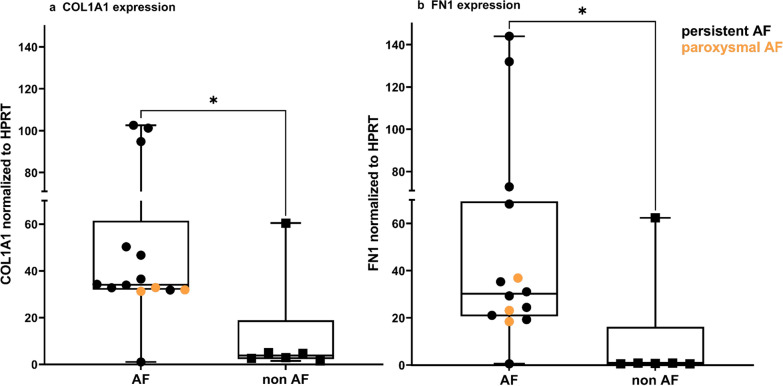
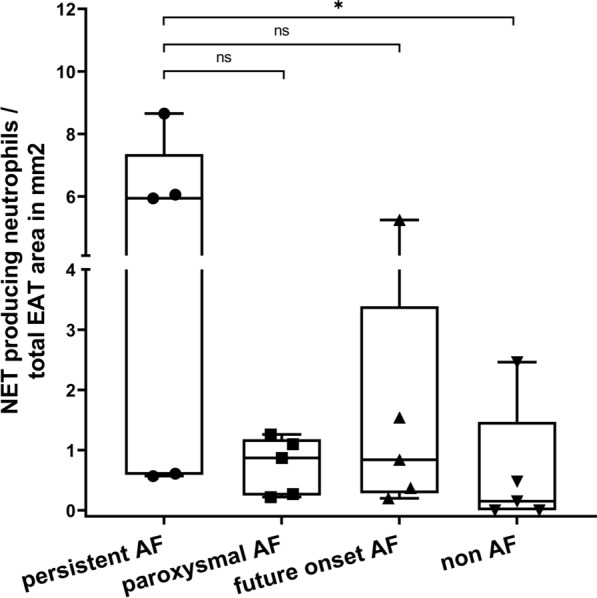
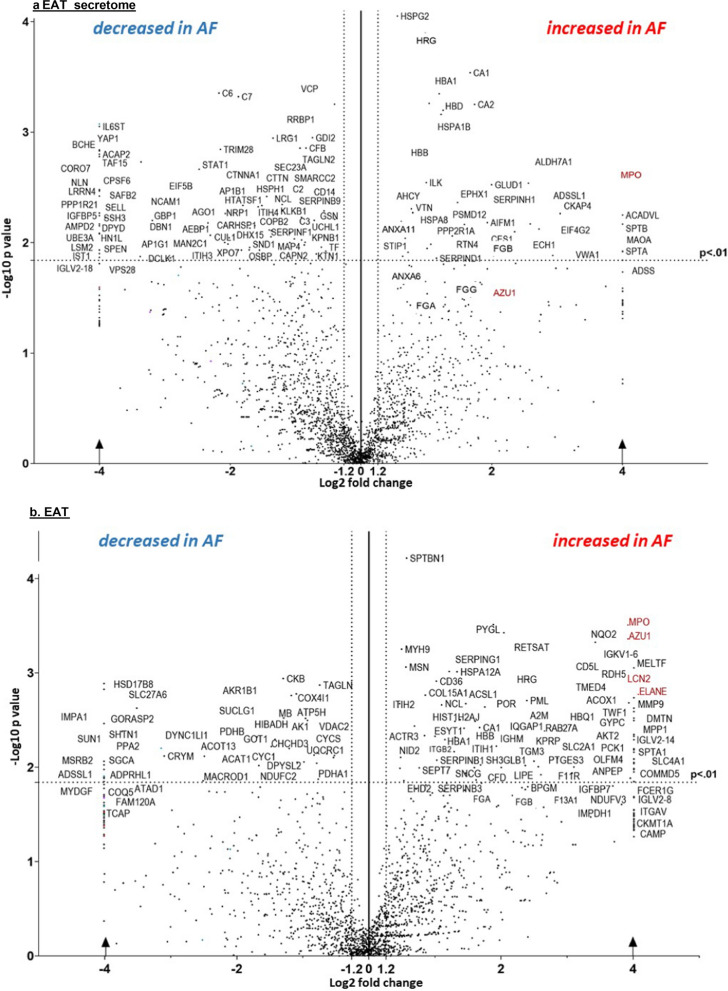
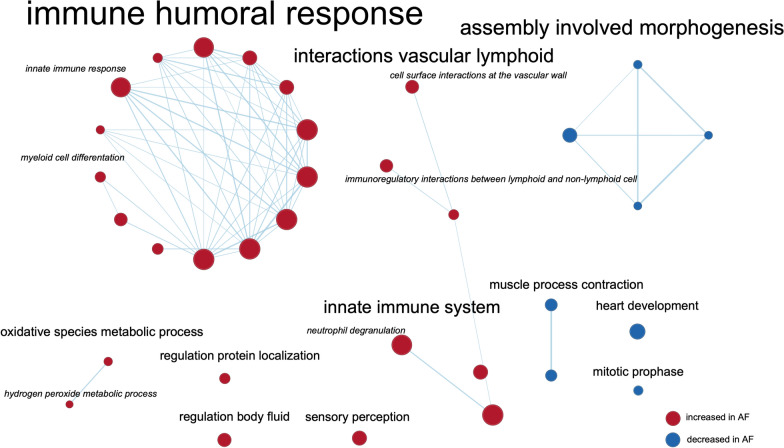
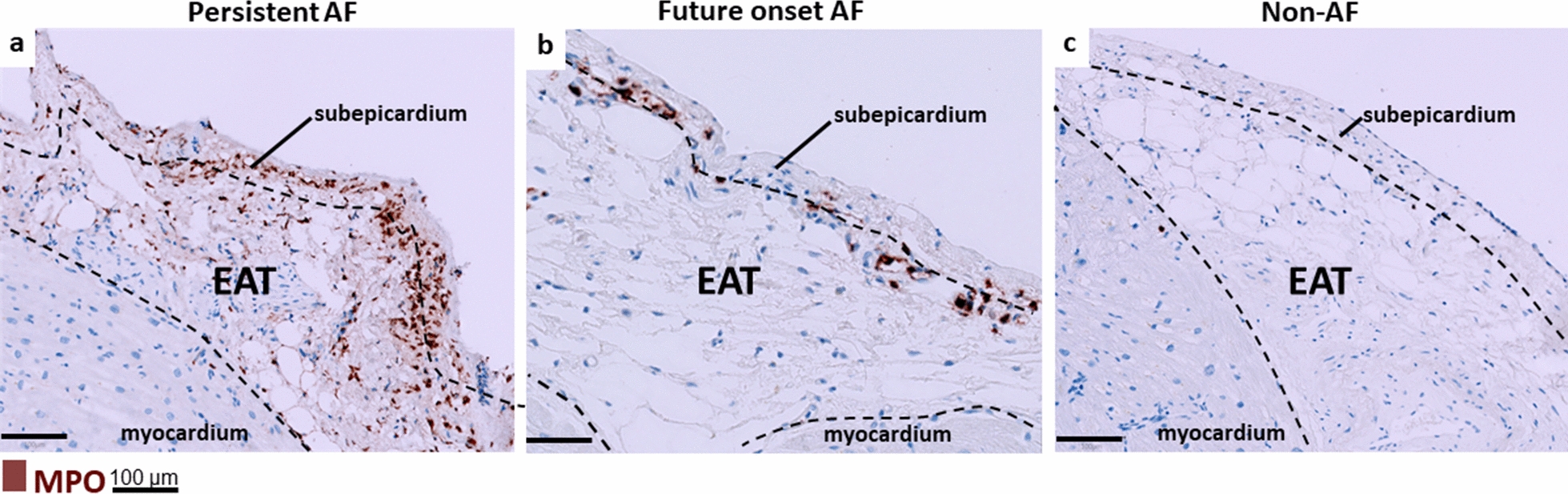
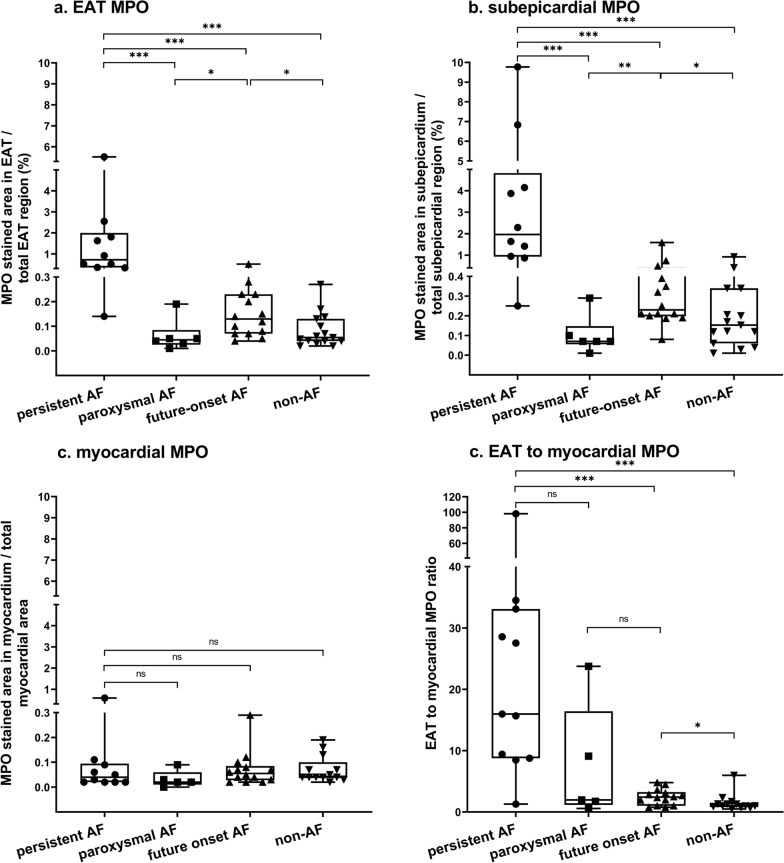
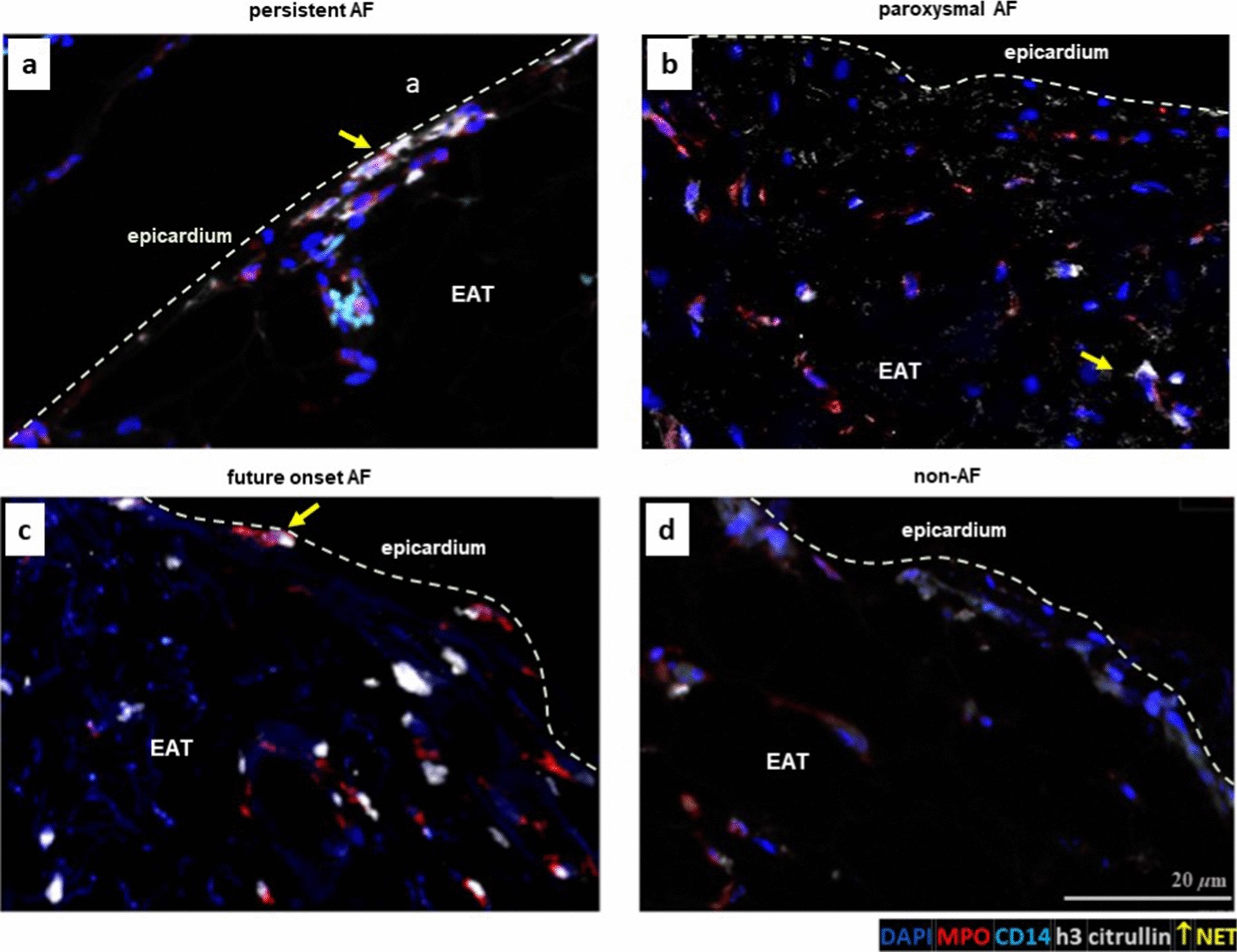
The expression of COL1A1 and FN1 in fibroblasts exposed to secretome from patients with AF was 3.7 and 4.7 times higher than in patients without AF (p < 0.05). Myeloperoxidase was the most increased protein in the EAT secretome and EAT from patients with versus without AF (FC 18.07 and 21.57, p < 0.005), as was the gene-set neutrophil degranulation. Immunohistochemically, myeloperoxidase was highest in persistent (FC 13.3, p < 0.0001) and increased in future onset AF (FC 2.4, p = 0.02) versus non-AF. Myeloperoxidase aggregated subepicardially and around fibrofatty infiltrates. NETs were increased in patients with persistent versus non-AF (p = 0.03).
In AF, the EAT secretome induces ECM gene expression in atrial fibroblasts and contains abundant myeloperoxidase. EAT myeloperoxidase was increased prior to AF onset, and both myeloperoxidase and NETs were highest in persistent AF, highlighting the role of EAT neutrophils in the pathophysiology of AF.
心外膜脂肪组织(EAT)分泌组可诱导纤维化。纤维化主要是由成纤维细胞产生的细胞外基质(ECM),为心房颤动(AF)创造了基质。AF 患者的 EAT 分泌组是否会激活人心房成纤维细胞,以及通过哪些成分激活,目前仍不清楚。
(a)研究 AF 患者与非 AF 患者的 EAT 分泌组是否会增加心房成纤维细胞的 ECM 产生。(b)鉴定 AF 患者和未来发生(未来发作)及无 AF 患者的 EAT 分泌组和 EAT 中的促纤维化蛋白和过程。
在胸腔镜消融(AF,n=20)或心脏直视手术(未来发作和非 AF,n=35)期间获得人心房 EAT。评估 AF 患者和非 AF 患者的 EAT 分泌组和 EAT 分泌组中人的心房成纤维细胞的 ECM 基因表达。免疫组织化学评估阵发性、持续性、未来发作和无 AF(非 AF)患者的髓过氧化物酶和中性粒细胞细胞外陷阱(NETs)。
与非 AF 患者相比,暴露于 AF 患者分泌组的成纤维细胞中 COL1A1 和 FN1 的表达分别高出 3.7 倍和 4.7 倍(p<0.05)。髓过氧化物酶是 AF 患者与非 AF 患者 EAT 分泌组和 EAT 中增加最多的蛋白(FC 18.07 和 21.57,p<0.005),基因集中性粒细胞脱颗粒也是如此。免疫组织化学显示,髓过氧化物酶在持续性 AF 中最高(FC 13.3,p<0.0001),在未来发作性 AF 中也有增加(FC 2.4,p=0.02),而非 AF 中则无增加。髓过氧化物酶在心外膜下和纤维脂肪浸润周围聚集。与非 AF 患者相比,持续性 AF 患者的 NETs 增加(p=0.03)。
在 AF 中,EAT 分泌组可诱导心房成纤维细胞的 ECM 基因表达,并且含有丰富的髓过氧化物酶。EAT 髓过氧化物酶在 AF 发作前增加,髓过氧化物酶和 NETs 在持续性 AF 中最高,突出了 EAT 中性粒细胞在 AF 病理生理学中的作用。