• 文献检索
  • 文档翻译
  • 深度研究
  • 学术资讯
  • Suppr Zotero 插件Zotero 插件
  • 邀请有礼
  • 套餐&价格
  • 历史记录
应用&插件
Suppr Zotero 插件Zotero 插件浏览器插件Mac 客户端Windows 客户端微信小程序
定价
高级版会员购买积分包购买API积分包
服务
文献检索文档翻译深度研究API 文档MCP 服务
关于我们
关于 Suppr公司介绍联系我们用户协议隐私条款
关注我们

Suppr 超能文献

核心技术专利:CN118964589B侵权必究
粤ICP备2023148730 号-1Suppr @ 2026

文献检索

告别复杂PubMed语法,用中文像聊天一样搜索,搜遍4000万医学文献。AI智能推荐,让科研检索更轻松。

立即免费搜索

文件翻译

保留排版,准确专业,支持PDF/Word/PPT等文件格式,支持 12+语言互译。

免费翻译文档

深度研究

AI帮你快速写综述,25分钟生成高质量综述,智能提取关键信息,辅助科研写作。

立即免费体验

共情式对话代理平台设计及其在心理健康领域的评估:系统评价。

Empathic Conversational Agent Platform Designs and Their Evaluation in the Context of Mental Health: Systematic Review.

机构信息

School of Health Sciences, Swinburne University of Technology, Hawthorn, Australia.

School of Computing, Engineering and Mathematical Sciences, La Trobe University, Bundoora, Australia.

出版信息

JMIR Ment Health. 2024 Sep 9;11:e58974. doi: 10.2196/58974.

DOI:10.2196/58974
PMID:39250799
原文链接:https://pmc.ncbi.nlm.nih.gov/articles/PMC11420590/
Abstract

BACKGROUND

The demand for mental health (MH) services in the community continues to exceed supply. At the same time, technological developments make the use of artificial intelligence-empowered conversational agents (CAs) a real possibility to help fill this gap.

OBJECTIVE

The objective of this review was to identify existing empathic CA design architectures within the MH care sector and to assess their technical performance in detecting and responding to user emotions in terms of classification accuracy. In addition, the approaches used to evaluate empathic CAs within the MH care sector in terms of their acceptability to users were considered. Finally, this review aimed to identify limitations and future directions for empathic CAs in MH care.

METHODS

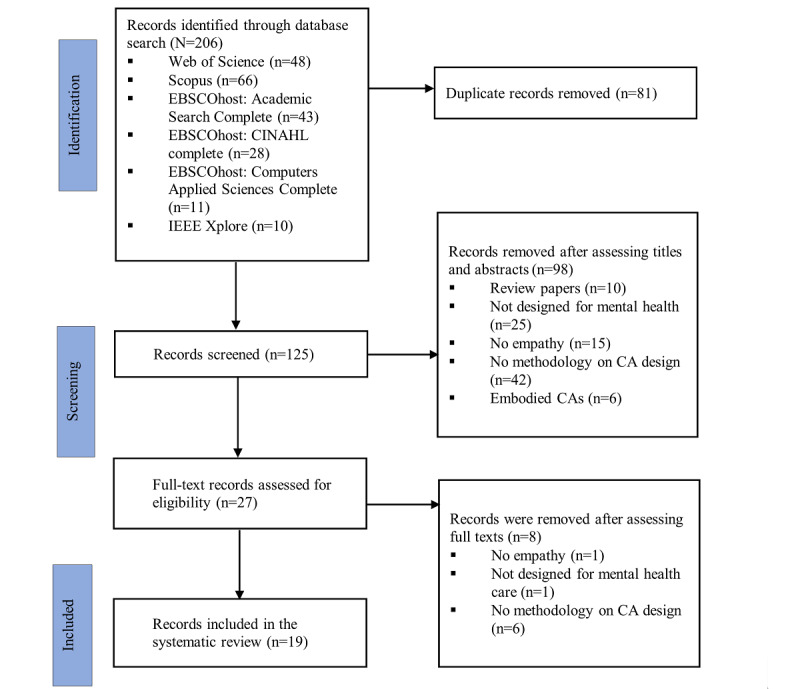
A systematic literature search was conducted across 6 academic databases to identify journal articles and conference proceedings using search terms covering 3 topics: "conversational agents," "mental health," and "empathy." Only studies discussing CA interventions for the MH care domain were eligible for this review, with both textual and vocal characteristics considered as possible data inputs. Quality was assessed using appropriate risk of bias and quality tools.

RESULTS

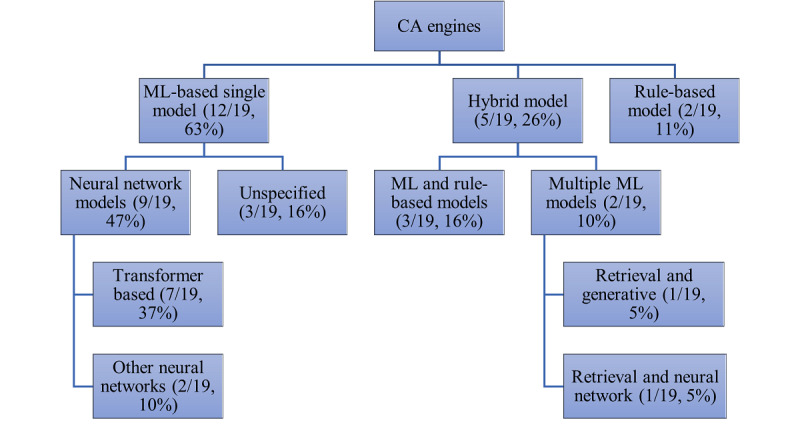
A total of 19 articles met all inclusion criteria. Most (12/19, 63%) of these empathic CA designs in MH care were machine learning (ML) based, with 26% (5/19) hybrid engines and 11% (2/19) rule-based systems. Among the ML-based CAs, 47% (9/19) used neural networks, with transformer-based architectures being well represented (7/19, 37%). The remaining 16% (3/19) of the ML models were unspecified. Technical assessments of these CAs focused on response accuracies and their ability to recognize, predict, and classify user emotions. While single-engine CAs demonstrated good accuracy, the hybrid engines achieved higher accuracy and provided more nuanced responses. Of the 19 studies, human evaluations were conducted in 16 (84%), with only 5 (26%) focusing directly on the CA's empathic features. All these papers used self-reports for measuring empathy, including single or multiple (scale) ratings or qualitative feedback from in-depth interviews. Only 1 (5%) paper included evaluations by both CA users and experts, adding more value to the process.

CONCLUSIONS

The integration of CA design and its evaluation is crucial to produce empathic CAs. Future studies should focus on using a clear definition of empathy and standardized scales for empathy measurement, ideally including expert assessment. In addition, the diversity in measures used for technical assessment and evaluation poses a challenge for comparing CA performances, which future research should also address. However, CAs with good technical and empathic performance are already available to users of MH care services, showing promise for new applications, such as helpline services.
https://cdn.ncbi.nlm.nih.gov/pmc/blobs/7560/11420590/c3ddfbf1c9d1/mental_v11i1e58974_fig2.jpg
https://cdn.ncbi.nlm.nih.gov/pmc/blobs/7560/11420590/c0f4d3708f52/mental_v11i1e58974_fig1.jpg
https://cdn.ncbi.nlm.nih.gov/pmc/blobs/7560/11420590/c3ddfbf1c9d1/mental_v11i1e58974_fig2.jpg
https://cdn.ncbi.nlm.nih.gov/pmc/blobs/7560/11420590/c0f4d3708f52/mental_v11i1e58974_fig1.jpg
https://cdn.ncbi.nlm.nih.gov/pmc/blobs/7560/11420590/c3ddfbf1c9d1/mental_v11i1e58974_fig2.jpg
摘要

背景

社区对心理健康 (MH) 服务的需求持续超过供应。与此同时,技术发展使得使用人工智能赋能的对话代理 (CA) 成为帮助填补这一空白的现实可能性。

目的

本综述的目的是确定 MH 护理领域中现有的移情 CA 设计架构,并根据分类准确性评估它们在检测和响应用户情绪方面的技术性能。此外,还考虑了 MH 护理领域内用于评估移情 CA 的方法,以评估其对用户的可接受性。最后,本综述旨在确定 MH 护理中移情 CA 的局限性和未来方向。

方法

对 6 个学术数据库进行了系统的文献检索,以确定使用涵盖 3 个主题的期刊文章和会议记录:“对话代理”、“心理健康”和“同理心”。只有讨论 MH 护理领域 CA 干预的文章符合本综述的纳入标准,文本和语音特征均被视为可能的数据输入。使用适当的偏倚风险和质量工具评估质量。

结果

共有 19 篇文章符合所有纳入标准。这些 MH 护理中的移情 CA 设计中,大多数(12/19,63%)是基于机器学习 (ML) 的,其中 26%(5/19)是混合引擎,11%(2/19)是基于规则的系统。在基于 ML 的 CA 中,47%(9/19)使用神经网络,基于转换器的架构得到了很好的体现(7/19,37%)。剩下的 16%(3/19)的 ML 模型未指定。这些 CA 的技术评估侧重于响应准确性及其识别、预测和分类用户情绪的能力。虽然单引擎 CA 表现出良好的准确性,但混合引擎实现了更高的准确性,并提供了更细致的响应。在这 19 项研究中,有 16 项(84%)进行了人类评估,其中只有 5 项(26%)直接关注 CA 的移情特征。所有这些论文都使用自我报告来衡量同理心,包括单或多(量表)评分或深入访谈的定性反馈。只有 1 篇(5%)论文同时包括 CA 用户和专家的评估,为该过程增加了更多价值。

结论

CA 设计及其评估的结合对于产生移情 CA 至关重要。未来的研究应侧重于使用同理心的明确定义和同理心测量的标准化量表,理想情况下包括专家评估。此外,技术评估和评估中使用的措施多样性给 CA 性能的比较带来了挑战,未来的研究也应该解决这一问题。然而,具有良好技术和移情性能的 CA 已经可供 MH 护理服务的用户使用,为新的应用程序(如求助热线服务)展示了前景。

相似文献

1
Empathic Conversational Agent Platform Designs and Their Evaluation in the Context of Mental Health: Systematic Review.共情式对话代理平台设计及其在心理健康领域的评估:系统评价。
JMIR Ment Health. 2024 Sep 9;11:e58974. doi: 10.2196/58974.
2
Folic acid supplementation and malaria susceptibility and severity among people taking antifolate antimalarial drugs in endemic areas.在流行地区,服用抗叶酸抗疟药物的人群中,叶酸补充剂与疟疾易感性和严重程度的关系。
Cochrane Database Syst Rev. 2022 Feb 1;2(2022):CD014217. doi: 10.1002/14651858.CD014217.
3
Scope, Characteristics, Behavior Change Techniques, and Quality of Conversational Agents for Mental Health and Well-Being: Systematic Assessment of Apps.用于心理健康和福祉的对话代理的范围、特征、行为改变技术和质量:应用程序的系统评估。
J Med Internet Res. 2023 Jul 18;25:e45984. doi: 10.2196/45984.
4
Conversational Agents in Health Care: Expert Interviews to Inform the Definition, Classification, and Conceptual Framework.医疗保健中的会话代理:专家访谈以提供定义、分类和概念框架。
J Med Internet Res. 2023 Nov 1;25:e50767. doi: 10.2196/50767.
5
Evaluation of chatbot-delivered interventions for self-management of depression: Content analysis.基于自然语言处理的抑郁自我管理干预措施评估:内容分析
J Affect Disord. 2022 Dec 15;319:598-607. doi: 10.1016/j.jad.2022.09.028. Epub 2022 Sep 20.
6
Towards an Artificially Empathic Conversational Agent for Mental Health Applications: System Design and User Perceptions.面向心理健康应用的人工共情对话代理:系统设计与用户认知
J Med Internet Res. 2018 Jun 26;20(6):e10148. doi: 10.2196/10148.
7
Artificial Intelligence-Based Conversational Agents for Chronic Conditions: Systematic Literature Review.基于人工智能的慢性病对话代理:系统文献综述。
J Med Internet Res. 2020 Sep 14;22(9):e20701. doi: 10.2196/20701.
8
An Empathy-Driven, Conversational Artificial Intelligence Agent (Wysa) for Digital Mental Well-Being: Real-World Data Evaluation Mixed-Methods Study.用于数字心理健康的共情驱动对话式人工智能代理(Wysa):现实世界数据评估混合方法研究
JMIR Mhealth Uhealth. 2018 Nov 23;6(11):e12106. doi: 10.2196/12106.
9
Transforming Health Care Through Chatbots for Medical History-Taking and Future Directions: Comprehensive Systematic Review.通过聊天机器人进行病史采集实现医疗保健变革及未来方向:全面系统综述
JMIR Med Inform. 2024 Aug 29;12:e56628. doi: 10.2196/56628.
10
The future of Cochrane Neonatal.考克兰新生儿协作网的未来。
Early Hum Dev. 2020 Nov;150:105191. doi: 10.1016/j.earlhumdev.2020.105191. Epub 2020 Sep 12.

引用本文的文献

1
Multimodal Sensing-Enabled Large Language Models for Automated Emotional Regulation: A Review of Current Technologies, Opportunities, and Challenges.用于自动情绪调节的多模态传感大语言模型:当前技术、机遇与挑战综述
Sensors (Basel). 2025 Aug 1;25(15):4763. doi: 10.3390/s25154763.
2
Machine Learning Approach to Identifying Empathy Using the Vocals of Mental Health Helpline Counselors: Algorithm Development and Validation.使用心理健康热线咨询师声音识别同理心的机器学习方法:算法开发与验证
JMIR Form Res. 2025 Apr 16;9:e67835. doi: 10.2196/67835.

本文引用的文献

1
Systematic review and meta-analysis of AI-based conversational agents for promoting mental health and well-being.基于人工智能的对话代理促进心理健康和幸福的系统评价与荟萃分析。
NPJ Digit Med. 2023 Dec 19;6(1):236. doi: 10.1038/s41746-023-00979-5.
2
Factors Predicting Intentions of Adoption and Continued Use of Artificial Intelligence Chatbots for Mental Health: Examining the Role of UTAUT Model, Stigma, Privacy Concerns, and Artificial Intelligence Hesitancy.预测采用和持续使用人工智能聊天机器人进行心理健康咨询的因素:审视UTAUT模型、污名、隐私担忧和人工智能犹豫的作用。
Telemed J E Health. 2024 Mar;30(3):722-730. doi: 10.1089/tmj.2023.0313. Epub 2023 Sep 27.
3
To chat or bot to chat: Ethical issues with using chatbots in mental health.
聊天还是由聊天机器人来聊天:心理健康领域使用聊天机器人的伦理问题。
Digit Health. 2023 Jun 22;9:20552076231183542. doi: 10.1177/20552076231183542. eCollection 2023 Jan-Dec.
4
Voice analytics in the wild: Validity and predictive accuracy of common audio-recording devices.自然环境下的语音分析:常见录音设备的有效性和预测准确性。
Behav Res Methods. 2024 Mar;56(3):2114-2134. doi: 10.3758/s13428-023-02139-9. Epub 2023 May 30.
5
Conversational Agent Interventions for Mental Health Problems: Systematic Review and Meta-analysis of Randomized Controlled Trials.对话代理干预心理健康问题:随机对照试验的系统评价和荟萃分析。
J Med Internet Res. 2023 Apr 28;25:e43862. doi: 10.2196/43862.
6
Using Vocal Characteristics To Classify Psychological Distress in Adult Helpline Callers: Retrospective Observational Study.利用声音特征对成人求助热线来电者的心理困扰进行分类:回顾性观察研究。
JMIR Form Res. 2022 Dec 19;6(12):e42249. doi: 10.2196/42249.
7
Validity of Chatbot Use for Mental Health Assessment: Experimental Study.用于心理健康评估的聊天机器人的有效性:实验研究。
JMIR Mhealth Uhealth. 2022 Oct 31;10(10):e28082. doi: 10.2196/28082.
8
Chatbot as an emergency exist: Mediated empathy for resilience via human-AI interaction during the COVID-19 pandemic.作为应急存在的聊天机器人:在新冠疫情期间通过人机交互实现对恢复力的中介式共情。
Inf Process Manag. 2022 Nov;59(6):103074. doi: 10.1016/j.ipm.2022.103074. Epub 2022 Aug 31.
9
Using Voice Biomarkers to Classify Suicide Risk in Adult Telehealth Callers: Retrospective Observational Study.利用语音生物标志物对成人远程医疗呼叫者的自杀风险进行分类:回顾性观察研究。
JMIR Ment Health. 2022 Aug 15;9(8):e39807. doi: 10.2196/39807.
10
A Mental Health Chatbot with Cognitive Skills for Personalised Behavioural Activation and Remote Health Monitoring.具有认知技能的心理健康聊天机器人,用于个性化行为激活和远程健康监测。
Sensors (Basel). 2022 May 11;22(10):3653. doi: 10.3390/s22103653.