Brough D E, Rice S A, Sell S, Klessig D F
J Virol. 1985 Jul;55(1):206-12. doi: 10.1128/JVI.55.1.206-212.1985.
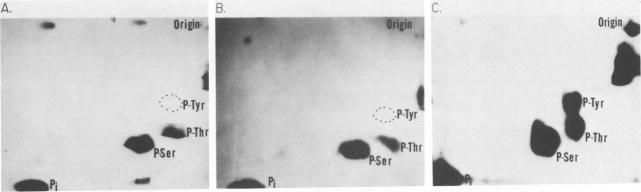
Human adenovirus fails to multiply efficiently in monkey cells owing to a block to late viral gene expression. Ad2hr400 through Ad2hr403 are a set of host range (hr) mutants which were selected for their ability to readily grow in these cells at 37 degrees C. The mutations responsible for this extended host range have previously been mapped to the 5' portion of the gene encoding the 72-kilodalton DNA-binding protein (DBP). DNA sequence analyses indicate that all four hr mutants contain the same alteration at coding triplet 130, which changes a histidine codon to a tyrosine codon. These results extend those of Anderson et al. (J. Virol. 48:31-39, 1983), which suggested that only this change in the DBP amino acid sequence can expand adenovirus host range to monkey cells. The hr phenotype does not appear to require phosphorylation of this tyrosine residue, since no phosphotyrosine was detected in DBP isolated from Ad2hr400-infected monkey cells. The hr mutants Ad2hr400 through Ad2hr403, however, are cold sensitive for growth in monkey cells. The mutant Ad2ts400, which was derived from Ad2hr400, represents a second class of hr mutants which can grow efficiently in monkey cells at 32.5 degrees C. The cold-resistant hr mutation of Ad2ts400 has previously been mapped to the 5' region of the DBP gene (map units 63.6 through 66). DNA sequence analysis of this region shows that this mutant contains the original hr alteration at coding triplet 130 as well as a second alteration at coding triplet 148, which changes an alanine codon to a valine codon. We suspect that the alterations at amino acids 130 and 148 change the structure of the amino-terminal domain of the DBP, allowing it to better interact with monkey cell components required for late viral gene expression. Ad2ts400 also contains a temperature-sensitive mutation which has previously been mapped to the 3' portion of the DBP gene (map units 61.3 through 63.6). Sequence analysis of this region indicates that the DBP coding triplet 413 has been altered. This change from a serine codon to a proline codon is the same alteration reported in the previously sequenced DBP mutants Ad5ts125 (W. Kruijer et al., Nucleic Acids Res. 9:4439-4457, 1981) and Ad5ts107 (W. Kruijer et al., Virology 124:425-433, 1983). Thus it appears that only a very limited number of changes in either the 5' or the 3' portion of the DBP gene can give rise to the hr or temperature-sensitive phenotypes, respectively.
由于晚期病毒基因表达受阻,人腺病毒在猴细胞中无法高效繁殖。Ad2hr400至Ad2hr403是一组宿主范围(hr)突变体,它们因其在37℃下能够在这些细胞中轻易生长的能力而被筛选出来。此前,导致这种扩展宿主范围的突变已被定位到编码72千道尔顿DNA结合蛋白(DBP)的基因的5'部分。DNA序列分析表明,所有四个hr突变体在编码三联体130处都有相同的改变,即将组氨酸密码子变为酪氨酸密码子。这些结果扩展了Anderson等人(《病毒学杂志》48:31 - 39, 1983)的研究结果,该研究表明只有DBP氨基酸序列中的这种变化才能将腺病毒宿主范围扩展到猴细胞。hr表型似乎不需要该酪氨酸残基的磷酸化,因为在从感染Ad2hr400的猴细胞中分离出的DBP中未检测到磷酸酪氨酸。然而,hr突变体Ad2hr400至Ad2hr403在猴细胞中生长对温度敏感。源自Ad2hr400的突变体Ad2ts400代表另一类hr突变体,它能够在32.5℃下在猴细胞中高效生长。Ad2ts400的耐冷hr突变此前已被定位到DBP基因的5'区域(图谱单位63.6至66)。该区域的DNA序列分析表明,这个突变体在编码三联体130处含有原始的hr改变,以及在编码三联体148处的第二个改变,即将丙氨酸密码子变为缬氨酸密码子。我们推测氨基酸130和148处的改变改变了DBP氨基末端结构域的结构,使其能够更好地与晚期病毒基因表达所需的猴细胞成分相互作用。Ad2ts400还含有一个温度敏感突变,此前已被定位到DBP基因的3'部分(图谱单位61.3至63.6)。该区域的序列分析表明,DBP编码三联体413已发生改变。从丝氨酸密码子到脯氨酸密码子的这种变化与先前测序的DBP突变体Ad5ts125(W. Kruijer等人,《核酸研究》9:4439 - 4457, 1981)和Ad5ts107(W. Kruijer等人,《病毒学》124:425 - 433, 1983)中报道的变化相同。因此,似乎DBP基因5'或3'部分中只有非常有限数量的变化分别能够产生hr或温度敏感表型。