Zhao Yunkun, Bhosale Aditya A, Zhang Xiaoliang
Department of Biomedical Engineering, State University of New York at Buffalo, Buffalo, NY, United States.
Department of Electrical Engineering, State University of New York at Buffalo, Buffalo, NY, United States.
medRxiv. 2024 Aug 31:2024.08.30.24312851. doi: 10.1101/2024.08.30.24312851.
Low-field open magnetic resonance imaging (MRI) systems, typically operating at magnetic field strengths below 1 Tesla, has greatly expanded the accessibility of MRI technology to meet a wide range of patient needs. However, the inherent challenges of low-field MRI, such as limited signal-to-noise ratios and limited availability of dedicated radiofrequency (RF) coils, have prompted the need for innovative coil designs that can improve imaging quality and diagnostic capabilities.
In response to these challenges, we introduce the coupled stack-up volume coil, a novel RF coil design that addresses the shortcomings of conventional birdcage in the context of low-field open MRI.
The proposed coupled stack-up volume coil design utilizes a unique architecture that optimizes both transmit/receive efficiency and RF field homogeneity and offers the advantage of a simple design and construction, making it a practical and feasible solution for low-field MRI applications. This paper presents a comprehensive exploration of the theoretical framework, design considerations, and experimental validation of this innovative coil design.
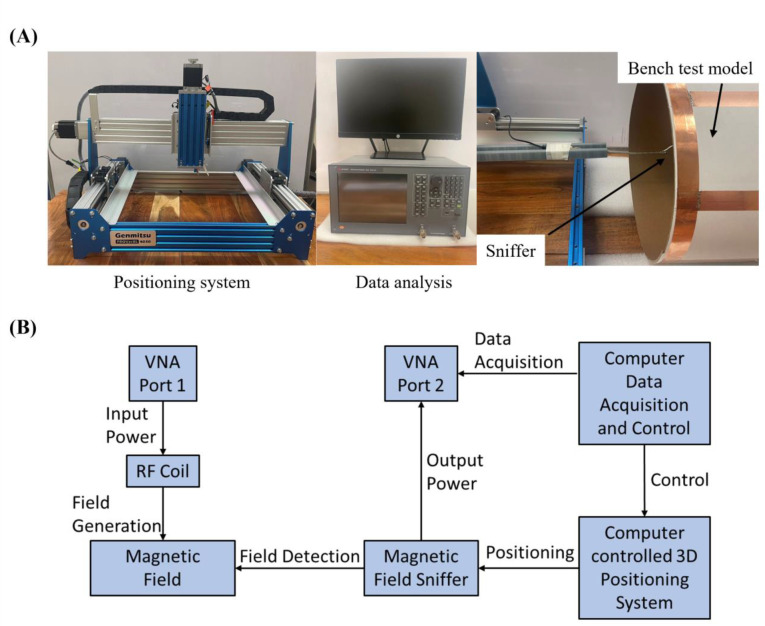
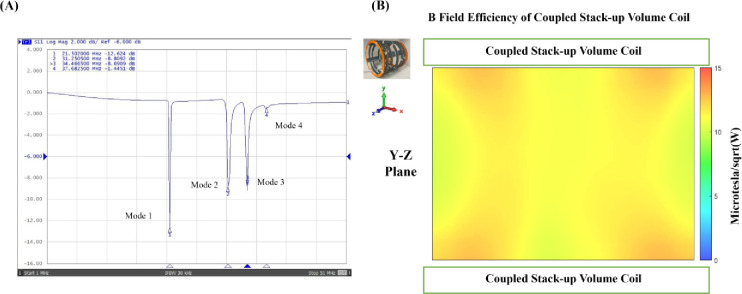
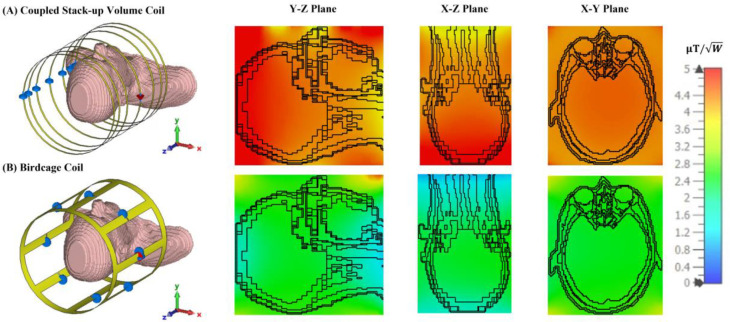
We demonstrate the superior performance of the coupled stack-up volume coil in achieving 47.7% higher transmit/receive efficiency and 68% more uniform magnetic field distribution compared to traditional birdcage coils in electromagnetic simulations. Bench tests results show that the B1 field efficiency of coupled stack-up volume coil is 57.3% higher compared with that of conventional birdcage coil.
The proposed coupled stack-up volume coil outperforms the conventional birdcage coil in terms of B1 efficiency, imaging coverage, and low-frequency operation capability. This design provides a robust and simple solution to low-field MR RF coil design.
低场开放式磁共振成像(MRI)系统通常在低于1特斯拉的磁场强度下运行,极大地扩展了MRI技术的可及性,以满足广泛的患者需求。然而,低场MRI的固有挑战,如有限的信噪比和专用射频(RF)线圈的可用性有限,促使人们需要创新的线圈设计,以提高成像质量和诊断能力。
为应对这些挑战,我们引入了耦合堆叠体线圈,这是一种新颖的RF线圈设计,在低场开放式MRI的背景下解决了传统鸟笼式线圈的缺点。
所提出的耦合堆叠体线圈设计采用了独特的架构,优化了发射/接收效率和RF场均匀性,并具有设计和构造简单的优点,使其成为低场MRI应用的实用可行解决方案。本文对这种创新线圈设计的理论框架、设计考虑因素和实验验证进行了全面探索。
我们在电磁模拟中证明,与传统鸟笼式线圈相比,耦合堆叠体线圈在实现高47.7%的发射/接收效率和均匀性高68%的磁场分布方面具有卓越性能。台架测试结果表明,耦合堆叠体线圈的B1场效率比传统鸟笼式线圈高57.3%。
所提出的耦合堆叠体线圈在B1效率、成像覆盖范围和低频运行能力方面优于传统鸟笼式线圈。这种设计为低场MR RF线圈设计提供了一种强大而简单的解决方案。