d' Isa Raffaele, Parsons Michael H, Chrzanowski Marcin, Bebas Piotr, Stryjek Rafal
Institute of Experimental Neurology (INSPE), Division of Neuroscience (DNS), IRCCS San Raffaele Scientific Institute, Milan, Italy.
Centre for Urban Ecological Solutions LLC, Houston, TX, USA.
R Soc Open Sci. 2024 Jul 3;11(7):231692. doi: 10.1098/rsos.231692. eCollection 2024 Jul.
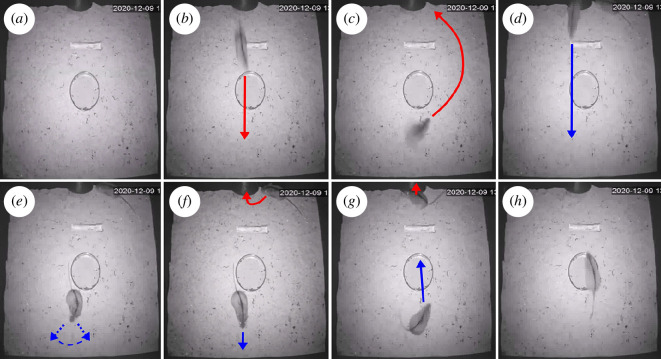
Intentional tactical deception, the employment of a tactic to intentionally deceive another animal, is a complex behaviour based on higher-order cognition, that has rarely been documented outside of primates and corvids. New laboratory-to-field assays, however, provide the opportunity to investigate such behaviour among free-living mice. In the present study, we placed laboratory-style test chambers with a single entrance near a forest outside Warsaw, where we observed the social interactions of two territorial murids, black-striped and yellow-necked mice, under food competition for seven months. Notably, among the social interactions, we video-recorded 21 instances of deceptive pursuer evasion. In the most obvious cases, an individual inside the chamber, to avoid an incoming mouse, hid by the chamber opening (the only means to enter or exit), paused until the pursuer entered and passed by, and then exploited the distraction of the back-turned pursuer by fleeing through the opening in a direction opposite to the one the pursuer came from. This deceptive dodging is the first evidence of a behaviour suggestive of intentional tactical deception among mice. As such, this deceptive behaviour may be of interest not only for rodent psychology but also, more generally, for the fields of non-human intentionality and theory of mind.
故意战术欺骗,即运用一种策略故意欺骗其他动物,是一种基于高阶认知的复杂行为,除了灵长类动物和鸦科动物外,这种行为鲜有记录。然而,新的从实验室到野外的实验方法为研究自由生活的小鼠中的此类行为提供了机会。在本研究中,我们在华沙郊外的一片森林附近放置了带有单个入口的实验室风格测试室,在那里我们观察了两种领地性啮齿动物——黑线姬鼠和黄颈姬鼠在食物竞争下的社会互动,为期七个月。值得注意的是,在这些社会互动中,我们视频记录了21次欺骗性的追捕者躲避行为。在最明显的案例中,测试室内的个体为了躲避来袭的老鼠,会躲在测试室开口处(唯一的进出通道),停顿片刻,直到追捕者进入并经过,然后利用追捕者转身的时机,从开口处朝与追捕者来的方向相反的方向逃离。这种欺骗性躲避行为是小鼠中存在暗示故意战术欺骗行为的首个证据。因此,这种欺骗行为不仅可能引起啮齿动物心理学的兴趣,更广泛地说,还可能引起非人类意向性和心理理论领域的兴趣。