Nagano Mitsuhiro, Tanabe Kosuke, Kamei Kazumasa, Lim Sooyeol, Nakamura Honoka, Ito Shuhei
Japan Access and Value, Pfizer Japan Inc., 3-22-7, Yoyogi, Shibuya-ku, Tokyo, 151-8589, Japan.
Vaccine Medical Affairs, Pfizer Japan Inc., Tokyo, Japan.
Infect Dis Ther. 2024 Oct;13(10):2155-2177. doi: 10.1007/s40121-024-01032-y. Epub 2024 Sep 10.
Japan will be transitioning from the free-of-charge COVID-19 vaccination program to annual periodic vaccination under a national immunization program for old adults and high-risk patients from 2024 fall/winter season. The policy transition including out-of-pocket payment requirement may discourage vaccination, leading to a lower vaccination rate. This study aimed to estimate the impact of varying vaccination rates with BNT162b2 COVID-19 mRNA vaccine on economics and public health in an illustrative prefecture which administers and promotes the periodic vaccination program, using budget impact analysis.
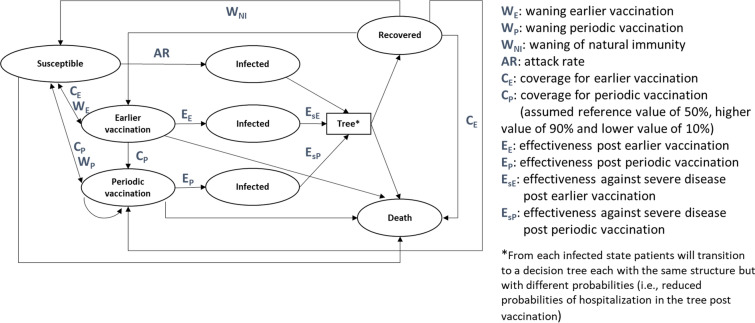
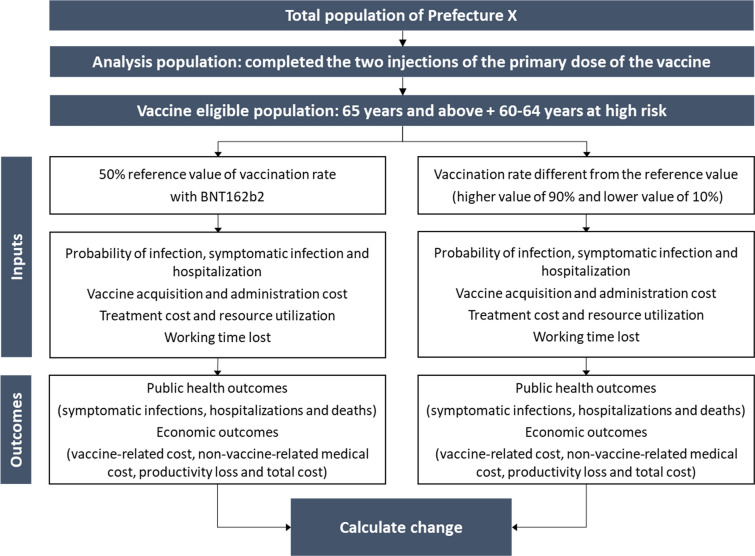
A combined cohort Markov decision tree model estimated the public health outcomes of COVID-19-related symptomatic cases, hospitalizations and deaths; and the economic outcomes including vaccine-related cost, non-vaccine-related medical cost, and productivity loss from the societal perspective. The base case examined the impact on the outcomes when vaccination coverage changed from the reference value of 50% to upper and lower values, respectively. Scenario analyses were performed based on multiple scenarios.
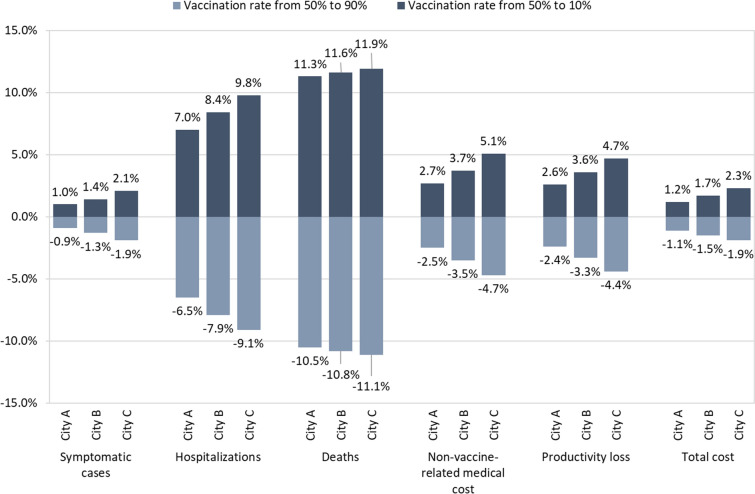
Increase in the vaccination rate demonstrated improvement in all public health outcomes. At 50% vaccination, the vaccine-related cost for 3 years in a prefecture was estimated at JPY 7.58 billion (USD 57.67 million), the non-vaccine-related medical cost at JPY 79.22 billion (USD 602.48 million), the productivity loss at JPY 253.11 billion (USD 1.92 billion), and the total cost at JPY 339.92 billion (USD 2.59 billion). When the vaccination rate increased to 90%, the total cost decreased by JPY 4.88 billion (USD 37.11 million) (1.4%). When the vaccination rate decreased to 10%, the total cost increased by JPY 5.73 billion (USD 43.58 million) (1.7%). Results were consistent across almost all scenario analyses.
Maintaining a high vaccination rate with BNT162b2 is important from both public health and economic perspectives in Japan. The findings highlight to local governments the importance of continued effort to promote vaccination.
从2024年秋冬季节起,日本将从免费的新冠疫苗接种计划过渡到针对老年人和高危患者的国家免疫计划下的年度定期接种。包括自付费用要求在内的政策转变可能会阻碍疫苗接种,导致接种率降低。本研究旨在通过预算影响分析,估计在一个负责管理和推广定期接种计划的示范县中,不同的BNT162b2新冠mRNA疫苗接种率对经济和公共卫生的影响。
一个联合队列马尔可夫决策树模型估计了新冠相关症状性病例、住院和死亡的公共卫生结果;以及从社会角度出发的经济结果,包括疫苗相关成本、非疫苗相关医疗成本和生产力损失。基础案例分别考察了接种覆盖率从参考值50%变为较高值和较低值时对结果的影响。基于多种情景进行了情景分析。
接种率的提高表明所有公共卫生结果都有所改善。在接种率为50%时,一个县3年的疫苗相关成本估计为75.8亿日元(5767万美元),非疫苗相关医疗成本为792.2亿日元(6.0248亿美元),生产力损失为2531.1亿日元(19.2亿美元),总成本为3399.2亿日元(25.9亿美元)。当接种率提高到90%时,总成本下降了48.8亿日元(3711万美元)(1.4%)。当接种率降至10%时,总成本增加了57.3亿日元(4358万美元)(1.7%)。几乎所有情景分析的结果都是一致的。
在日本,从公共卫生和经济角度来看,维持较高的BNT162b2疫苗接种率都很重要。研究结果向地方政府强调了持续努力推广疫苗接种的重要性。