Institute for Global Health, University College London, London, UK.
Department of Epidemiology and Public Health, University College London, London, UK.
Transl Psychiatry. 2024 Sep 10;14(1):368. doi: 10.1038/s41398-024-03089-2.
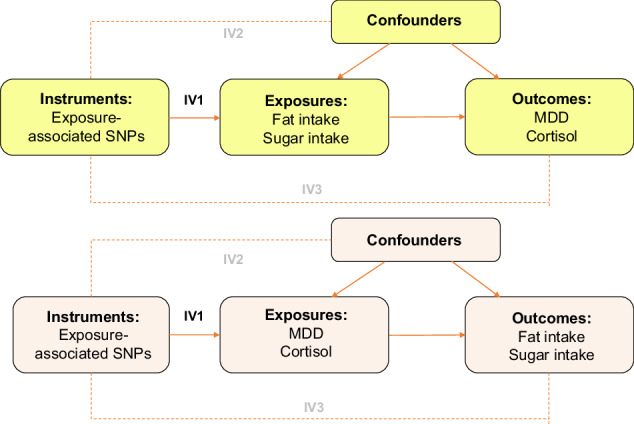
Unhealthy diets high in fat and sugar content may have an impact on psychological health and increase the risk of Major Depressive Disorder (MDD) and stress levels. On the other hand, MDD and stress might be related to food choices and intake. However, it is not clear whether diet, and specifically fat and sugar intake, is causally related to stress and MDD, and whether this relationship may be bi-directional. This study utilised Mendelian Randomisation (MR) to investigate the causal nature of the relationship of fat and sugar intake with MDD and cortisol (as a proxy of stress), and to shed light on the direction of this relationship. Summary-level data for all exposure and outcome variables were obtained from large-scale, non-overlapping GWASs in individuals of European ancestry. Bidirectional analyses were performed: one with macronutrients as exposures and one with MDD/cortisol as exposures. Random-effects inverse-variance weighted regression was used as the primary analytic method for genetic instruments with at least two single nucleotide polymorphisms (SNPs) available (and individual Wald ratio was used when only one SNP was available). Higher levels of genetically predicted relative sugar intake were causally associated with lower MDD risk, for both genome-wide significant p-value threshold of p < 1 × 10, (OR = 0.553, 95% CI: 0.395-0.775) and relaxed p-value threshold of p < 1 × 10 (OR = 0.786, 95% CI: 0.630-0.981). No reverse causality was detected in the opposite direction as MDD was not associated with sugar consumption. The associations observed for all the other pairs of variables were weak and imprecise. A number of limitations was present in the study, such as low-SNP based heritability for some exposures, inability to prove whether variants were correlated with unmeasured confounders and self-reporting of MDD data. Lifestyle and/or pharmacological interventions targeting sugar-related physiological mechanisms may help to reduce depressive symptoms. However, more research is necessary on short- and long-term effects of sugar on the risk of MDD. Additionally, future studies should investigate whether the amount and type of sugar consumed may underlie the impact of sugar on mood and stress levels.
高脂肪和高糖饮食可能会对心理健康产生影响,增加患重度抑郁症(MDD)和压力水平的风险。另一方面,MDD 和压力可能与食物选择和摄入有关。然而,目前尚不清楚饮食,特别是脂肪和糖的摄入,是否与压力和 MDD 有因果关系,以及这种关系是否可能是双向的。本研究利用孟德尔随机化(MR)来研究脂肪和糖摄入与 MDD 和皮质醇(作为压力的替代物)之间关系的因果性质,并阐明这种关系的方向。在欧洲血统个体中,从大规模、非重叠的 GWAS 中获得了所有暴露和结局变量的汇总水平数据。进行了双向分析:一种是将宏量营养素作为暴露因素,另一种是将 MDD/皮质醇作为暴露因素。对于至少有两个单核苷酸多态性(SNP)可用的遗传工具,使用随机效应逆方差加权回归作为主要分析方法(当只有一个 SNP 可用时使用个体 Wald 比)。更高水平的遗传预测相对糖摄入量与 MDD 风险降低有关,无论是全基因组显著 p 值阈值 p < 1 × 10 -8 (OR = 0.553,95%CI:0.395-0.775)还是放宽的 p 值阈值 p < 1 × 10 -7 (OR = 0.786,95%CI:0.630-0.981)。在相反的方向上没有检测到反向因果关系,因为 MDD 与糖消耗无关。观察到的所有其他变量对之间的关联都很弱且不精确。该研究存在一些局限性,例如一些暴露因素的 SNP 基础遗传率低、无法证明变体是否与未测量的混杂因素相关以及 MDD 数据的自我报告。针对与糖相关的生理机制的生活方式和/或药物干预措施可能有助于减轻抑郁症状。然而,还需要更多关于糖对 MDD 风险的短期和长期影响的研究。此外,未来的研究应调查消耗的糖的量和类型是否是糖对情绪和压力水平影响的基础。