Akram Mohammad, Kamaal Naimuddin, Pratap Aditya, Kumar Deepender, Muin Abdul, Sabale P R, Aidbhavi Revanasidda, Sunani Sunil Kumar, Rathore Meenal, Gupta Sanjeev, Singh N P, Dey N, Dixit G P, Nair Ramakrishnan M
ICAR-Indian Institute of Pulses Research, Kanpur, India.
ICAR-IIPR Regional Research Station, Dharwad, India.
Front Microbiol. 2024 Aug 27;15:1451986. doi: 10.3389/fmicb.2024.1451986. eCollection 2024.
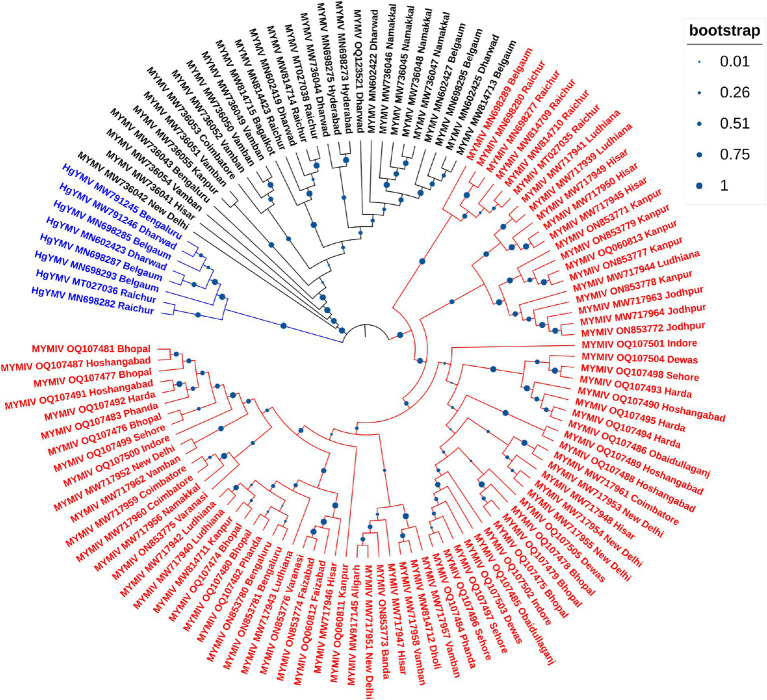
Yellow mosaic disease (YMD) caused by several begomoviruses is one of the major constraints of over a dozen leguminous crops worldwide, particularly in Asian and Southeast Asian countries. The present study aimed to investigate the distribution, diversity and prevalence of begomoviruses associated with YMD in leguminous hosts in five agro-climatic zones of India, to assess the extent of their geographical presence and develop location and crop-specific distribution maps. One hundred and seventy-four leguminous plant samples were tested from 32 locations in India to detect YMD-causing viruses. Additionally, publicly available data were incorporated into this study to provide a comprehensive overview of their distribution in India. This resulted in 581 reports on the DNA-A component representing 119 locations, which were also utilized to depict the distribution of YMD-causing viruses on a map of India. In this study, 117 full-length DNA-A and 103 DNA-B components were successfully characterized, representing the detected mungbean yellow mosaic India virus (MYMIV), mungbean yellow mosaic virus (MYMV), and horsegram yellow mosaic virus in the collected samples. Phylogenetic analysis of isolates of these species showed no differentiation based on location in India. Diversity indices revealed the abundance (55.9%) and dominance (0.56) of MYMIV across 119 locations. These findings hold significant implications for legume researchers, offering insights into disease prevalence and geographic distribution. Furthermore, the distribution of YMD-causing viruses in different agro-climatic zones will help researchers in developing zone-specific YMD-resistant cultivars of the legume crops and would facilitate effective disease management options.
由几种双生病毒引起的黄花叶病(YMD)是全球十几种豆科作物的主要限制因素之一,在亚洲和东南亚国家尤为严重。本研究旨在调查印度五个农业气候区豆科寄主中与黄花叶病相关的双生病毒的分布、多样性和流行情况,评估它们在地理上的存在范围,并绘制特定地点和作物的分布图。从印度的32个地点采集了174份豆科植物样本,检测导致黄花叶病的病毒。此外,本研究还纳入了公开可用的数据,以全面概述它们在印度的分布情况。这产生了581份关于DNA-A组分的报告,代表119个地点,这些报告也被用于在印度地图上描绘导致黄花叶病的病毒的分布。在本研究中,成功鉴定了117个全长DNA-A和103个DNA-B组分,代表了在采集样本中检测到的印度绿豆黄花叶病毒(MYMIV)、绿豆黄花叶病毒(MYMV)和豆薯黄花叶病毒。对这些物种分离株的系统发育分析表明,它们在印度各地没有因地理位置而产生分化。多样性指数显示,在119个地点中,MYMIV的丰度为55.9%,优势度为0.56。这些发现对豆类研究人员具有重要意义,为疾病流行情况和地理分布提供了见解。此外,导致黄花叶病的病毒在不同农业气候区的分布将有助于研究人员培育特定区域的抗黄花叶病豆类作物品种,并有助于制定有效的疾病管理方案。