Cumming School of Medicine, University of Calgary, Calgary, AB, Canada.
19 to Zero Inc., Calgary, AB, Canada.
Front Public Health. 2024 Aug 27;12:1430968. doi: 10.3389/fpubh.2024.1430968. eCollection 2024.
Human papillomavirus (HPV) testing as a method of cervical cancer screening can be performed by healthcare providers or by patients through self-sampling directly in the community, removing several barriers experienced by under screened populations. The objective of this scoping review was to determine which HPV self-sampling implementation and engagement strategies have been used to engage under screened populations (i.e., Indigenous, newcomer, and rural and remote communities) in cervical cancer screening.
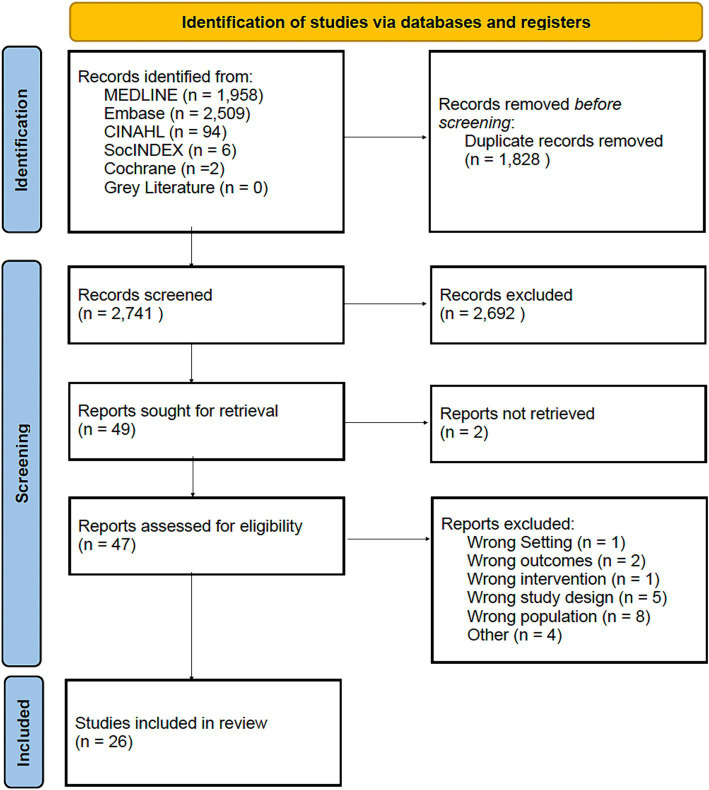
A scoping review was conducted searching MEDLINE, CINAHL, EMBASE, Cochrane Library, and SocINDEX from inception to August 2023. The inclusion criteria were: (1) Indigenous, newcomer, and rural and remote communities; (2) countries identified as members of the Organization for Economic Co-operation and Development; and (3) intervention included HPV self-sampling. The review was registered prior to conducting the search (https://osf.io/zfvp9).
A total of 26 studies out of 2,741 studies met the inclusion criteria. In-person engagement with trusted community leaders was the most widely used and accepted recruitment and engagement strategy across all three populations. Six out of seven studies with Indigenous communities distributed HPV self-sampling kits to eligible participants in person in a clinical setting for collection on site or at home. Similarly, nine of the identified studies that engaged newcomers recruited participants in person through the community, where eligible participants were either given a kit ( = 7) or received one in the mail ( = 2). Lastly, of the 10 identified studies engaging rural and remote participants in HPV self-sampling, six recruited eligible participants in person at various community locations and four used electronic medical records or registries to identify and mail kits to participants.
HPV self-sampling through in person kit distribution and mail out of HPV self-sampling kits is an effective way to increase participation rates amongst under screened populations.
人乳头瘤病毒(HPV)检测作为宫颈癌筛查方法,可以由医疗保健提供者或患者通过直接在社区进行自我采样来进行,从而消除了未充分筛查人群所面临的许多障碍。本范围综述的目的是确定哪些 HPV 自我采样实施和参与策略已被用于使未充分筛查人群(即土著、新移民和农村及偏远社区)参与宫颈癌筛查。
我们进行了一项范围综述,检索了 MEDLINE、CINAHL、EMBASE、Cochrane 图书馆和 SocINDEX 从成立到 2023 年 8 月的文献。纳入标准为:(1)土著、新移民和农村及偏远社区;(2)被确定为经济合作与发展组织成员国的国家;(3)干预措施包括 HPV 自我采样。在进行检索之前,该综述已在 OSF 注册(https://osf.io/zfvp9)。
在 2741 项研究中,共有 26 项研究符合纳入标准。在所有三个群体中,与受信任的社区领袖进行面对面的接触是最广泛使用和接受的招募和参与策略。在 7 项针对土著社区的研究中,有 6 项研究将 HPV 自我采样试剂盒亲自分发给符合条件的参与者,在临床环境中进行现场或居家采集。同样,在 9 项针对新移民的研究中,通过社区与参与者进行了面对面的接触,在这些研究中,符合条件的参与者要么亲自收到了试剂盒( = 7),要么通过邮件收到了试剂盒( = 2)。最后,在参与 HPV 自我采样的 10 项针对农村和偏远地区参与者的研究中,有 6 项在各种社区地点亲自招募了符合条件的参与者,有 4 项使用电子病历或登记册来确定并将试剂盒邮寄给参与者。
通过亲自分发 HPV 自我采样试剂盒和邮寄 HPV 自我采样试剂盒的方式进行 HPV 自我采样,是提高未充分筛查人群参与率的有效方法。