Universidade Estadual do Norte do Paraná, Jacarezinho, PR, Brazil.
Universidade Estadual de Londrina, Londrina ,PR, Brazil.
Rev Paul Pediatr. 2024 Sep 9;43:e2023250. doi: 10.1590/1984-0462/2025/43/2023250. eCollection 2024.
To examine the associations between self-reported screen time and symptoms of stress, anxiety, and depression in adolescents.
A cross-sectional study was conducted with 982 adolescents aged between 12 and 15 years, enrolled in public schools in Jacarezinho (PR), Brazil. Screen time was assessed by the question "Considering a typical day, how much time do you spend watching TV, playing videogame, using computer or smartphone?" The DASS-21 questionnaire (short form) was used to assess symptoms of depression, anxiety, and stress. Crude and adjusted analyses (age, sex, and maternal level of education) between screen time and mental disorders symptoms were performed using general linear regression models, with Poisson distribution, with significance level at p<0.05.
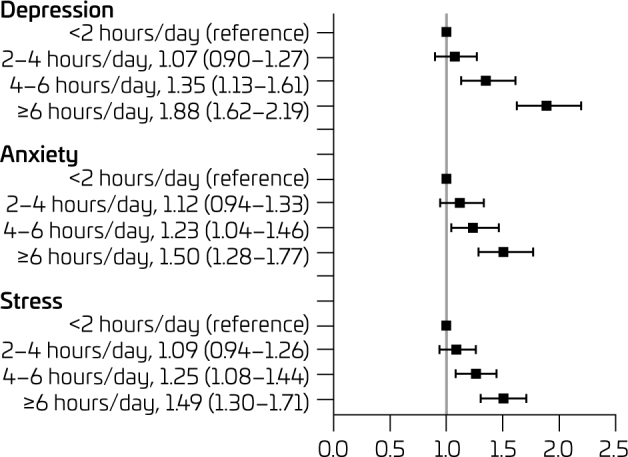
Higher depressive symptoms were observed in adolescents who reported screen time of 4-6 hours/day (PR 1.35, 95%CI 1.13-1.61) and ≥6 hours/day (PR 1.88, 95%CI 1.62-2.19), compared with their pairs with <2 hours/day. The same was observed for anxiety symptoms with screen time of 4-6 hours/day (PR 1.23, 95%CI 1.04-1.46) and ≥6 hours/day (PR 1.50, 95%CI 1.28-1.77); and stress, with 4-6 hours/day (PR 1.25, 95%CI 1.08-1.44) and ≥6 hours/day (PR 1.49, 95%CI 1.30-1.71), also compared with their pairs with <2 hours/day.
Screen time was positively associated with depressive, anxiety, and stress symptoms in adolescents. Special attention should be given to those who spend more than four hours a day in front of a screen.
研究青少年自我报告的屏幕时间与压力、焦虑和抑郁症状之间的关联。
这是一项横断面研究,共纳入了巴西雅卡雷济纽市公立学校的 982 名 12 至 15 岁的青少年。通过“考虑一天中的典型情况,您每天花多少时间看电视、玩电子游戏、使用电脑或智能手机?”这一问题评估屏幕时间。使用 DASS-21 问卷(短式)评估抑郁、焦虑和压力症状。使用一般线性回归模型(泊松分布)进行未经调整和调整(年龄、性别和母亲受教育程度)分析,以评估屏幕时间与精神障碍症状之间的关系,显著性水平为 p<0.05。
与每天屏幕时间<2 小时的青少年相比,报告每天屏幕时间为 4-6 小时(PR 1.35,95%CI 1.13-1.61)和≥6 小时(PR 1.88,95%CI 1.62-2.19)的青少年出现更严重抑郁症状的比例更高。对于焦虑症状也是如此,报告每天屏幕时间为 4-6 小时(PR 1.23,95%CI 1.04-1.46)和≥6 小时(PR 1.50,95%CI 1.28-1.77)的青少年;以及报告每天屏幕时间为 4-6 小时(PR 1.25,95%CI 1.08-1.44)和≥6 小时(PR 1.49,95%CI 1.30-1.71)的青少年。
屏幕时间与青少年的抑郁、焦虑和压力症状呈正相关。应特别关注每天在屏幕前花费超过四小时的青少年。