Biological Neuropsychiatry and Dementia Unit, School of Public Health and Preventative Medicine, Monash University, Melbourne, Australia.
Kosovo Rehabilitation Center for Torture Victims (KRCT), Pristina Kosovo, Australia.
Brain Behav. 2024 Sep;14(9):e70029. doi: 10.1002/brb3.70029.
Maternal stress and trauma during pregnancy have been shown to influence cortisol levels and epigenetic patterns, including DNA methylation, in the offspring. This study aimed to determine whether a tailor-made family intervention could help reduce cortisol levels in children born to traumatized mothers, and to determine whether it effected offspring DNA methylation. The secondary aim was to determine whether the family intervention influenced DNA methylation aging, a marker of biological aging.
A needs-based family intervention was designed to help address relational difficulties and family functioning, and included a focus on family strengths and problem-solving patterns. Women survivors of sexual violence during the Kosovar war in 1998-1999, and their families (children with or without partners) were randomly assigned to 10 sessions of a family therapy over a 3-5-month period, or to a waitlist control group. Both mothers and children completed assessments prior to and after the intervention phase. Children's blood samples collected at these two time points were used to measure cortisol and epigenome-wide DNA methylation patterns (Illumina EPIC array). Cortisol levels, and genome-wide DNA methylation changes pre-/postintervention were compared between children in the intervention and the waitlist groups. DNA methylation age and accelerated biological aging were calculated.
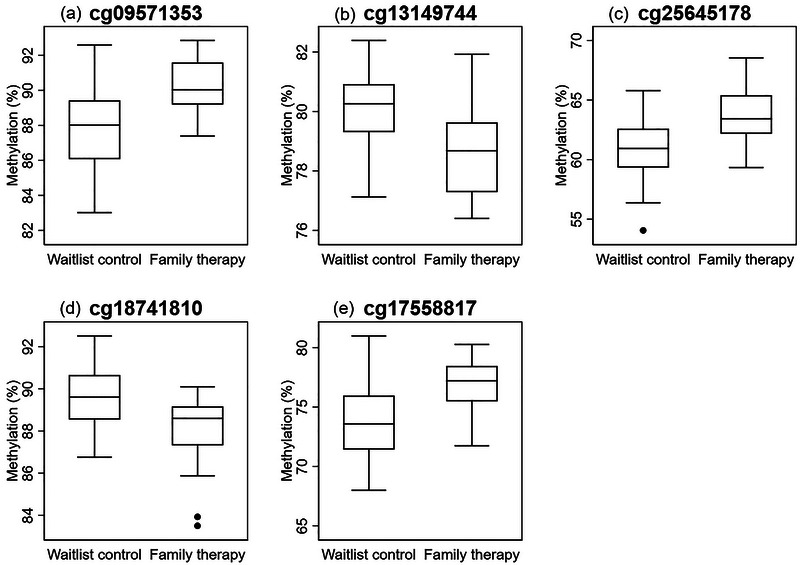
Sixty-two women-child dyads completed the study, 30 were assigned first to the intervention group, and 32 to the waitlist control group. In adjusted linear regression, the family intervention was associated with a significant decline in cortisol levels compared to the waitlist control (β = -124.72, 95% confidence interval [CI]: -197.4 to -52.1, p = .001). Children in the intervention group, compared to the waitlist control group, showed >1% differential methylation degree at 5819 CpG (5'-C-phosphate-G-3') sites across the genome (p < .01), with the largest methylation difference being 21%. However, none of these differences reached genome-wide significant levels. There was no significant difference in DNA methylation aging between the two groups.
We find evidence that a tailored family-based intervention reduced stress levels in the children (based on cortisol levels), and modified DNA methylation levels at a number of sites across the genome. This study provides some preliminary evidence to suggest the potential for tailored interventions to help break the intergenerational transmission of trauma, however, large studies powered to detect associations at genome-wide significant levels are needed.
孕期母体压力和创伤已被证明会影响皮质醇水平和表观遗传模式,包括 DNA 甲基化。本研究旨在确定定制家庭干预是否有助于降低遭受创伤的母亲所生孩子的皮质醇水平,并确定其是否影响后代的 DNA 甲基化。次要目的是确定家庭干预是否影响 DNA 甲基化衰老,这是生物衰老的一个标志物。
设计了一项基于需求的家庭干预措施,以帮助解决关系困难和家庭功能问题,包括关注家庭优势和解决问题的模式。1998-1999 年科索沃战争期间遭受性暴力的女性幸存者及其家庭(有或没有伴侣的孩子)被随机分配到为期 3-5 个月的 10 次家庭治疗中,或分配到候补名单对照组。母亲和孩子在干预前和干预后都完成了评估。在这两个时间点采集孩子的血样,用于测量皮质醇和全基因组 DNA 甲基化模式(Illumina EPIC 阵列)。比较干预组和候补名单对照组儿童在干预前后的皮质醇水平和全基因组 DNA 甲基化变化。计算 DNA 甲基化年龄和加速的生物衰老。
62 名女性-儿童对子完成了研究,30 名被分配到干预组,32 名被分配到候补名单对照组。在调整后的线性回归中,与候补名单对照组相比,家庭干预与皮质醇水平显著下降相关(β=-124.72,95%置信区间[CI]:-197.4 至-52.1,p=0.001)。与候补名单对照组相比,干预组的儿童在整个基因组的 5819 个 CpG(5'-C-磷酸-G-3')位点上显示出超过 1%的差异甲基化程度(p<0.01),最大的甲基化差异为 21%。然而,这些差异都没有达到全基因组显著水平。两组之间的 DNA 甲基化衰老没有显著差异。
我们有证据表明,定制的基于家庭的干预措施降低了儿童的应激水平(基于皮质醇水平),并改变了整个基因组多个位点的 DNA 甲基化水平。这项研究提供了一些初步证据,表明有针对性的干预措施有可能帮助打破创伤的代际传递,然而,需要进行大型研究以检测全基因组显著水平的关联。