Tanwar Rahul, Agarwal Pradeep Kumar
Department of Civil Engineering, Maulana Azad National Institute of Technology Bhopal, 462003, India.
Heliyon. 2024 Aug 24;10(17):e36844. doi: 10.1016/j.heliyon.2024.e36844. eCollection 2024 Sep 15.
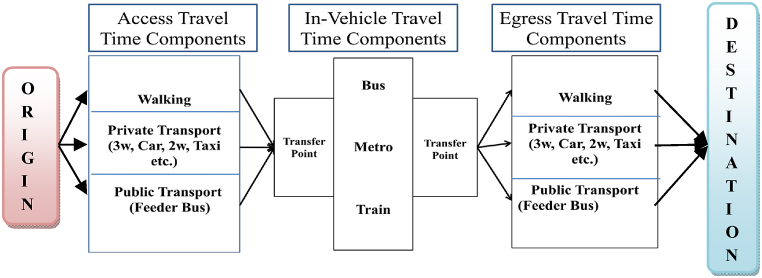
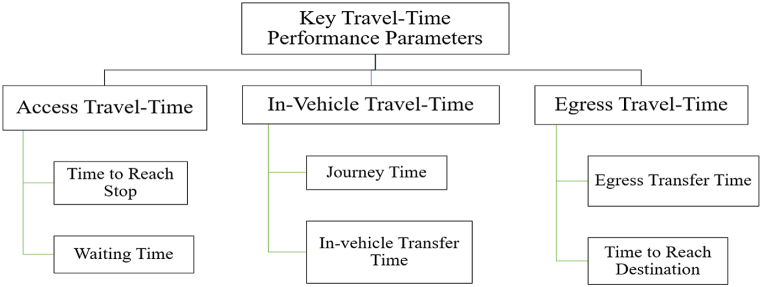
Insufficient multimodal transportation infrastructure in Indian cities increases travel time, waiting time, traffic congestion, traffic accidents, travel costs, fast-growing energy consumption, and walking distance. The multimodal transportation system's journey time performance must be analysed to tackle these transportation concerns. Thus, this research provides a fundamental method for assessing multimodal transportation system trip time performance. This study proposes three steps for assessing travel time performance: identifying factors, generating individual indices, and evaluating the Multimodal Transport System Travel-Time Performance Index. The travel-time performance index of Bhopal city was 0.79 after evaluating the results of the individual indices (Access 0.49, In-vehicle 0.39, and Egress 0.38). Consequently, this study will help identify areas for improvement in Bhopal's multimodal transportation system and provide insights for enhancing its efficiency and user satisfaction. The proposed methodology can be applied to other cities facing similar challenges, aiding in the development of more sustainable and user-friendly transportation systems.
印度城市多式联运基础设施不足,导致出行时间增加、等待时间延长、交通拥堵、交通事故频发、出行成本上升、能源消耗快速增长以及步行距离变长。必须分析多式联运系统的行程时间表现,以解决这些交通问题。因此,本研究提供了一种评估多式联运系统出行时间表现的基本方法。本研究提出了评估出行时间表现的三个步骤:识别因素、生成个体指标以及评估多式联运系统出行时间表现指数。在评估个体指标(可达性0.49、车内时间0.39和出站时间0.38)的结果后,博帕尔市的出行时间表现指数为0.79。因此,本研究将有助于确定博帕尔多式联运系统中需要改进的领域,并为提高其效率和用户满意度提供见解。所提出的方法可应用于面临类似挑战的其他城市,有助于开发更可持续、更方便用户的交通系统。