Department of Sexual Health, Infectious Diseases and Environmental Health, South Limburg Public Health Service, Heerlen, The Netherlands.
Department of Social Medicine, Care and Public Health Research Institute (CAPHRI), Maastricht University, Maastricht, The Netherlands.
PLoS One. 2022 May 12;17(5):e0268057. doi: 10.1371/journal.pone.0268057. eCollection 2022.
The availability of valid Severe Acute Respiratory Syndrome Coronvirus-2 (SARS-CoV-2) serological tests overcome the problem of underestimated cumulative Coronavirus Disease 2019 (COVID-19) cases during the first months of the pandemic in The Netherlands. The possibility to reliably determine the number of truly infected persons, enabled us to study initial drivers for exposure risk in the absence of routine testing. Numerous activities or circumstances can accelerate virus spread, here defined as exposure factors. Hence, we aimed to evaluate a wide variety of demographic, behavioural and social exposure factors associated with seropositivity during the first eight months of the pandemic in Limburg, The Netherlands.
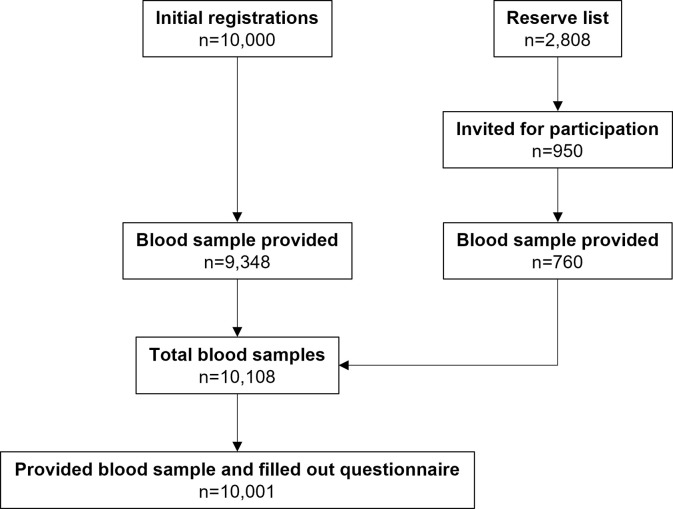
SARS-CoV-2 point-seroprevalence was determined cross-sectionally to indicate previous infection in a convenience sample of minimal 10,000 inhabitants of the study province. All adult (18+ years) inhabitants of the study province were eligible to register themselves for participation. Once the initial 10,000 registrations were reached, a reserve list was kept to ensure sufficient participants. Possible exposure factors were mapped by means of an extensive questionnaire. Associated exposure factors were determined using univariable and multivariable logistic regression models.
Seropositivity was established in 19.5% (n = 1,948) of the 10,001 participants (on average 49 years old (SD = 15; range 18-90 years), majority women (n = 5,829; 58.3%). Exposure factors associated with seropositivity included current education, working in healthcare and not working from home, and being a member of three or four associations or clubs. Specifically for February-March 2020, visiting an après-ski bar during winter sports in Austria, travelling to Spain, celebrating carnival, and participating in a singing activity or ball sport were associated with seropositivity.
Our results confirm that relevant COVID-19 exposure factors generally reflected circumstances where social distancing was impossible, and the number and duration of contacts was high, in particular for indoor activities.
有效的严重急性呼吸系统综合征冠状病毒 2 型(SARS-CoV-2)血清学检测克服了在荷兰大流行的最初几个月中低估 2019 年冠状病毒病(COVID-19)累计病例的问题。能够可靠地确定真正感染人数,使我们能够在没有常规检测的情况下研究最初的暴露风险驱动因素。许多活动或情况会加速病毒传播,这里定义为暴露因素。因此,我们旨在评估在荷兰林堡省大流行的头八个月中与血清阳性相关的各种人口统计学、行为和社会暴露因素。
通过横断面研究确定 SARS-CoV-2 点血清阳性率,以表明研究省的便利样本中至少有 10,000 名居民以前曾感染过。该研究省的所有成年(18 岁以上)居民都有资格注册参加。一旦达到最初的 10,000 名注册人数,就会保留候补名单以确保有足够的参与者。通过广泛的问卷来映射可能的暴露因素。使用单变量和多变量逻辑回归模型确定相关的暴露因素。
在 10,001 名参与者中(平均年龄为 49 岁(SD=15;范围 18-90 岁),大多数为女性(n=5,829;58.3%)),有 19.5%(n=1,948)的人血清呈阳性。与血清阳性相关的暴露因素包括当前的教育程度、在医疗保健行业工作且不居家办公,以及是三个或四个协会或俱乐部的成员。特别是在 2020 年 2 月至 3 月期间,在奥地利冬季运动期间光顾滑雪后酒吧、前往西班牙旅行、参加狂欢节、参加唱歌活动或球类运动与血清阳性相关。
我们的结果证实,一般而言,与 COVID-19 相关的暴露因素反映了社交距离不可能的情况,并且接触的人数和持续时间都很高,特别是对于室内活动。